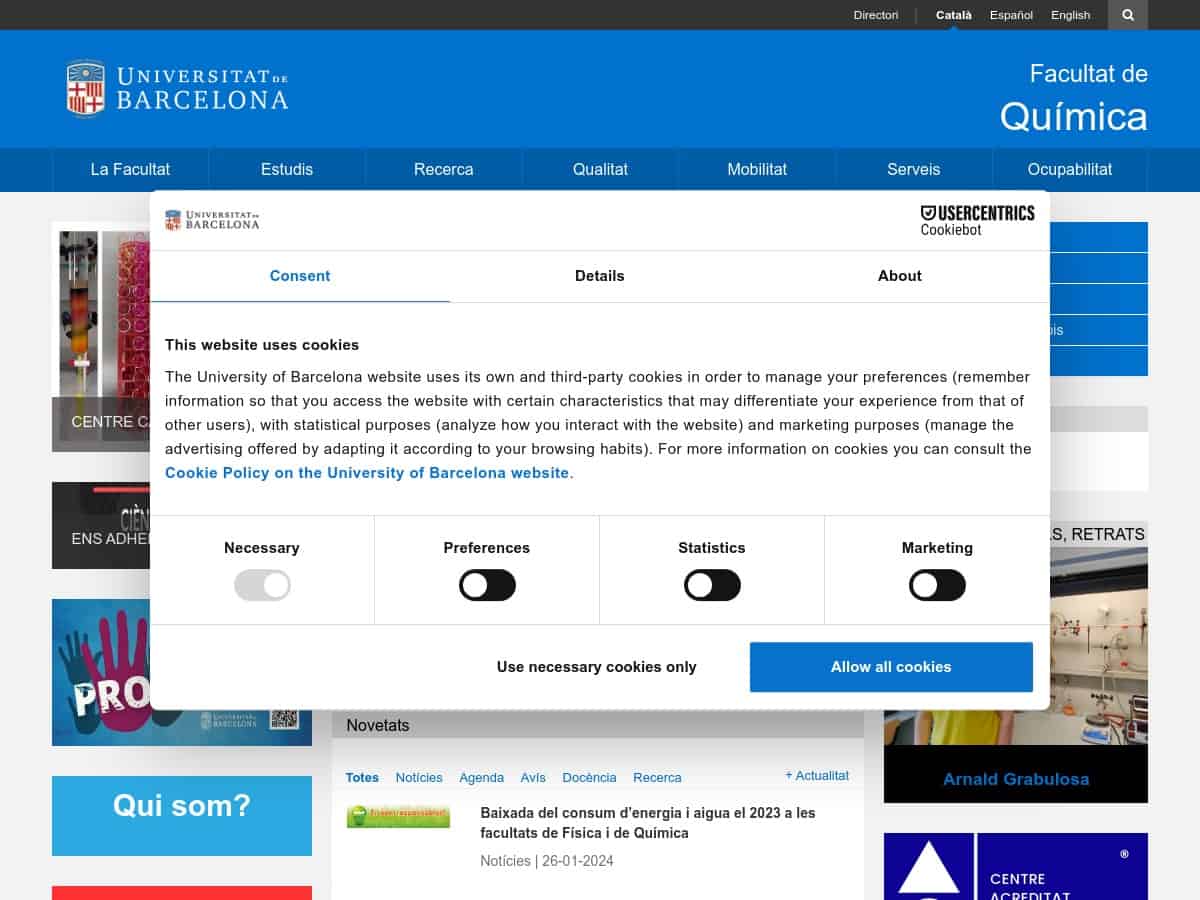
Address: Carrer de Martí i Franquès, 1, 08028 Barcelona, Barcelona, Spain
Chemistry, Chemical Engineering, Materials Engineering
The Faculty of Chemistry of the University of Barcelona (UB) is a historic and prestigious faculty dedicated to education and research in all fields of chemistry, as well as Chemical Engineering and Materials Engineering. It is part of Spain’s oldest university.
The Facultat de Química of the Universitat de Barcelona is the chemistry faculty of UB, a public university founded in 1450. It has about 2,500 students and 300 staff, and around one student in ten comes from abroad. The faculty is located on Carrer de Martí i Franquès, on the Diagonal campus in the Les Corts district of Barcelona, in a group of buildings shared with the physics and pharmacy faculties and with several research institutes.
The faculty teaches bachelor’s degrees in chemistry, chemical engineering and materials chemistry, as well as master’s degrees in fields such as nanoscience, organic chemistry, industrial chemistry, theoretical chemistry and materials. Teaching combines lectures with extensive laboratory work, and many courses are in Catalan or Spanish, with some master’s programmes in English. Students can take part in exchange programmes and internships in the chemical and pharmaceutical industries of Catalonia.
Research is carried out in the departments of organic, inorganic, physical, analytical and chemical engineering, and in several institutes. The Institute of Theoretical and Computational Chemistry, the Institute of Nanoscience and Nanotechnology of UB and the Institute of Biomedicine study problems in catalysis, molecular design, materials, electrochemistry and green chemistry. Catalonia has a large chemical and pharmaceutical industry, particularly around Tarragona and Barcelona, and graduates often join these companies.
Admission to bachelor’s degrees uses the national university entrance exam and the cut-off marks of each degree, which vary every year. Public universities in Catalonia set tuition per credit, with prices that are higher for students from outside the EU. Check the current tariff. Master’s degrees have separate application rounds and fees, and doctoral candidates are recruited through calls and fellowships.
The Diagonal campus is served by metro and tram, and the faculty is close to Camp Nou stadium. Barcelona is expensive for renters, but students can find rooms in shared flats and residence halls.
Domains taught:
Bioengineering, Chemistry, Engineering, Food Science, Materials, Mathematics, Nanotechnologies, Physics, Process Control
Diplomas*:
Bachelor, Doctor, Master
Status:
Public
Partnerships:
Part of UB, one of Spain’s oldest and largest universities, with extensive international partnerships (LERU, Coimbra Group) and strong collaborations with the chemical and pharmaceutical industries.
Research:
Leading research in organic, inorganic, physical, and analytical chemistry, catalysis, materials science, nanotechnology, chemical process engineering, and theoretical chemistry.
Famous Alumnis:
Joan Oró
International recognition**:
Number of staff***:
300
Current students***:
2500
Foreign students***:
10%
Cumulative former students***:
15000
Pros
Highly renowned faculty for chemistry and chemical engineering with excellent research facilities and strong industry connections. Part of a top-ranked university.
Cons
Large faculty, potentially competitive environment. Some facilities are historic, many are modern.
Best For
Students seeking a world-class education in chemistry, chemical engineering, or materials engineering at a historic and highly-ranked university.
Facultad de Ciencias y Tecnologías Químicas overlaps with this university on food science, nanotechnologies and process control, so the two are easy to compare, and it is also a public institution, and runs the same bachelor's, master's and doctoral programmes.
Also strong in nanotechnologies, physics and mathematics, Facultad de Ciencias Físicas makes a sensible second look at home; it is also a public institution, and runs the same bachelor's, master's and doctoral programmes.
The comparison with Barcelona School of Telecommunications Engineering is straightforward on subjects, since both focus on nanotechnologies, bioengineering and engineering, and it covers optics and signal processing as well, and is slightly smaller, at about 2,000 students against roughly 2,500 here.
For students who like the mathematics and engineering focus of this institution but want another option nearby, Facultat de Matemàtiques i Informàtica fits well: it covers computer vision and statistics as well, and is slightly smaller, at about 1,800 students against roughly 2,500 here.
Escola d'Enginyeria Agroalimentària i de Biosistemes de Barcelona sits close to this institution on food science, bioengineering and process control; it runs the same bachelor's, master's and doctoral programmes, and covers agriculture and ecology and sustainability as well.
Most Similar Schools Abroad
For nanotechnologies, bioengineering and chemistry outside the home country, Saint Petersburg State Institute of Technology (SPbGTI ) in Russia is a natural reference; it teaches at the same levels, namely bachelor's, master's and doctoral, and covers chemical engineering as well.
On content, Ivanovo State University of Chemistry and Technology in Russia and this university are close, as both teach nanotechnologies, bioengineering and chemistry; it is also a public institution, and teaches at the same levels, namely bachelor's, master's and doctoral.
Abroad, Ukrainian State University of Chemical Technology (Ukraine) covers nanotechnologies, bioengineering and chemistry in a comparable way, and it is larger, enrolling about 5,000 students against roughly 2,500 here, and is also a public institution.
Students considering a move abroad can look at Indian Institute of Science in India, where physics, mathematics and materials also form the core, and it runs the same bachelor's, master's and doctoral programmes, and covers aerospace and life sciences as well.
Institute of Chemical Technology Mumbai in India shares the food science, bioengineering and chemistry orientation of this institution, and it runs the same bachelor's, master's and doctoral programmes, and covers life sciences as well.
*our own picks (our criteria: a mix between domains, diploma delivered, reputation and size), but obviously too many criteria for an apple-to-apple ranking.
FAQ
What is the Facultat de Química of UB?
The chemistry faculty of the Universitat de Barcelona, a public university founded in 1450.
Where is it?
At Carrer de Martí i Franquès 1 on the Diagonal campus in Barcelona, Spain.
How large is it?
About 2,500 students and 300 staff.
What does it teach?
Bachelor's degrees in chemistry, chemical engineering and materials chemistry, and master's degrees in nanoscience, organic chemistry, industrial chemistry and other fields.
Which research institutes are linked to it?
The Institute of Theoretical and Computational Chemistry, the Institute of Nanoscience and Nanotechnology of UB and the Institute of Biomedicine.
Which industries employ its graduates?
The chemical and pharmaceutical industries of Catalonia, particularly around Tarragona and Barcelona.
How do you apply?
Bachelor's applicants use the national university entrance exam and the cut-off marks of each degree.
What does it cost?
Public universities in Catalonia set tuition per credit. Check the current tariff.
In which language are courses taught?
Catalan or Spanish, with some master's programmes in English.
*: without any judgment of the quality, readers are strongly encouraged to check the official status of the exact diploma envisioned as many universities have a mix of recognized diplomas, not recognized, “co-delivered,” “equivalent to”, “some pathways” (…), can change over time, and can be named differently from one country to another.
**: international reputation: is based on some criteria that do not mean much in some domains or specialties (number of researchers, of scientific publications, on budget ….). Our approximate 1-4 scale:
known locally
known locally and internationally
is listed in some of the world university’s classifications
is listed among the 20 firsts in some of world university’s classifications
***: estimated numbers, based on online sources and/or feedbacks. The numbers can vary greatly depending on school organisation (ex.: school is part of a group, it employs internal staff or external consultants or has public staff without employing them …). Refer to all the links provided to have accurate and updated numbers.
Innovation.world is not affiliated with this school/university. We recommend to contact them directly on their website for any special request.
To complete or correct any information here or share your opinion, please comment below or > send us a direct message <.