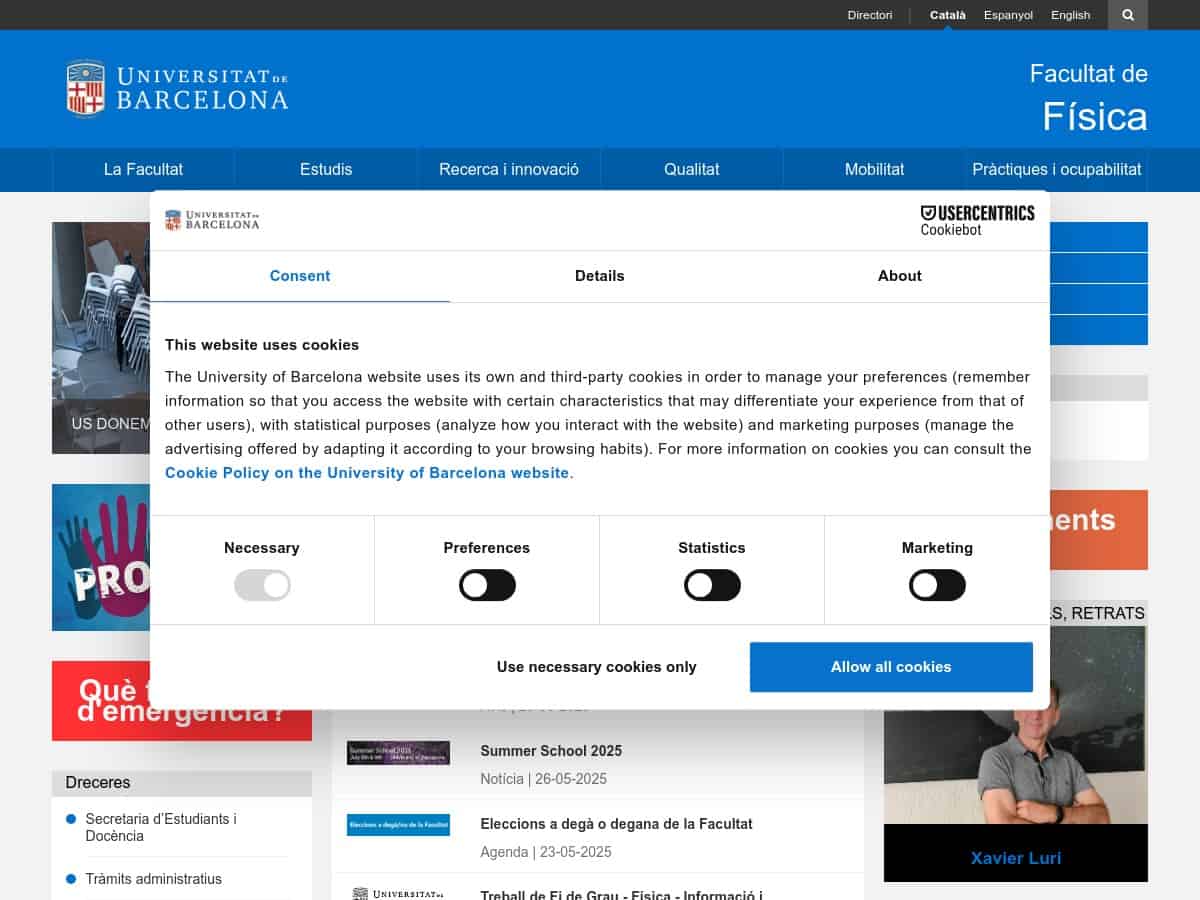
The Faculty of Physics of the University of Barcelona (UB) is a leading center for physics education and research, covering a wide range of areas from fundamental physics to applied physics and engineering. It hosts the Institute of Cosmos Sciences (ICCUB).
The Faculty of Physics of the University of Barcelona is located in the Martí i Franquès building on the Diagonal, in the south of the city, next to the Faculty of Chemistry, in a complex shared by the sciences. It belongs to a university founded in 1450 by Alfonso the Magnanimous, which is the largest university in Catalonia. The faculty has about 2,000 students and 250 teaching staff, and it covers fundamental and applied physics, with an important research base.
The main undergraduate degree is in Physics, with options such as double degrees with Mathematics, and the faculty also teaches degrees related to engineering and materials. Master’s programmes include astrophysics, particle physics and cosmology, nanoscience, nanotechnology, biophysics, energy and photonics. Teaching is in Catalan and Spanish, and many master’s courses are in English. The curriculum starts with mechanics, electromagnetism, mathematical methods and thermodynamics and moves to quantum physics, statistical physics, solid state and astrophysics.
Research is organised through departments and institutes. The Institute of Cosmos Sciences, ICCUB, works on cosmology, particle physics, gravitation, astrophysics and the mission Gaia, in which Barcelona has a major role in data processing. The Institute of Nanoscience and Nanotechnology, IN2UB, covers materials and devices, and the Institute of Complex Systems studies the physics of networks, biological systems and the economy. Cooperation with the Barcelona Supercomputing Center and with the Institute of High Energy Physics is common.
Admission to the degree follows the Spanish university system, in which places are allocated by the grades in the university entrance exam and the secondary school record. Public prices in Catalonia are regulated and fixed per credit, and non-EU students may pay more. Check the current tariff.
The faculty is served by the metro station of Palau Reial on line 3 and by several bus lines. Barcelona is a popular city for international students, and housing is expensive but varied.
Domains taught:
Aerospace, Astroscience, Bioengineering, Data Analytics, Electrical and Electronics, Engineering, Materials, Mathematics, Nanotechnologies, Optics, Physics, Statistics
Diplomas*:
Bachelor, Doctor, Master
Status:
Public
Partnerships:
Part of UB, with strong international research collaborations (e.g., CERN, ESA) and connections with technology companies. It hosts the Institute of Cosmos Sciences (ICCUB), a María de Maeztu Unit of Excellence.
Research:
Cutting-edge research in particle physics, astrophysics and cosmology, condensed matter physics, quantum technologies, biophysics, medical physics, and complex systems.
Famous Alumnis:
N/A
International recognition**:
Number of staff***:
250
Current students***:
2000
Foreign students***:
10%
Cumulative former students***:
12000
Pros
Offers excellent physics education and research opportunities in diverse fields, with strong international links and specialized institutes. High academic standards.
A good alternative in the same country is Facultad de Ciencias Físicas, which likewise covers astroscience, aerospace and nanotechnologies; it runs the same bachelor's, master's and doctoral programmes, and covers signal processing and thermodynamics as well.
Where this university leans on nanotechnologies, optics and bioengineering, Barcelona School of Telecommunications Engineering does the same, and it has almost the same size, at about 2,000 students, and is also a public institution.
Another national school that puts astroscience, aerospace and nanotechnologies at the centre is Consejo Superior de Investigaciones Científicas, and it does not run the bachelor's programmes found here and covers ergonomics and metrology as well.
On content, Facultat de Matemàtiques i Informàtica and this university are close, as both teach statistics, mathematics and data analytics; it has almost the same size, at about 1,800 students, and is also a public institution.
For students who like the statistics, mathematics and data analytics focus of this university but want another option nearby, Facultad de Ciencias Matemáticas fits well: it covers AI and machine learning as well, and has almost the same size, at about 2,000 students.
Most Similar Schools Abroad
Looking internationally, Moscow Institute of Physics and Technology in Russia is where aerospace, nanotechnologies and physics get a comparable treatment; it is also a public institution, and runs the same bachelor's, master's and doctoral programmes.
Indian Institute of Science, based in India, is built around aerospace, physics and mathematics much like this institution, and it is also a public institution, and runs the same bachelor's, master's and doctoral programmes.
Indian Institute of Science Education and Research Pune in India pursues a similar profile in physics, mathematics and data analytics, and it has almost the same size, at about 2,000 students, and is also a public institution.
Beyond national borders, CUNY Graduate Center stands out as a comparable school for nanotechnologies, optics and statistics; it is also a public institution and does not run the bachelor's programmes found here.
Students considering a move abroad can look at École Normale Supérieure Paris-Saclay in France, where aerospace, nanotechnologies and optics also form the core, and it covers bioinformatics and signal processing as well, and has almost the same size, at about 2,000 students.
*our own picks (our criteria: a mix between domains, diploma delivered, reputation and size), but obviously too many criteria for an apple-to-apple ranking.
FAQ
Where is the Faculty of Physics of the University of Barcelona?
In the Martí i Franquès building on the Diagonal, in the south of Barcelona.
Which university does it belong to?
The University of Barcelona, founded in 1450 by Alfonso the Magnanimous and the largest university in Catalonia.
How large is it?
About 2,000 students and 250 teaching staff.
What degrees does it offer?
Physics, with options such as double degrees with Mathematics, and master's programmes such as astrophysics, particle physics and cosmology, nanoscience, biophysics and photonics.
What language is teaching in?
Catalan and Spanish, with many master's courses in English.
What is ICCUB?
The Institute of Cosmos Sciences, which works on cosmology, particle physics, gravitation and astrophysics, including data processing for the Gaia mission.
What is IN2UB?
The Institute of Nanoscience and Nanotechnology, which covers materials and devices.
Which research partners are close by?
The Barcelona Supercomputing Center and the Institute of High Energy Physics.
How do you reach it?
By metro station Palau Reial on line 3 and by several bus lines.
What does it cost?
Public prices in Catalonia are regulated and fixed per credit, and non-EU students may pay more. Check the current tariff.
Astrophysics, Environmental Engineering, Innovation, Physics, Sustainable Development
*: without any judgment of the quality, readers are strongly encouraged to check the official status of the exact diploma envisioned as many universities have a mix of recognized diplomas, not recognized, “co-delivered,” “equivalent to”, “some pathways” (…), can change over time, and can be named differently from one country to another.
**: international reputation: is based on some criteria that do not mean much in some domains or specialties (number of researchers, of scientific publications, on budget ….). Our approximate 1-4 scale:
known locally
known locally and internationally
is listed in some of the world university’s classifications
is listed among the 20 firsts in some of world university’s classifications
***: estimated numbers, based on online sources and/or feedbacks. The numbers can vary greatly depending on school organisation (ex.: school is part of a group, it employs internal staff or external consultants or has public staff without employing them …). Refer to all the links provided to have accurate and updated numbers.
Innovation.world is not affiliated with this school/university. We recommend to contact them directly on their website for any special request.
To complete or correct any information here or share your opinion, please comment below or > send us a direct message <.