Due to their performance yet cheap price, plastic bottles are the highest volume of consumable plastic parts produced, which converts into the highest plastic pollution source on earth. View here the technology principles of plastic bottle manufacturing and the Visitas guiadas à fábrica Use-os conscientemente ou encontre alternativas em seu próximo projeto.
(2 vídeos de visitas à fábrica no final desta publicação)
Etapas de fabricação de garrafas plásticas
1. Do petróleo aos pellets
Assim como na maioria dos processos de fabricação de plásticos, o processo de produção de garrafas plásticas começa em uma refinaria com a criação de grânulos de plástico fáceis de dosar e manusear. Esses grânulos são feitos combinando matérias-primas (petróleo, gás natural, etc.) com diversos produtos químicos e aditivos. A composição exata dos grânulos depende do tipo de plástico utilizado, sendo o PET o mais comum para garrafas plásticas.
PET = PolyEthylene Terephthalate
Mais detalhes em Polietileno tereftalato estão na Wikipédia.
Esta etapa nunca é realizada no local de enchimento, mas sim em fábricas de transformação de petróleo dedicadas.
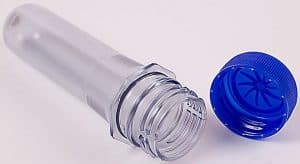
2. De grânulos a pré-formas
Na tecnologia de moldagem por sopro, um tubo oco de plástico é criado inicialmente por máquinas de injeção de plástico tradicionais. Essa chamada "pré-forma" já possui o formato final da rosca e da pinça, que serão utilizadas na próxima etapa para fixar a futura garrafa. O comprimento do tubo facilitará a operação seguinte e permitirá uma extensão uniforme do material.
Como nenhum material é removido posteriormente, a pré-forma já possui o peso da garrafa plástica vazia final. Devido ao volume extremamente alto desse mercado e à pequena seção transversal da pré-forma, o molde de injeção possui um número muito elevado de cavidades, produzindo assim muitas pré-formas por ciclo de prensagem. Com exceção da alimentação do molde, há muito pouco desperdício de matéria-prima.
3. Das pré-formas às garrafas de plástico
Esse processo de moldagem pode ser feito de várias maneiras, mas o método mais comum é conhecido como "moldagem por sopro". A pré-forma injetada no processo anterior é então colocada sobre um molde e um jato de ar quente é usado para soprar o tubo até que ele adquira o formato do molde.
Devido ao volume de garrafas de plástico vazias e ao seu estado de limpeza nesta fase, esta etapa é sempre realizada na fábrica de envase final.
4. Preenchimento e Etapas Finais
As garrafas recém-produzidas são então preenchidas com o líquido final, seladas geralmente com uma tampa de rosca de plástico, injetadas separadamente, geralmente em polietileno (PE), rotuladas e marcadas com:
- informações do produto
- informações de rastreabilidade
- data de validade
Em seguida, são montadas e embaladas em lotes para o consumidor final e lotes logísticos, frequentemente com películas plásticas adicionais.
Visitas guiadas a fábricas de garrafas de plástico
UM visita à fábrica de fabricação de garrafas em altíssimo volume, representativa das tecnologias das famosas marcas de sucos e refrigerantes.
E uma apresentação muito mais comercial, porém complementar à anterior.
Note: while we agree on the “recyclable” term used in the video, it does not mean effectively reciclado in the real life. The degradation of physical properties of recycled compounds, and likely also the costly collection effort required by disseminated trash versus low new material cost, lower the quantity of effectively recycled materials.
Ecological Alternative Approaches
Use fewer consumables
As our Análises de valor moto, follow the first rule:
Do not improve something you can suppress at the first place
- by not buying liquids that can be obtained without bottles at all. Example: tap water in countries with excellent local or national piping distribution systems.
- by using bottles made of reusable glass or reusable plastic. Some countries have a full bottle refilling circuit, usually with a deposit system. The bottles are produced in a similar way as shown above but have much thicker walls to withstand the additional logistic circuit and intense cleaning and disinfection before refilling and relabelling.
- go for the biggest bottle whenever possible. Not only does it contain the biggest quantity of liquid per quantity of plastic material, it also has only one cap compared to several small bottles, but it is way easier to collect as it disseminates less.
Use other Materials
Ask your plastic compounds supplier about bio-sourced plastic alternatives. More and more can be used in traditional injection machines with few parameter changes. Cost is higher but some markets are ready for this. More on these new bio-sourced materials in our design ecológico seção.
Dica: mind when these raw materials are only used as a percentage, and when the principle is just to split the usual raw plastic material into pieces. Of course, the trash becomes less visible in the field, but in fact, it disseminates the plastics in tiny bits impossible to collect, with almost the same huge degradation time. Instead, look for materials where the core raw material degrades naturally and fast, typically made of starch or equivalent.
Or use no plastic at all, but glass or metals, or other materials. See our dedicated article on this.
Again, only to be used when single-use bottles can not be suppressed completely in the first place.
Leituras e métodos complementares
- Reciclagem Processes for Plastic Bottles: Explore how plastic bottles are collected, sorted, and reprocessed into new products.
- Innovations in Biodegradable Plastics: Discover advancements in creating eco-friendly alternatives to traditional plastic bottles.
- Regulations and Policies on Plastic Bottles: Understand the global and local regulations governing the use and disposal of plastic bottles.
- Alternative Packaging Solutions: Investigate other materials and designs being used to replace plastic bottles.
- Consumer Behavior and Plastic Usage: Study how consumer habits impact the demand for plastic bottles.
- Energy Consumption in Plastic Production: Assess the energy requirements and efficiency of producing plastic bottles.
- Chemical Composition of Plastics: Learn about the types of plastics used in bottle manufacturing and their chemical properties.
External Links on Plastic Bottles
Normas internacionais
- ISO 8317:2019 Plastic bottles – Child-resistant packaging – Requirements and testing
- ASTM D6400-19:2019 Standard Specification for Labeling of Plastics Designed to be Aerobically Composted in Municipal or Industrial Facilities
- ISO 11607-1:2019 Packaging for terminally sterilized medical devices – Part 1: Requirements for materials, sterile barrier systems and packaging systems
(Passe o cursor sobre o link para ver nossa descrição do conteúdo)
Glossário de termos utilizados
Positron Emission Tomography (PET): Uma técnica de imagem médica que detecta raios gama emitidos pela aniquilação de pósitrons, usada para visualizar processos metabólicos em tecidos, frequentemente empregando radiotraçadores para avaliar condições como câncer, distúrbios neurológicos e doenças cardiovasculares.