RapidAPI API Marketplace compared with Postman API Network, APILayer and AWS Marketplace| RapidAPI API Marketplace | Postman API Network | APILayer | AWS Marketplace |
|---|
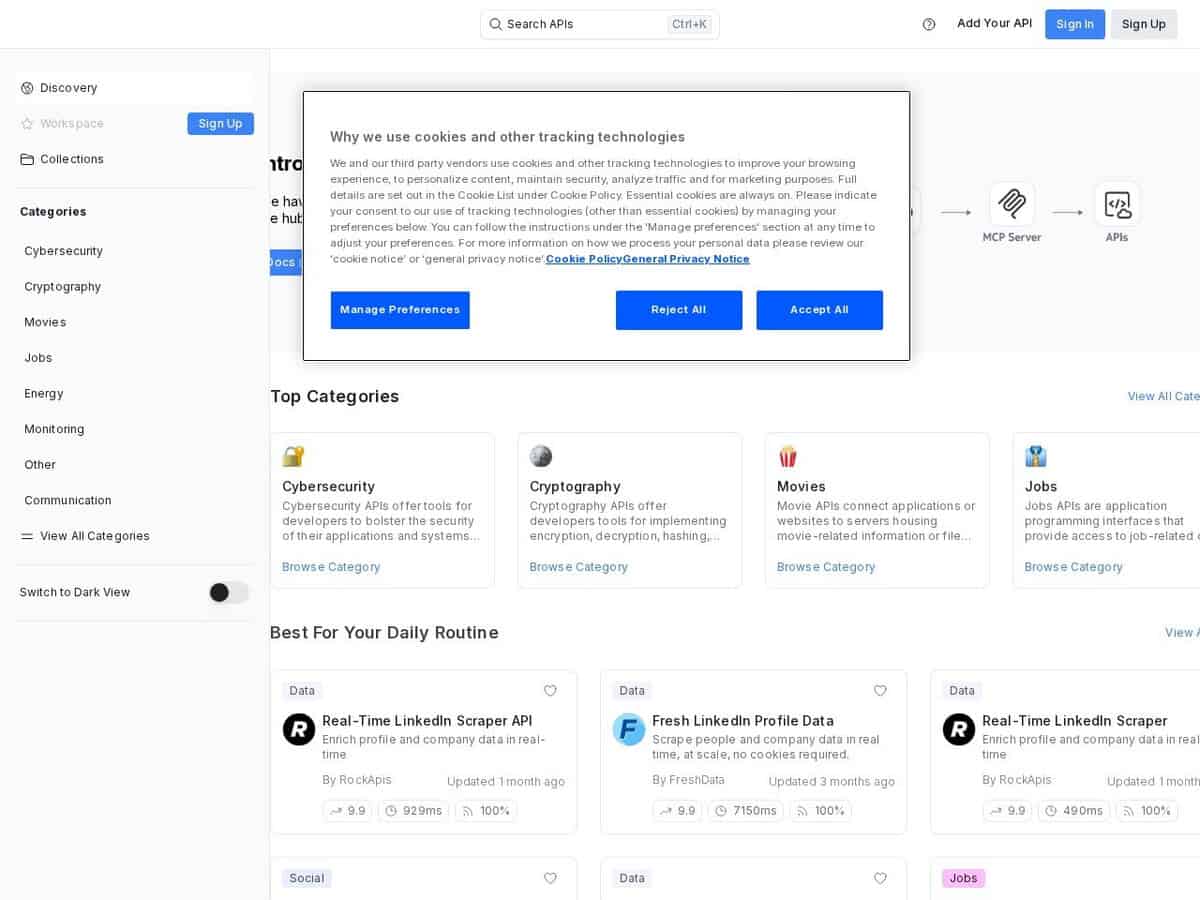
| Type of offer: It is a hub of third-party APIs from many providers. The operator reported 4 million developers and more than 40,000 APIs. Nokia acquired the technology assets of the operator in November 2024. | Type of offer: It is a catalogue of public APIs published as collections in public workspaces, in categories such as communication, financial services, payments and travel. Verified publisher teams are recommended. | Type of offer: It is a single vendor offering its own API family, about 40 or more, such as IPstack for geolocation, Marketstack for stock data and Weatherstack for weather. | Type of offer: It is a general software and data marketplace with product types such as SaaS, AMI, container, machine learning and data. API access appears there as data products. |
| Account and key model: A free account is required. Many APIs offer a free BASIC plan and you subscribe per API. Paid plans recur monthly with overage fees past the quota. | Account and key model: The catalogue is aimed at exploring and calling APIs from within Postman. Whether use is free is not stated on the page reviewed. | Account and key model: One signup gives one key that works across the platform, with no separate billing per API. Free plans are stated for every API. | Account and key model: Purchases go through an AWS account. Pay-as-you-go products are billed monthly for usage, and subscription products by the length set by the provider. |
| Testing and integration: Each API listing has an endpoint tester in the browser, documentation and code snippets in many languages. Latency and success rate are shown for comparison. | Testing and integration: APIs are consumed as collections inside the Postman client, which is convenient when requests are already organised there. | | Testing and integration: Integration is done in AWS tooling. Data transfer and other AWS services used with the data are billed separately. |
| Breadth and specialisation: Breadth is the main benefit, from weather and currencies to specialised data. Quality and legal status of data vary by provider, so licence and privacy rules must be checked. | Breadth and specialisation: Breadth is wide, but entries are public APIs published by companies, which often means documentation of high quality for well-known services. | Breadth and specialisation: Depth is limited to its own products, which makes it easier to judge the single supplier. | Breadth and specialisation: Offers are mostly enterprise oriented, with private offers and free trials on many listings. |
| When to choose it: Choose it to compare many small data APIs quickly with one account and one tester. | When to choose it: Choose it to find the official API of a known service and start from ready collections. | When to choose it: Choose it when a few standard data feeds (geolocation, finance, weather) are enough. | When to choose it: Choose it when procurement and billing must stay inside an AWS contract. |