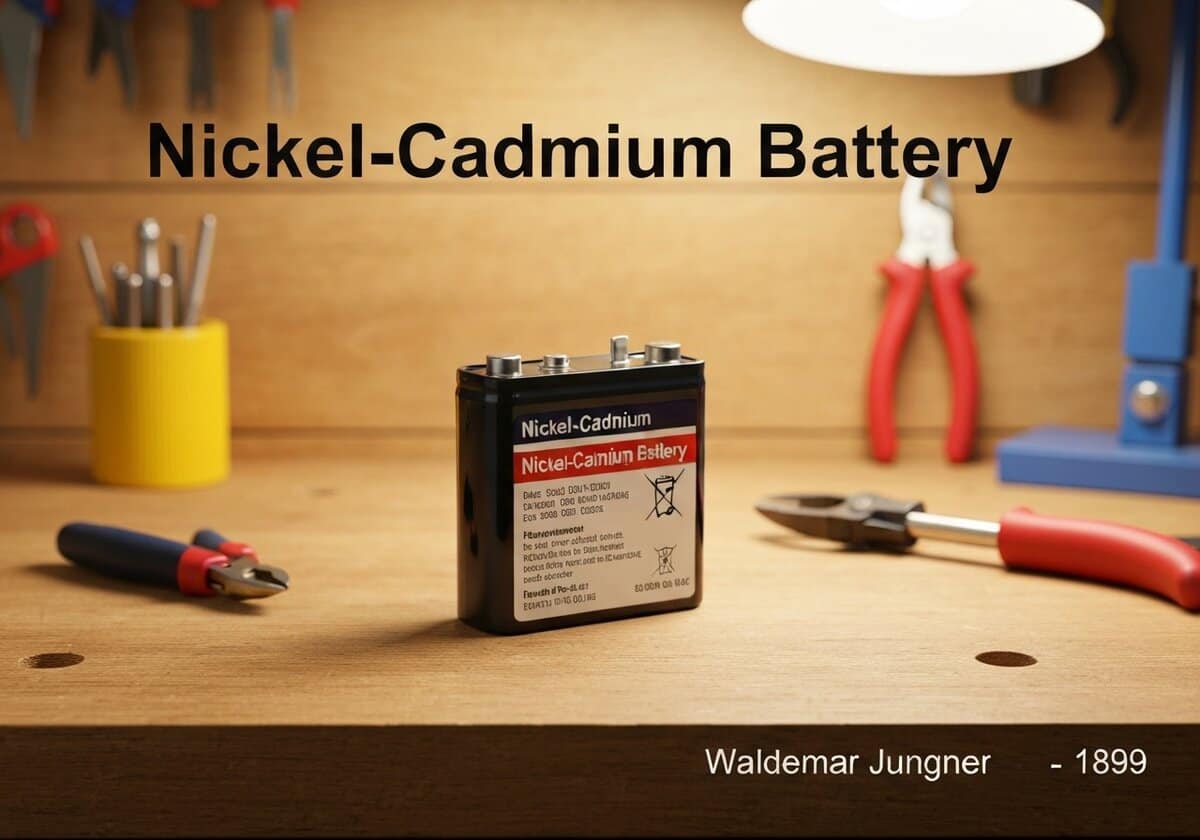
1899년 발데마르 융너가 발명한 니켈-카드뮴(NiCd) 배터리는 양극으로 산화수산화니켈(NiO(OH))을, 음극으로 금속 카드뮴(Cd)을 사용하며, 전해액으로는 수산화칼륨(KOH)을 사용합니다. 긴 수명과 저온에서의 우수한 성능이 장점으로 알려져 있지만, 메모리 효과와 카드뮴의 독성이라는 단점이 있습니다.


(설명을 위한 생성된 이미지입니다)
1899년 발데마르 융너가 발명한 니켈-카드뮴(NiCd) 배터리는 양극으로 산화수산화니켈(NiO(OH))을, 음극으로 금속 카드뮴(Cd)을 사용하며, 전해액으로는 수산화칼륨(KOH)을 사용합니다. 긴 수명과 저온에서의 우수한 성능이 장점으로 알려져 있지만, 메모리 효과와 카드뮴의 독성이라는 단점이 있습니다.

니켈-카드뮴 배터리는 이전보다 훨씬 발전된 기술이었다. lead-acid battery, offering a higher energy density and a much longer cycle life in a sealed, maintenance-free package. Waldemar Jungner’s invention provided a robust and reliable power source that became dominant in portable applications for much of the 20th century. The core chemical reaction during discharge is [latex]2 NiO(OH) + Cd + 2 H_2O rightarrow 2 Ni(OH)_2 + Cd(OH)_2[/latex].
The use of an alkaline electrolyte, typically potassium hydroxide, was a key difference from the acidic electrolyte of lead-acid cells. This chemistry allowed for a very flat discharge voltage curve, meaning the battery delivered a nearly constant voltage until it was almost fully depleted. However, its major drawbacks led to its decline. Cadmium is a heavy metal with significant environmental toxicity, making disposal and recycling a critical issue. Furthermore, NiCd batteries are prone to the ‘메모리 효과,’ where repeated partial discharge/charge cycles can cause a reduction in usable capacity. This necessitated periodic full discharge cycles to maintain performance. Despite being largely replaced by NiMH and Li-ion technologies in consumer goods, its durability ensures it remains in some niche industrial and 항공 응용 프로그램.
니켈-카드뮴 배터리(NiCd)
(날짜를 알 수 없거나 관련이 없는 경우, 예를 들어 "유체역학"의 경우, 주목할 만한 등장 시기를 대략적으로 추정하여 제공합니다.)

고화질 이미지 및 다운로드는 등록된 회원에게만 100% 무료로 제공됩니다.
> 로그인 <