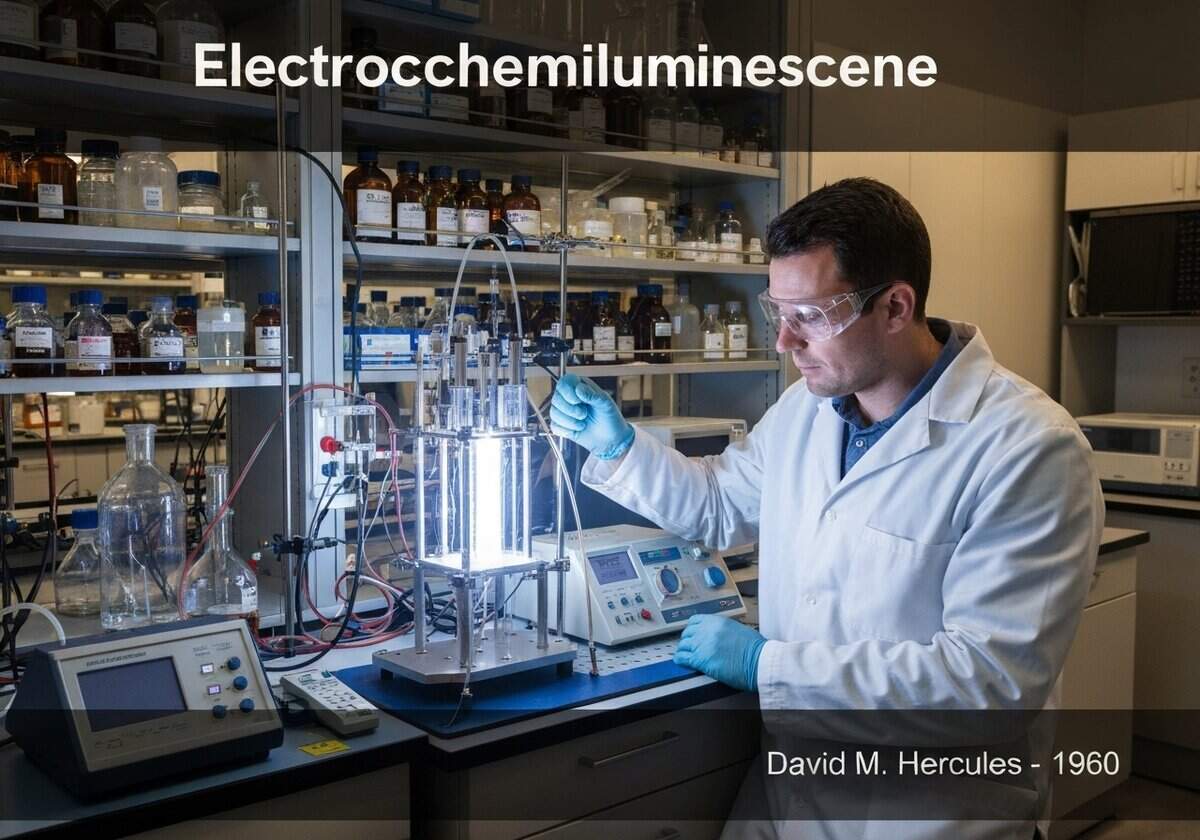
전기화학발광(Electrochemiluminescence, ECL)은 전극 표면에서 시작된 화학 반응으로부터 빛이 생성되는 현상입니다. 전기화학적으로 생성된 물질은 고에너지 전자 전달 반응을 통해 여기 상태를 형성하고, 이 여기 상태가 이완될 때 빛을 방출합니다. ECL은 화학발광의 분석적 장점(낮은 배경 신호, 높은 감도)과 전기화학적 트리거의 정밀한 제어를 결합한 분석법입니다.

(설명을 위한 생성된 이미지입니다)
전기화학발광(Electrochemiluminescence, ECL)은 전극 표면에서 시작된 화학 반응으로부터 빛이 생성되는 현상입니다. 전기화학적으로 생성된 물질은 고에너지 전자 전달 반응을 통해 여기 상태를 형성하고, 이 여기 상태가 이완될 때 빛을 방출합니다. ECL은 화학발광의 분석적 장점(낮은 배경 신호, 높은 감도)과 전기화학적 트리거의 정밀한 제어를 결합한 분석법입니다.
In a typical ECL system, a stable precursor molecule, such as a ruthenium(II) complex like [latex]Ru(bpy)_3^{2+}[/latex], is used. When a voltage is applied to an electrode in a solution containing this complex and a co-reactant (e.g., tripropylamine, TPA), both species are oxidized at the electrode surface. The oxidized TPA loses a proton and an electron to become a highly reducing radical intermediate. This radical then transfers an electron to the oxidized ruthenium complex, [latex]Ru(bpy)_3^{3+}[/latex], in a highly exothermic reaction. This 전자 전달 is so energetic that it promotes the resulting [latex]Ru(bpy)_3^{2+}[/latex] to an electronically excited state, [latex][Ru(bpy)_3^{2+}]^*[/latex]. This excited state then relaxes to the ground state, emitting a photon of light at approximately 620 nm. The key advantage of ECL is its temporal and spatial control. The reaction only occurs when the voltage is applied and only at the electrode surface, which dramatically reduces background noise and allows for highly sensitive detection, often down to the attomolar level. This makes it a powerful tool in modern bioanalytical assays.
전기화학발광(ECL)
(날짜를 알 수 없거나 관련이 없는 경우, 예를 들어 "유체역학"의 경우, 주목할 만한 등장 시기를 대략적으로 추정하여 제공합니다.)

고화질 이미지 및 다운로드는 등록된 회원에게만 100% 무료로 제공됩니다.
> 로그인 <