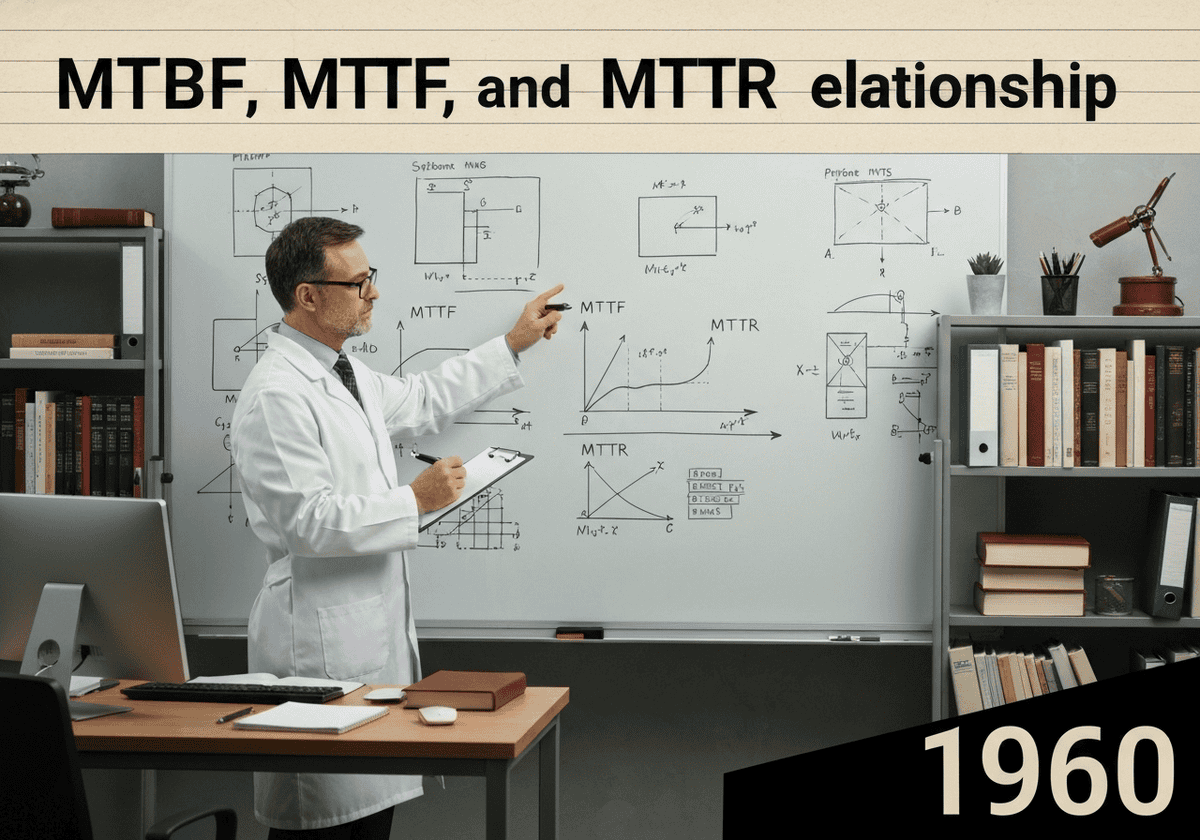
수리 가능한 시스템의 경우, 평균 고장 간격(MTBF)은 평균 고장 발생 시간(MTTF)과 평균 수리 시간(MTTR)의 합입니다. 공식은 [latex]MTBF = MTTF + MTTR[/latex]입니다. MTTF는 고장 발생 전 평균 작동 시간을 나타내고, MTTR은 시스템을 수리하는 데 걸리는 평균 시간을 나타냅니다. 이러한 구분은 시스템 가용성을 이해하는 데 매우 중요합니다.

(설명을 위한 생성된 이미지입니다)
수리 가능한 시스템의 경우, 평균 고장 간격(MTBF)은 평균 고장 발생 시간(MTTF)과 평균 수리 시간(MTTR)의 합입니다. 공식은 [latex]MTBF = MTTF + MTTR[/latex]입니다. MTTF는 고장 발생 전 평균 작동 시간을 나타내고, MTTR은 시스템을 수리하는 데 걸리는 평균 시간을 나타냅니다. 이러한 구분은 시스템 가용성을 이해하는 데 매우 중요합니다.

The relationship [latex]MTBF = MTTF + MTTR[/latex] clarifies the full cycle of a repairable system’s life. MTTF (Mean Time To Failure) is the average duration a system operates successfully. MTTR (Mean Time To Repair) is the average time spent in a non-operational state, from the moment of failure until the system is restored to full functionality. This repair time includes fault detection, diagnosis, technician travel, sourcing parts, the actual repair, and verification.
This decomposition is vital for improving system availability. Availability, often expressed as a percentage, can be calculated as [latex]A = \frac{MTTF}{MTTF + MTTR} = \frac{MTTF}{MTBF}[/latex]. To increase availability, one can either increase the MTTF (make the system more reliable) or decrease the MTTR (make repairs faster). For many complex systems, such as a telecommunications network, reducing MTTR through rapid diagnostics and automated recovery is often more feasible than dramatically increasing the inherent reliability (MTTF) of every component.
For non-repairable items, such as a light bulb, the concept of MTTR is irrelevant. Once they fail, they are discarded. Therefore, their reliability is characterized solely by MTTF. The term MTBF is sometimes used interchangeably with MTTF, especially where MTTR is negligible, but this is technically incorrect.
MTBF, MTTF 및 MTTR 간의 관계
(날짜를 알 수 없거나 관련이 없는 경우, 예를 들어 "유체역학"의 경우, 주목할 만한 등장 시기를 대략적으로 추정하여 제공합니다.)

고화질 이미지 및 다운로드는 등록된 회원에게만 100% 무료로 제공됩니다.
> 로그인 <