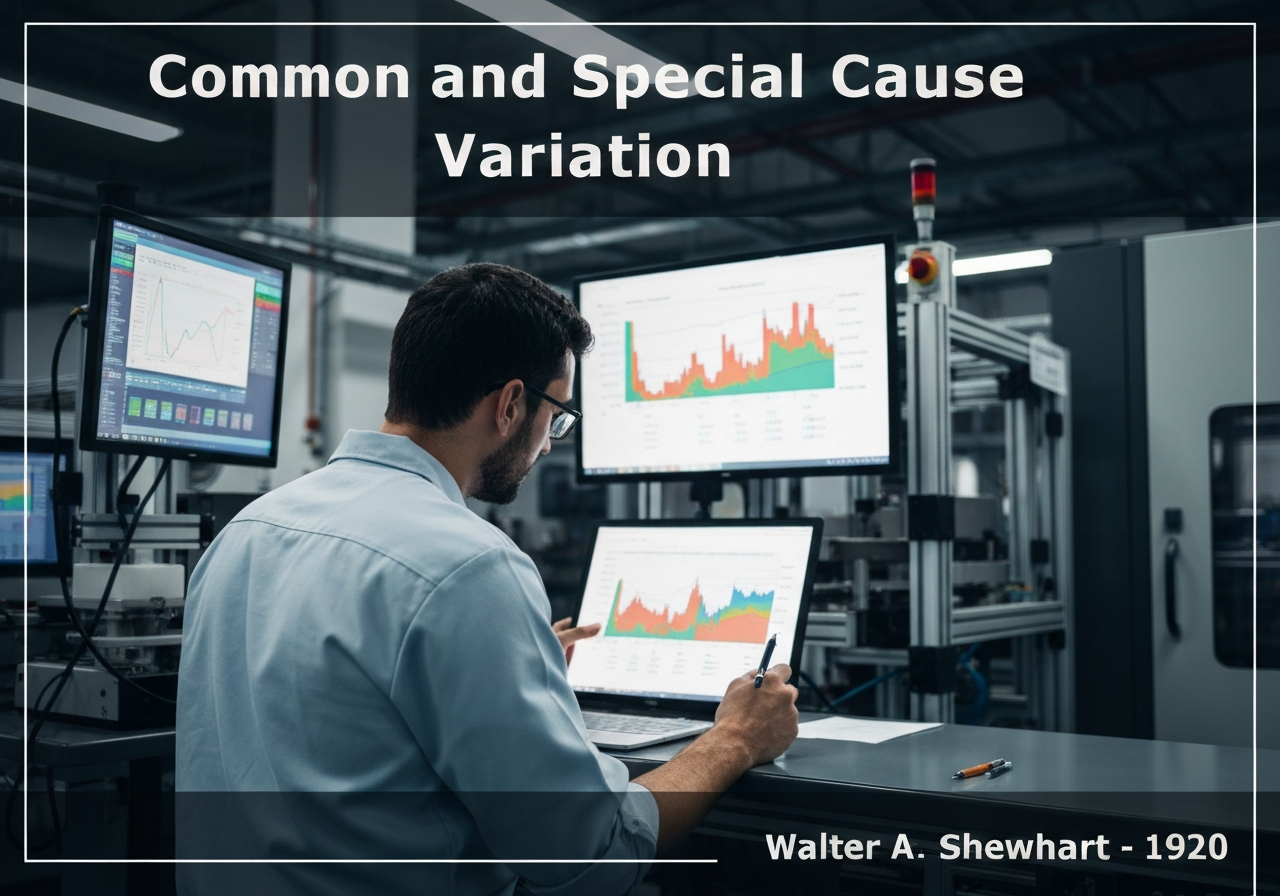
핵심 원칙 SPC 두 가지 유형의 공정 변동을 구분합니다. 일반 원인 변동은 공정 내에 내재된 무작위적인 '잡음'으로, 안정적이고 예측 가능한 요소입니다. 특수 원인 변동, 또는 특정 원인으로 인한 변동은 외부의 식별 가능한 원인에서 발생하며, 공정의 불안정성을 나타냅니다. 목표는 특수 원인을 제거하고 일반 원인 변동을 줄이는 것입니다.


(설명을 위한 생성된 이미지입니다)
핵심 원칙 SPC 두 가지 유형의 공정 변동을 구분합니다. 일반 원인 변동은 공정 내에 내재된 무작위적인 '잡음'으로, 안정적이고 예측 가능한 요소입니다. 특수 원인 변동, 또는 특정 원인으로 인한 변동은 외부의 식별 가능한 원인에서 발생하며, 공정의 불안정성을 나타냅니다. 목표는 특수 원인을 제거하고 일반 원인 변동을 줄이는 것입니다.

The distinction between common and special causes of variation is the bedrock upon which Statistical Process Control is built. Walter A. Shewhart, while working at Bell Labs, recognized that variation is inherent in any process, but not all variation is equal. He categorized it into two types. Common cause variation is the cumulative effect of many small, unavoidable causes. It is a natural part of the process and, when only common causes are present, the process is considered stable, in-control, and predictable within statistical limits. Examples include slight variations in material properties, ambient temperature, or machine vibration. This variation creates a distribution that is typically normal.
In contrast, special cause variation (also called assignable cause) arises from specific, identifiable circumstances that are not part of the process’s usual operation. These causes are intermittent, unpredictable, and result in a process that is out of statistical control. Examples could be a new, untrained operator, a faulty batch of raw material, a machine malfunction, or a change in measurement method. The key objective of SPC is to first detect the presence of special causes using tools like control charts. Once detected, these causes can be investigated and eliminated, bringing the process back into a state of statistical control. Only after a process is stable (i.e., free of special causes) can one meaningfully work on reducing the common cause variation to improve 프로세스 능력.
일반 원인 및 특수 원인 변동
(날짜를 알 수 없거나 관련이 없는 경우, 예를 들어 "유체역학"의 경우, 주목할 만한 등장 시기를 대략적으로 추정하여 제공합니다.)

고화질 이미지 및 다운로드는 등록된 회원에게만 100% 무료로 제공됩니다.
> 로그인 <