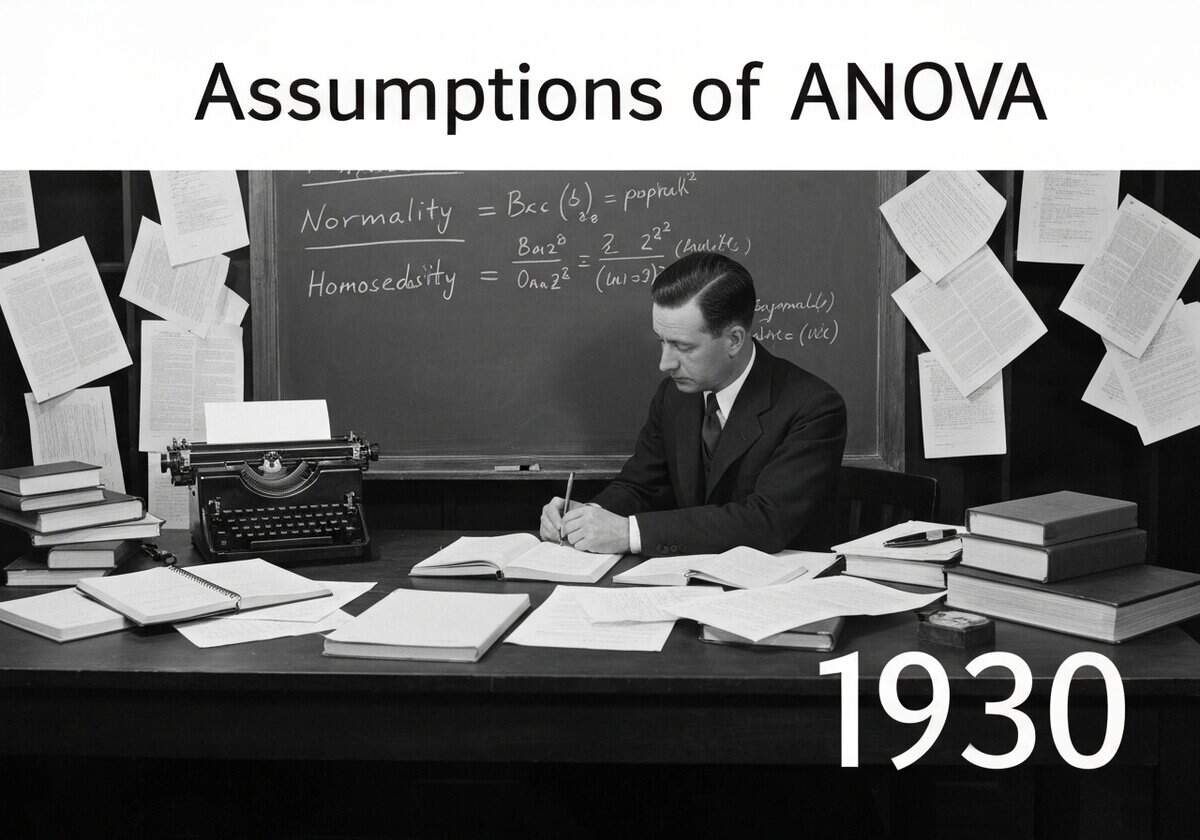
ANOVA 결과가 유효하다고 간주되려면 데이터에 대한 몇 가지 주요 가정이 충족되어야 합니다. 이러한 가정은 다음과 같습니다. (1) 관측치의 독립성, 즉 오차가 상관관계가 없음. (2) 정규성, 즉 각 그룹의 잔차가 대략적으로 정규 분포를 따름. (3) 등분산성 또는 분산의 동질성, 즉 모든 그룹에서 잔차의 분산이 동일함.

(설명을 위한 생성된 이미지입니다)
ANOVA 결과가 유효하다고 간주되려면 데이터에 대한 몇 가지 주요 가정이 충족되어야 합니다. 이러한 가정은 다음과 같습니다. (1) 관측치의 독립성, 즉 오차가 상관관계가 없음. (2) 정규성, 즉 각 그룹의 잔차가 대략적으로 정규 분포를 따름. (3) 등분산성 또는 분산의 동질성, 즉 모든 그룹에서 잔차의 분산이 동일함.
These assumptions relate to the residuals (the differences between observed values and the group means), not the raw data itself. Independence is the most critical assumption and is typically ensured by proper experimental design and random sampling; violations can lead to severely biased results. Normality means the distribution of residuals within each group should follow a bell curve. ANOVA is considered relatively robust to moderate violations of this assumption, especially with large and balanced sample sizes, due to the Central Limit Theorem. Homoscedasticity ([latex]\sigma_1^2 = \sigma_2^2 = \dots = \sigma_k^2[/latex]) means the spread or scatter of data points around their group mean should be similar for all groups. Significant violation of this assumption (heteroscedasticity) can increase the rate of Type I errors. Statisticians have developed diagnostic tools to check these assumptions. For example, Q-Q plots can assess normality, and Levene’s test or Bartlett’s test can check for homogeneity of variances. If assumptions are severely violated, researchers may need to transform the data or use alternative statistical methods that do not rely on these assumptions.
분산분석의 가정
(날짜를 알 수 없거나 관련이 없는 경우, 예를 들어 "유체역학"의 경우, 주목할 만한 등장 시기를 대략적으로 추정하여 제공합니다.)

고화질 이미지 및 다운로드는 등록된 회원에게만 100% 무료로 제공됩니다.
> 로그인 <