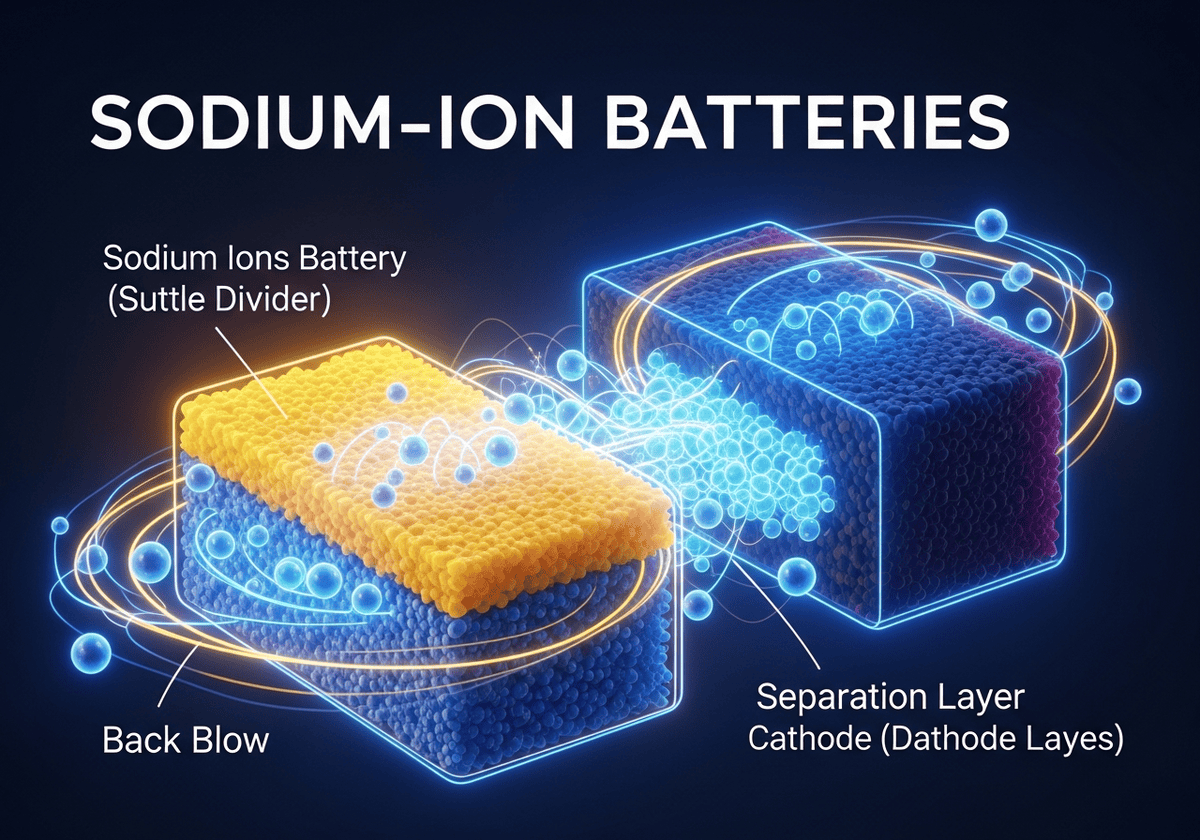
ナトリウムイオン電池は、ナトリウムイオンを電気化学エネルギー貯蔵セルとして利用し、 リチウム 充電および放電サイクル中に正極と負極の間を移動する電荷運搬種として、リチウムイオンと機構的に類似した挿入および抽出化学に基づいて動作するが、ナトリウムのより大きなイオン半径、より低い還元電位、およびはるかに多い地殻存在量によって支配される。
正極材料技術は、主に3つの系統に分類されます。
- 層状遷移金属酸化物
- プルシアンブルーの類似品
- NASICON型リン酸塩および硫酸塩を含む多価陰イオン化合物
それぞれが比容量、電圧プラトー、繰り返しナトリウム挿入時の構造安定性、合成コストの間で異なるトレードオフを示しており、リチウムイオン電池においてNMCとLFPが占める市場統合を達成した単一の正極材料はまだ存在しない。
負極側では、グラファイトのナトリウムインターカレーション容量がごくわずかであるため不向きであり、バイオマスや樹脂前駆体由来のハードカーボンが現在の実用的な標準として研究が進められており、ナトリウム金属負極は高エネルギーだがデンドライトが発生しやすいという課題を抱えている。電解液の組成(エーテルまたは炭酸塩溶媒中のNaPF6またはNaClO4塩、イオン液体、あるいは新興の固体ナトリウム導体)は、最初のサイクルにおけるクーロン効率、レート性能、および経年劣化を左右する固体電解質界面の化学反応を決定づける重要な要素である。
以下に索引付けされた出版物および特許は、正極および負極材料の合成、電解質工学、SEI特性評価、セルフォーマット設計、形成プロトコルの最適化、およびシステムレベルの技術経済モデリングに関するものです。
これは、ナトリウムイオン電池に関する英語の世界中の出版物と特許の最新のセレクションです。多くの科学オンラインジャーナルの中から、ナトリウムイオン電池、Naイオンセル、ナトリウムイオンカソード、層状酸化物カソードナトリウム、プルシアンブルー類似カソード、ポリアニオンカソードナトリウム、NASICONカソード、ハードカーボンアノードナトリウム、ソフトカーボンアノードナトリウム、ナトリウム金属アノード、ナトリウムイオン電解質、エーテル系電解質ナトリウム、ナトリウム塩電解質、NaPF6電解質、ナトリウムイオン、固体電解質、ナトリウムイオンSEI層に分類され、焦点を絞っています。
All-solid-state secondary battery
Patent published on the 2026-07-02 in WO under Ref WO2026140032 by NTT INC [JP] (Okubo Sho [jp], Hayashi Masahiko [jp], Iwata Mikayo [jp], Ono Youko [jp], Aratake Atsushi [jp])
Abstract: An all-solid-state secondary battery comprising: a positive electrode 11 which contains a lithium-containing sulfate; a negative electrode 13 containing a substance capable of lithium insertion and extraction at a potential lower than that of the positive electrode; and a chloride solid electrolyte 12 containing lithium.[...]
Our summary: The all-solid-state secondary battery features a positive electrode with lithium-containing sulfate. The negative electrode allows lithium insertion and extraction at a lower potential. A chloride solid electrolyte containing lithium is also included in the design.
all-solid-state battery, lithium sulfate, chloride electrolyte, lithium insertion
Patent
Method for preparing conductive material comprising halide-based solid electrolyte, conductive material prepared using same, and all-solid-state batte
Patent published on the 2026-07-02 in WO under Ref WO2026142002 by IUCF HYU INDUSTRY UNIV COOPERATION FOUNDATION HANYANG UNIV [KR] (Paik Un Gyu [kr], Song Tae Seup [kr], Lee Seung Woo [kr], Kim Jae Ik [kr])
Abstract: The present invention relates to a method for preparing a conductive material comprising a halide-based solid electrolyte, a conductive material prepared using same, and an all-solid-state battery comprising same. With respect to the conductive material comprising a halide-based solid electrolyte, a linear carbon material is island-coated or conformal-coated with a halide-based solid electrolyte so as to prevent direct contact with the solid electrolyte, thereby enabling oxidation and side react[...]
Our summary: The invention describes a method for preparing a conductive material using a halide-based solid electrolyte. It involves coating a linear carbon material to prevent direct contact with the electrolyte, reducing oxidation and side reactions. This approach enhances the interfacial properties with a binder and improves battery performance.
conductive material, halide-based solid electrolyte, all-solid-state battery, interfacial properties
Patent
All-solid-state battery
Patent published on the 2026-07-02 in WO under Ref WO2026142382 by LG ENERGY SOLUTION LTD [KR] (Narimatsu Eiichiro [jp], Matsubara Keiko [jp])
Abstract: The purpose of the present invention is to provide an anode-free all-solid-state battery having improved discharge capacity and cycle characteristics. In addition, the purpose of the present invention is to provide an anode-free all-solid-state battery that can be driven at a low confining pressure. The present invention provides an all-solid-state battery comprising: a positive electrode including a positive electrode active material layer; a negative electrode current collector; and a solid el[...]
Our summary: The invention presents an anode-free all-solid-state battery with enhanced discharge capacity and cycle characteristics. It features a positive electrode with an active material layer and a solid electrolyte layer. The design allows for lithium ions to form a lithium metal layer on the negative electrode current collector without a negative electrode active material.
all-solid-state battery, anode-free, solid electrolyte, discharge capacity
Patent
All-solid-state secondary battery
Patent published on the 2026-07-02 in WO under Ref WO2026140178 by NTT INC [JP] (Okubo Sho [jp], Hayashi Masahiko [jp], Iwata Mikayo [jp], Ono Youko [jp], Aratake Atsushi [jp])
Abstract: This all-solid-state secondary battery includes: a positive electrode 11 containing cyanide containing lithium; a negative electrode 13 containing a substance capable of inserting and desorbing lithium at a potential lower than that of the positive electrode; and a chloride solid electrolyte 12 containing lithium.[...]
Our summary: This all-solid-state secondary battery features a lithium-containing positive electrode and a lithium-inserting negative electrode. It utilizes a chloride solid electrolyte to facilitate ion movement. The design aims to enhance battery performance and safety.
all-solid-state battery, lithium-ion, positive electrode, solid electrolyte
Patent
Solid-state battery and method of manufacturing solid-state battery
Patent published on the 2026-07-01 in EP under Ref EP4769497 by TOYOTA MOTOR CO LTD [JP] (Kakishita Kenichi [jp], Sato Yuki [jp], Tokioka Hideyuki [jp], Matsuyama Takuya [jp], Waseda Tetsuya [jp], Kimura Takuya [jp])
Abstract: A solid-state battery, and a method of manufacturing a solid-state battery, including a structure in which a first collector, a first electrode layer, a solid electrolyte layer, a second electrode layer and a second collector are disposed in this order in a first axial direction, the solid-state battery having a void at at least one of an interior of the first electrode layer and a periphery of the first electrode layer, wherein a shape of the void, as seen in a cross-sectional view along the fi[...]
Our summary: A solid-state battery consists of multiple layers including collectors, electrodes, and a solid electrolyte. The manufacturing method involves creating a void within the first electrode layer. This void has an elongate shape when viewed in cross-section along the axial direction.
solid-state battery, manufacturing method, solid electrolyte, electrode structure
Patent
Solid electrolyte layer, all-solid-state battery including the same, and method for manufacturing a solid electrolyte layer
Patent published on the 2026-07-01 in EP under Ref EP4769617 by SAMSUNG SDI CO LTD [KR] (Oh Daeyang [kr])
Abstract: The present disclosure relates to a solid electrolyte layer, an all-solid-state battery including the solid electrolyte layer, and a method for manufacturing the solid electrolyte layer. The solid electrolyte layer includes a sulfide-based solid electrolyte, a binder, and an additive. The additive includes a metal acetylacetonate.[...]
Our summary: The disclosure presents a solid electrolyte layer for all-solid-state batteries. It comprises a sulfide-based solid electrolyte, binder, and an additive. The additive utilized is a metal acetylacetonate.
solid electrolyte, all-solid-state battery, sulfide-based electrolyte, metal acetylacetonate
Patent
Crosslinked Zwitterionic PVA-g-SBMA/PEDOT:PSS Networks for Mechanically Robust All-Solid-State Electrolytes
Published on 2026-01-28 by Chia-Wen Wei, Chia-Yu Chen, Shyh-Chyang Luo, Dmitry G. Belov, Szu-Nan Yang @MDPI
Abstract: Conventional lithium-ion batteries face issues like electrolyte leakage and interface instability. Solid-state lithium batteries with solid electrolytes address these, while solid-state polymer electrolytes (SPEs) offer safety and flexibility. This study primarily aimed to develop and synthesize a graft copolymer, PVA-g-SBMA, which was successfully synthesized by grafting [2-(methacryloyloxy)ethyl] dimethyl-(3-sulfopropyl)ammonium hydroxide (SBMA) onto poly(vinyl alcohol) (PVA). PVA provided exc[...]
Our summary: This study developed a graft copolymer, PVA-g-SBMA, by grafting SBMA onto PVA to enhance ionic conductivity and mechanical properties in solid-state electrolytes. The copolymer was crosslinked with PEDOT:PSS to form a robust network, improving film performance. The optimal system achieved a conductivity of 4.9 × 10⁻⁴ S/cm at room temperature with specific lithium salt concentrations.
Crosslinked, Zwitterionic, Solid-state, Electrolytes
Publication
Advances in Sodium Ion Batteries Based on Mixed Electrolytes of ILs and Organic Solvents
Published on 2026-01-28 by Sajjad Ghiyami, Claudio Mele @MDPI
Abstract: Sodium-ion batteries (SIBs) represent a topic of extreme interest in the research field, especially because the materials used are cheaper than those in lithium-ion batteries (LIBs). In SIBs, the choice of cathodes and electrolytes is very important because they will affect the energy density, cycling stability, and safety of the battery. This work focuses on the prospect of hybrid electrolyte cells that incorporate ionic liquids (ILs) into organic liquids in order to improve the safety and perf[...]
Our summary: This study explores the use of hybrid electrolytes combining ionic liquids and organic solvents in sodium-ion batteries. It highlights improvements in ionic conductivity, electrochemical stability, and thermal safety. The research suggests that these advancements could enhance the performance and lifecycle of sodium-ion battery technology for large-scale energy storage applications.
Sodium-ion batteries, hybrid electrolytes, ionic liquids, energy storage
Publication