Product Design, Manufacturing & Innovation Resources
» 生体材料における分子自己組織化

生体材料における分子自己組織化

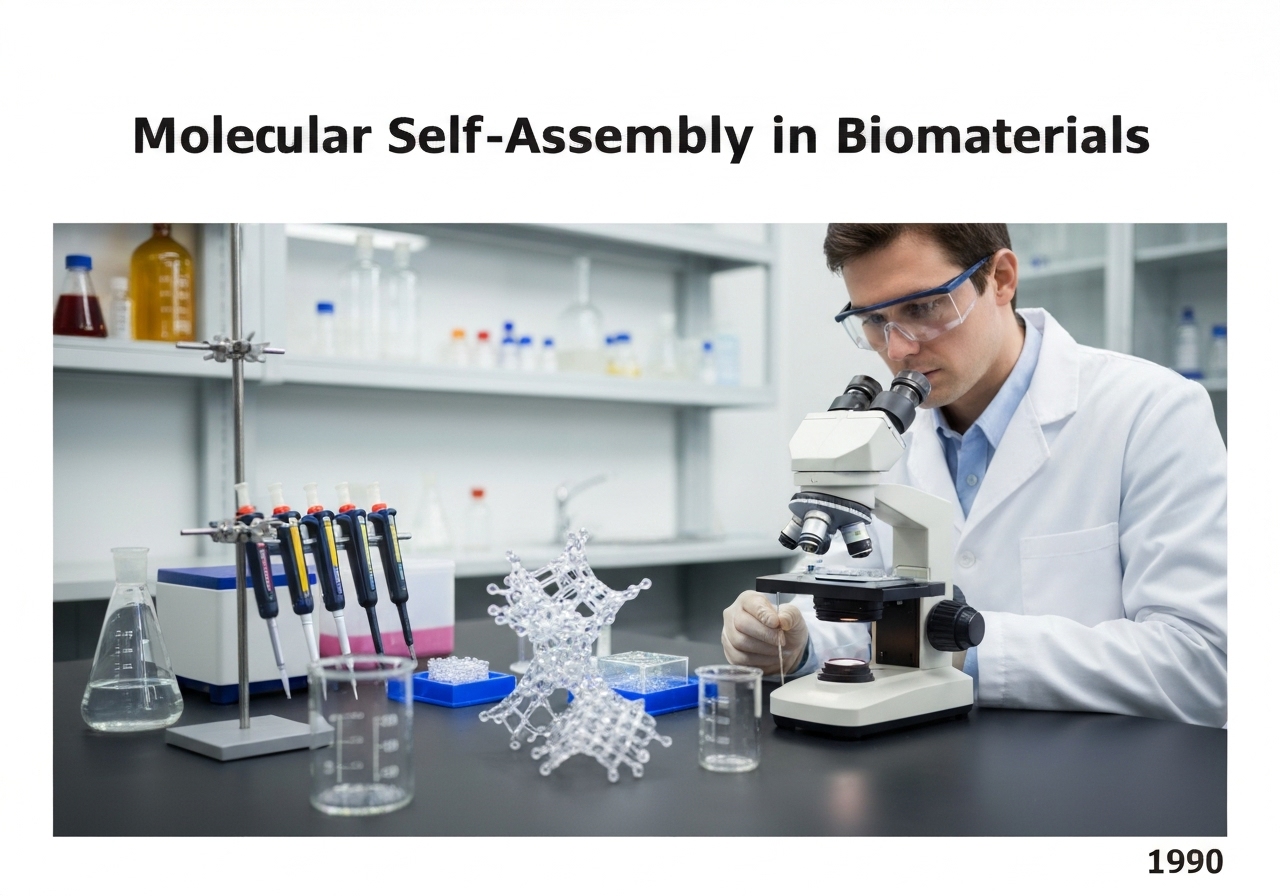
1990
バイオメディカル用途のバイオマテリアルにおける分子の自己組織化を実証する実験室風景。.

(画像はイメージです)

分子自己組織化は、外部からの誘導なしに分子が自発的に秩序だった構造に組織化される「ボトムアップ」プロセスです。この現象は、水素結合、疎水性効果、および ファンデルワールス 力は生物学において基礎的な役割を果たしており(例えば、タンパク質の折り畳み、脂質二重層の形成など)、生体材料においては、ハイドロゲルやナノファイバーといった複雑なナノ構造材料を生物医学用途向けに作製するために利用されている。

Self-assembly provides a powerful paradigm for creating biomaterials that mimic the hierarchical complexity of biological tissues. The process is thermodynamically driven, seeking a minimum Gibbs free energy state. The design begins with molecular building blocks, often amphiphilic molecules (containing both hydrophilic and hydrophobic parts) such as block copolymers or peptide amphiphiles (PAs). When placed in an aqueous environment above a critical concentration, these molecules arrange themselves to minimize the unfavorable contact between their hydrophobic segments and water. This can lead to various nanostructures, including spherical micelles, cylindrical nanofibers, or planar bilayers, with the final morphology dictated by molecular geometry and packing parameters. A key advantage is the ability to encode biological function directly into the building blocks. For example, a PA can be designed with a peptide sequence containing the RGD motif, a well-known cell adhesion ligand. Upon self-assembly into nanofibers, this motif is displayed on the fiber surface, creating a scaffold that actively promotes cell attachment. These systems are often dynamic and responsive. A change in pH, temperature, or ionic strength can trigger a structural transition, allowing for the creation of ‘smart’ materials. For instance, a self-assembling peptide solution can be designed to be liquid for easy injection but form a solid hydrogel scaffold at body temperature, entrapping cells and drugs at a target site for regenerative medicine applications.

UNESCO Nomenclature: 2209
高分子化学

タイプ

化学プロセス

混乱

基礎

使用法

新興技術

前駆物質

  • 非共有結合力(水素結合、ファンデルワールス力)の理解
  • 細胞膜の脂質二重層構造の発見
  • タンパク質の折り畳みと四次構造に関する研究
  • 高分子化学、特にブロック共重合体の発展
  • nobel prize-winning work in supramolecular chemistry by lehn, pedersen, and cram

アプリケーション

  • 天然の細胞外マトリックスを模倣した組織工学用ナノファイバー足場の作製
  • 薬物送達および細胞封入のための注射可能なハイドロゲルの開発
  • pHや温度などの刺激に反応して特性が変化する、応答性の高い「スマート」材料の創出
  • 標的療法のためのミセルやベシクルなどのナノキャリアの形成
  • 生物付着を防ぐ表面コーティング

特許:

NA

潜在的なイノベーションのアイデア

ボットによるトラフィック(現在1日あたり4万件以上)を排除するため、このコンテンツはコミュニティメンバー限定となっています。
> ログイン < または > 登録 < (100%無料)でこれにアクセスできます。他のすべての制限付きコンテンツとツールも同様です。

関連キーワード:自己組織化、ボトムアップ、超分子化学、非共有結合相互作用、ヒドロゲル、ナノファイバー、両親媒性物質、ブロック共重合体、スマート材料、ペプチド両親媒性物質。

歴史的背景

生体材料における分子自己組織化

1984
1985
1986
1990
1994
1997
2002
1980
1984
1986
1986
1991
1995
2000
2004

(日付が不明または関連性がない場合、例えば「流体力学」などでは、その注目すべき出現時期の概算値が提示されます。)

フルサイズの画像とダウンロードは、登録会員のみが100%無料で利用できます。