小数点以下の計算時間(D値)
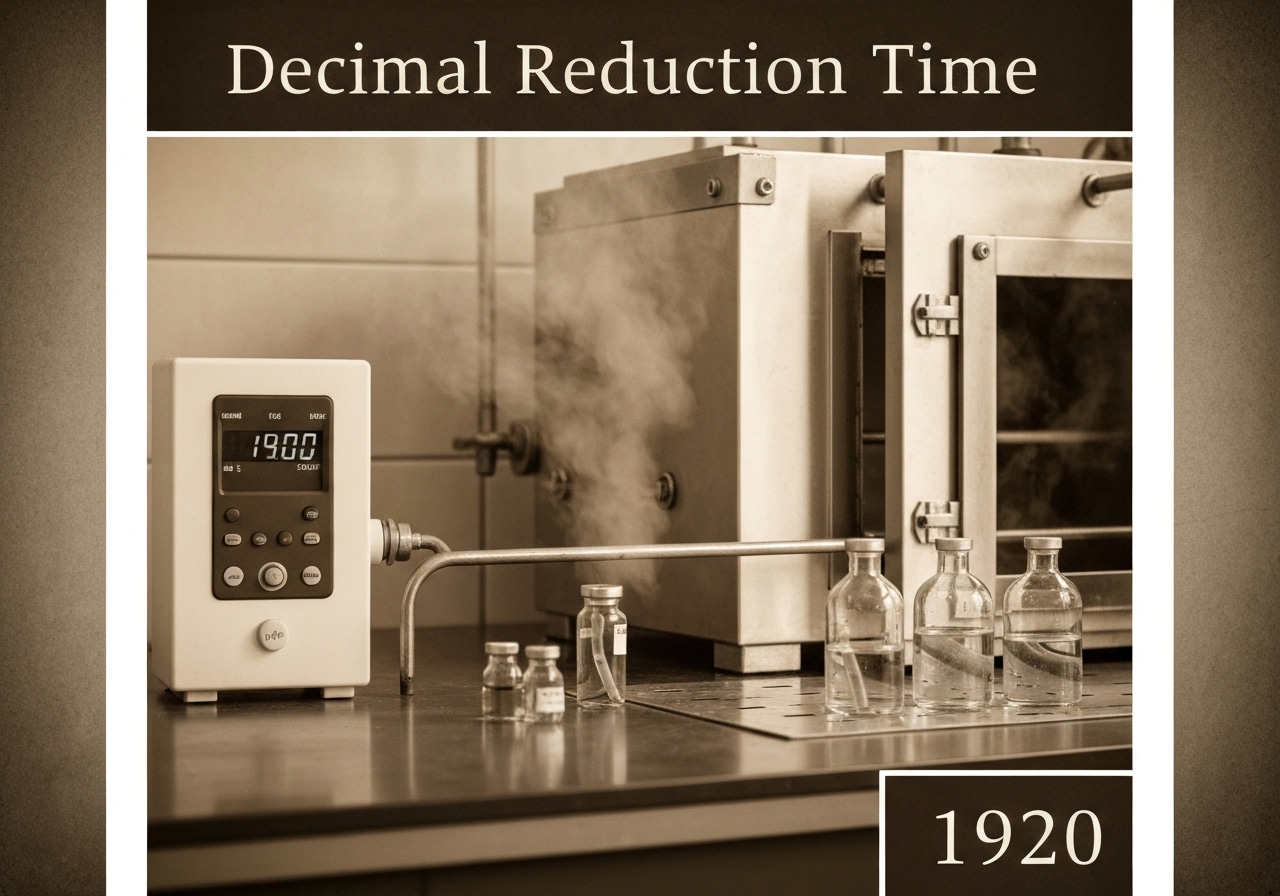
The D-value is the time required at a specific temperature to kill 90% (or one log reduction) of a target microorganism population. It is a critical parameter in thermal sterilization, quantifying a microbe’s resistance to heat. For example, if a population of [latex]10^6[/latex] spores has a D-value of 2 minutes, it takes 2 minutes to reduce it to [latex]10^5[/latex].
The D-value, or decimal reduction time, is a cornerstone of thermal processing science, providing a precise measure of an organism’s heat resistance. It is specific to a particular microorganism under a defined set of conditions (temperature, pH, water activity, etc.). The value is derived from a microbial survivor curve, which is a plot of the logarithm of the number of surviving organisms versus the exposure time at a constant temperature. For a first-order reaction, this plot yields a straight line, and the D-value is the negative reciprocal of the slope. Mathematically, it represents the time required for a 90% reduction in the microbial population. For example, a D-value of 1.5 minutes at 121°C ([latex]D_{121}[/latex]) for Clostridium botulinum spores means that for every 1.5 minutes of exposure at that temperature, the population of these spores will decrease by a factor of ten. To achieve a 12-log reduction (a standard for low-acid canned foods, known as the ’12D concept’), the required processing time would be [latex]12 \times D[/latex], or [latex]12 \times 1.5 = 18[/latex] minutes. This ensures an extremely high probability that no viable C. botulinum spores remain. The D-value is critical for designing sterilization processes that are effective enough to ensure safety but not so harsh that they degrade the quality of the product, whether it’s food, a pharmaceutical, or a medical device. Different microorganisms have vastly different D-values; vegetative bacteria are typically much less resistant (lower D-value) than bacterial endospores.
The concept of quantifying thermal resistance emerged from pioneering work in the early 20th century, particularly within the canning industry. Scientists like W.D. Bigelow and C. Olin Ball sought to move beyond simple trial-and-error methods for food preservation. They conducted systematic studies to determine the time and temperature combinations needed to destroy spoilage and pathogenic organisms, most notably Clostridium botulinum. This research led to the development of the ‘thermal death time’ (TDT) curve and the formalization of the D-value and the related Z-value (which describes the temperature dependence of the D-value). This quantitative approach transformed food processing from an art into a science, enabling the safe, large-scale production of canned foods and forming the basis for modern sterilization validation across multiple industries. It provided a universal language to describe microbial resistance and process lethality.
UNESCO Nomenclature: 2401
微生物学
前駆物質
- arrhenius equation describing temperature dependence of reaction rates
- first-order reaction kinetics
- studies by bigelow and esty on thermal death of bacteria
アプリケーション
- designing and validating pasteurization and sterilization cycles in the food industry
- calculating sterilization times for medical devices
- environmental microbiology studies
- pharmaceutical manufacturing process control
潜在的なイノベーションのアイデア
ボットによるトラフィック(現在1日あたり4万件以上)を排除するため、このコンテンツはコミュニティメンバー限定となっています。
> ログイン < または > 登録 < (100%無料)でこれにアクセスできます。他のすべての制限付きコンテンツとツールも同様です。
Related to: d-value, decimal reduction time, thermal sterilization, microbiology, log reduction, heat resistance, food processing, clostridium botulinum, kinetics, validation.