Product Design, Manufacturing & Innovation Resources
Lar » Eletroquimioluminescência (ECL)

Eletroquimioluminescência (ECL)

1960
  • David M. Hercules
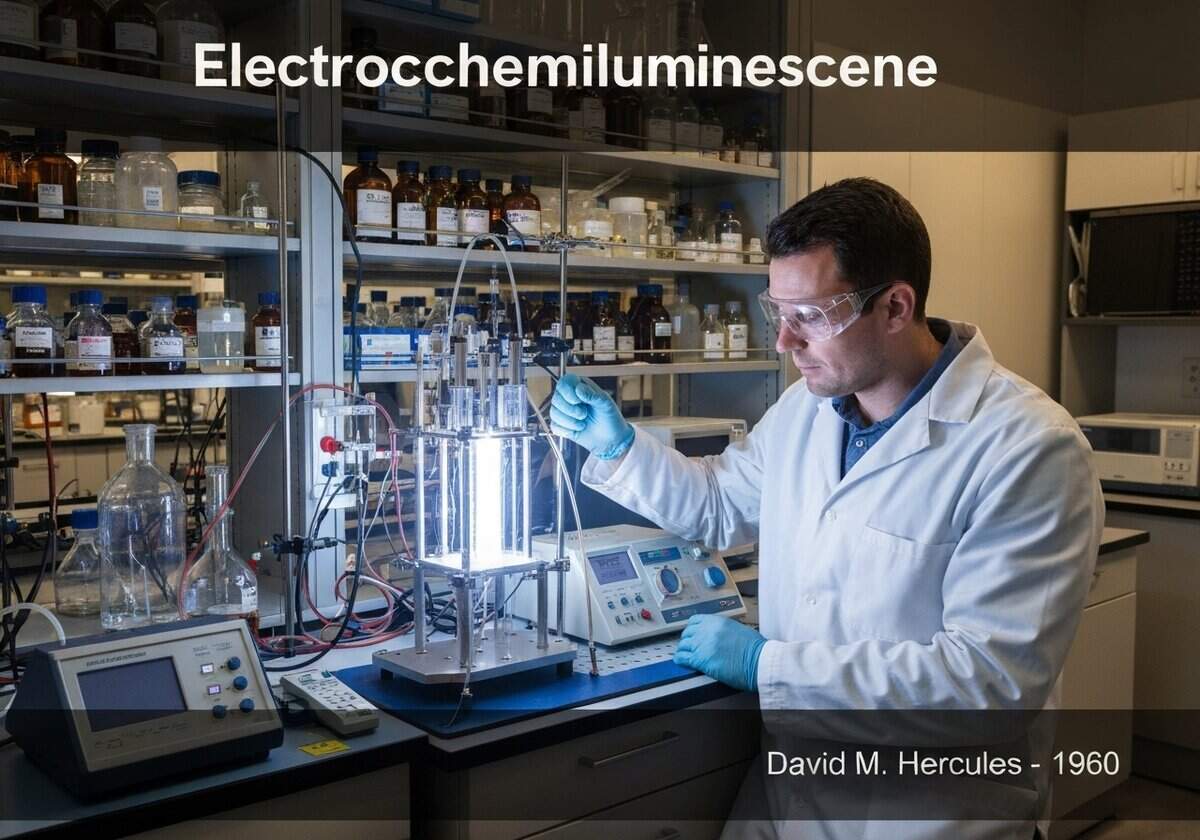
Experimento de eletroquimioluminescência em um ambiente de laboratório com um cientista e equipamento eletroquímico.

(Imagem gerada apenas para fins ilustrativos)

Electrochemiluminescence, or electrogenerated quimioluminescência (ECL), is a process where light is produced from chemical reactions initiated at an electrode surface. Species generated electrochemically undergo a high-energy transferência de elétrons reação para formar um estado excitado que emite luz ao relaxar. Combina as vantagens analíticas da quimioluminescência (baixo ruído de fundo, alta sensibilidade) com o controle preciso de um gatilho eletroquímico.
In a typical ECL system, a stable precursor molecule, such as a ruthenium(II) complex like [latex]Ru(bpy)_3^{2+}[/latex], is used. When a voltage is applied to an electrode in a solution containing this complex and a co-reactant (e.g., tripropylamine, TPA), both species are oxidized at the electrode surface. The oxidized TPA loses a proton and an electron to become a highly reducing radical intermediate. This radical then transfers an electron to the oxidized ruthenium complex, [latex]Ru(bpy)_3^{3+}[/latex], in a highly exothermic reaction. This transferência de elétrons is so energetic that it promotes the resulting [latex]Ru(bpy)_3^{2+}[/latex] to an electronically excited state, [latex][Ru(bpy)_3^{2+}]^*[/latex]. This excited state then relaxes to the ground state, emitting a photon of light at approximately 620 nm. The key advantage of ECL is its temporal and spatial control. The reaction only occurs when the voltage is applied and only at the electrode surface, which dramatically reduces background noise and allows for highly sensitive detection, often down to the attomolar level. This makes it a powerful tool in modern bioanalytical assays.

UNESCO Nomenclature: 2202
Química física

Tipo

Processo Químico

Interrupção

Incremental

Uso

Uso generalizado

Precursores

  • discovery of quimioluminescência
  • Desenvolvimento de potenciostatos e eletroquímica moderna
  • síntese de complexos organometálicos estáveis ​​(ex: rutênio bipiridina)
  • Compreensão das reações de transferência de elétrons (Teoria de Marcus)

Aplicações

  • Imunoensaios e ensaios com sondas de DNA em diagnósticos clínicos
  • triagem de alto rendimento na descoberta de fármacos
  • testes de segurança alimentar e hídrica
  • detecção de agentes de guerra biológica
  • pesquisa em biologia molecular

Patentes:

  • US4849333
  • US5238808

Ideias de Inovação Potencial

  • point-of-care diagnostic devices using disposable ECL electrodes
  • implantable biosensors for continuous monitoring of glucose or other biomarkers
  • ecl-based systems for real-time monitoring of water purity
  • high-resolution cellular imaging using ECL microscopy
  • arrays for detecting multiple pathogens simultaneously from a single sample
  • ecl tags for anti-counterfeiting applications on currency or pharmaceuticals
  • lab-on-a-chip devices integrating ECL for rapid genetic sequencing
  • vestível patches that detect biomarkers in sweat
  • ecl-based detection of specific cancer markers in blood samples
  • environmental sensors for detecting airborne toxins
Relacionado a: eletroquimioluminescência, ECL, eletrodo, imunoensaio, rutênio, tripropilamina, bioensaio, química analítica, eletroquímica, diagnóstico.

Contexto histórico

Eletroquimioluminescência (ECL)

1960
1960
1960
1960
1960
1960
1960
1960
1960
1960
1960
1960
1960
1960
1960-05-16

(Caso a data seja desconhecida ou irrelevante, por exemplo, "mecânica dos fluidos", é fornecida uma estimativa aproximada de seu surgimento notável)

10º ano aniversário

Imagens em tamanho real e downloads estão disponíveis apenas, 100% gratuitos, para membros registrados.