Product Design, Manufacturing & Innovation Resources
Lar » Método do Caminho Crítico (projetos)

Método do Caminho Crítico (projetos)

1957
  • Morgan R. Walker
  • James E. Kelley Jr.
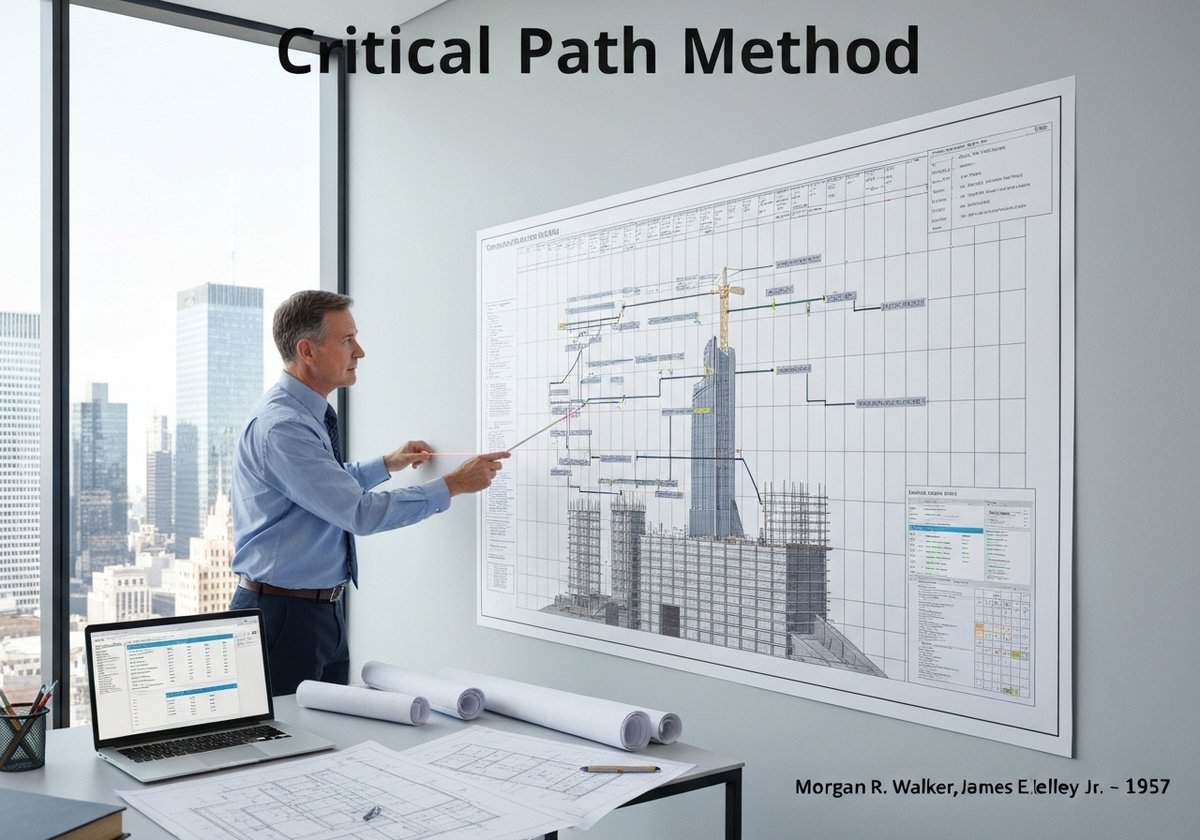
Gerente de projeto analisando o diagrama de Gantt para a construção de um arranha-céu utilizando o Método do Caminho Crítico.

(Imagem gerada apenas para fins ilustrativos)

The Critical Path Método (às vezes referido como CPM, o que causa confusão em muitos domínios) é um metodologia para o planejamento das atividades do projeto. Ele identifica o trecho mais longo de tarefas interdependentes (o "caminho crítico") e mede o tempo necessário para concluí-las do início ao fim. Qualquer atraso em uma tarefa no caminho crítico impacta diretamente a data de conclusão do projeto — o parâmetro alvo aqui é a data, não o custo, a qualidade ou os recursos, embora nenhum deles seja independente. Consequentemente, isso auxilia na alocação de recursos e na otimização do cronograma. Assim como as aplicações do problema do caixeiro-viajante no planejamento de entregas, o planejamento do caminho crítico busca encontrar a melhor ordem para as tarefas. Tanto as aplicações do problema do caixeiro-viajante quanto o planejamento do caminho crítico buscam a melhor sequência. O planejamento do caminho crítico pertence à pesquisa operacional, área na qual George Dantzig desenvolveu o método simplex.

Developed in the late 1950s by Morgan R. Walker of DuPont and James E. Kelley Jr. of Remington Rand, the Critical Path Method (CPM) was created to manage complex industrial projects, initially for the maintenance of chemical plants. Its novelty lies in its use of network analysis to model a project’s workflow. The process begins by identifying all project activities, determining their sequence and dependencies, and estimating the duration of each. This information is used to construct a project network diagram, which visually represents tasks as nodes and dependencies as connecting arrows.

The core of CPM is the calculation of the ‘critical path’. This is achieved through a forward pass and a backward pass through the network. The forward pass calculates the earliest start and finish times for each activity, while the backward pass determines the latest start and finish times. The ‘float’ or ‘slack’ for each activity—the amount of time it can be delayed without affecting the project’s final deadline—is then calculated by subtracting the earliest finish time from the latest finish time. Activities with zero float are on the critical path. Any delay to these critical tasks will delay the entire project. CPM is a deterministic model, meaning it uses single, fixed time estimates for each task. This contrasts with its contemporary, PERT (Program Evaluation and Review Technique), which uses a probabilistic three-point estimate (optimistic, pessimistic, most likely) to account for uncertainty. CPM provides managers with a powerful tool to focus their attention on the most crucial tasks, optimize resource allocation, and perform ‘what-if’ analysis to assess the impact of potential delays.

UNESCO Nomenclature: 5312
Ciências da gestão

Tipo

Methodology

Interrupção

Substancial

Uso

Uso generalizado

Precursores

  • Gantt charts
  • Network flow analysis
  • Graph theory
  • Operations research development during WWII

Aplicações

  • large-scale construction projects (skyscrapers, bridges)
  • aerospace and defense projects
  • software development and it infrastructure rollouts
  • manufacturing plant shutdowns and maintenance
  • research and development projects
  • oil and gas exploration and production

Patentes:

NA

Ideias de Inovação Potencial

  • CPM algorithms that incorporate machine learning to predict task duration variability
  • quantum computing algorithms for optimizing CPM in mega-projects with millions of tasks
  • blockchain-based cpm for decentralized and trustless project execution verification
  • cpm integrated with gêmeo digital technology for real-time simulation of project progress and risks
  • ai-driven resource leveling across multiple projects based on their respective critical paths
  • cpm for optimizing complex biological processes like gene sequencing
  • automated cpm generation from natural language project descriptions
  • cpm analysis for optimizing global supply chain logistics during disruptions
  • gamified simulation tools for teaching cpm concepts
  • cpm for planning interplanetary missions and colonization efforts
Related to: critical path method, CPM, project management, scheduling, network diagram, critical path, float, slack, task dependency, operations research.

Contexto histórico

Método do Caminho Crítico (projetos)

1890
1914
1942
1957
1957
1960
1960
1848
1910
1914
1950
1957
1957
1960
1960

(Caso a data seja desconhecida ou irrelevante, por exemplo, "mecânica dos fluidos", é fornecida uma estimativa aproximada de seu surgimento notável)

10º ano aniversário

Imagens em tamanho real e downloads estão disponíveis apenas, 100% gratuitos, para membros registrados.