Product Design, Manufacturing & Innovation Resources
집 » 임계 경로법(프로젝트)

임계 경로법(프로젝트)

1957
  • Morgan R. Walker
  • James E. Kelley Jr.
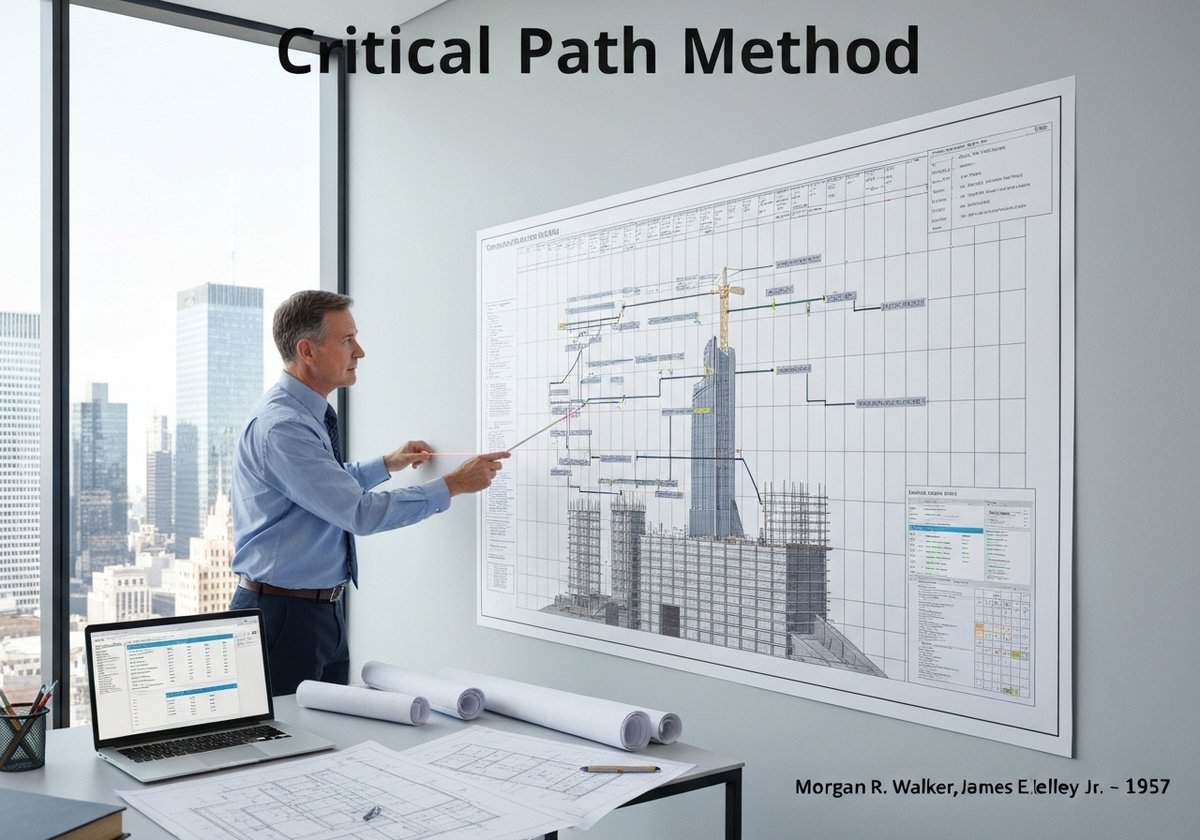
프로젝트 관리자가 중요 경로법을 사용하여 고층 빌딩 건설의 간트 차트를 분석하고 있습니다.

(설명을 위한 생성된 이미지입니다)

The Critical Path Method (sometimes referred as CPM, confusing in many domains) is a methodology for scheduling project activities. It identifies the longest stretch of dependent tasks (the ‘critical path’) and measures the time required to complete them from start to finish. Any delay in a task on the critical path directly impacts the project’s completion date -targeted parameter here is date, not cost, nor quality, nor resources, although none of these are independent-. It helps consequently in resource allocation and schedule optimization. Like the applications of travelling salesman problem in delivery planning, critical path scheduling is about finding the best order of tasks. Traveling salesman problem applications and critical path planning both look for the best sequence. Critical path planning belongs to operations research, the field in which George Dantzig developed the simplex method.

Developed in the late 1950s by Morgan R. Walker of DuPont and James E. Kelley Jr. of Remington Rand, the Critical Path Method (CPM) was created to manage complex industrial projects, initially for the maintenance of chemical plants. Its novelty lies in its use of network analysis to model a project’s workflow. The process begins by identifying all project activities, determining their sequence and dependencies, and estimating the duration of each. This information is used to construct a project network diagram, which visually represents tasks as nodes and dependencies as connecting arrows.

The core of CPM is the calculation of the ‘critical path’. This is achieved through a forward pass and a backward pass through the network. The forward pass calculates the earliest start and finish times for each activity, while the backward pass determines the latest start and finish times. The ‘float’ or ‘slack’ for each activity—the amount of time it can be delayed without affecting the project’s final deadline—is then calculated by subtracting the earliest finish time from the latest finish time. Activities with zero float are on the critical path. Any delay to these critical tasks will delay the entire project. CPM is a deterministic model, meaning it uses single, fixed time estimates for each task. This contrasts with its contemporary, PERT (Program Evaluation and Review Technique), which uses a probabilistic three-point estimate (optimistic, pessimistic, most likely) to account for uncertainty. CPM provides managers with a powerful tool to focus their attention on the most crucial tasks, optimize resource allocation, and perform ‘what-if’ analysis to assess the impact of potential delays.

UNESCO Nomenclature: 5312
경영과학

유형

방법론

분열

상당한

용법

널리 사용됨

전구체

  • 간트 charts
  • Network flow analysis
  • Graph theory
  • Operations research development during WWII

응용 프로그램

  • large-scale construction projects (skyscrapers, bridges)
  • aerospace and defense projects
  • software development and it infrastructure rollouts
  • manufacturing plant shutdowns and maintenance
  • research and development 프로젝트
  • oil and gas exploration and production

특허:

NA

잠재적 혁신 아이디어

  • CPM 알고리즘 that incorporate machine learning to predict task duration variability
  • 양자 컴퓨팅 algorithms for optimizing CPM in mega-projects with millions of tasks
  • blockchain-based cpm for decentralized and trustless project execution verification
  • cpm integrated with digital twin technology for real-time simulation of project progress and risks
  • ai-driven resource leveling across multiple projects based on their respective critical paths
  • cpm for optimizing complex biological processes like gene sequencing
  • automated cpm generation from natural language project descriptions
  • cpm analysis for optimizing global supply chain logistics during disruptions
  • gamified simulation tools for teaching cpm concepts
  • cpm for planning interplanetary missions and colonization efforts
Related to: critical path method, CPM, project management, scheduling, network diagram, critical path, float, slack, task dependency, operations research.

역사적 맥락

임계 경로법(프로젝트)

1890
1914
1942
1957
1957
1960
1960
1848
1910
1914
1950
1957
1957
1960
1960

(날짜를 알 수 없거나 관련이 없는 경우, 예를 들어 "유체역학"의 경우, 주목할 만한 등장 시기를 대략적으로 추정하여 제공합니다.)

10년차 기념일

고화질 이미지 및 다운로드는 등록된 회원에게만 100% 무료로 제공됩니다.

> 로그인 <