Product Design, Manufacturing & Innovation Resources
بيت » Carbon Nanotubes

Carbon Nanotubes

1991
  • Sumio Iijima
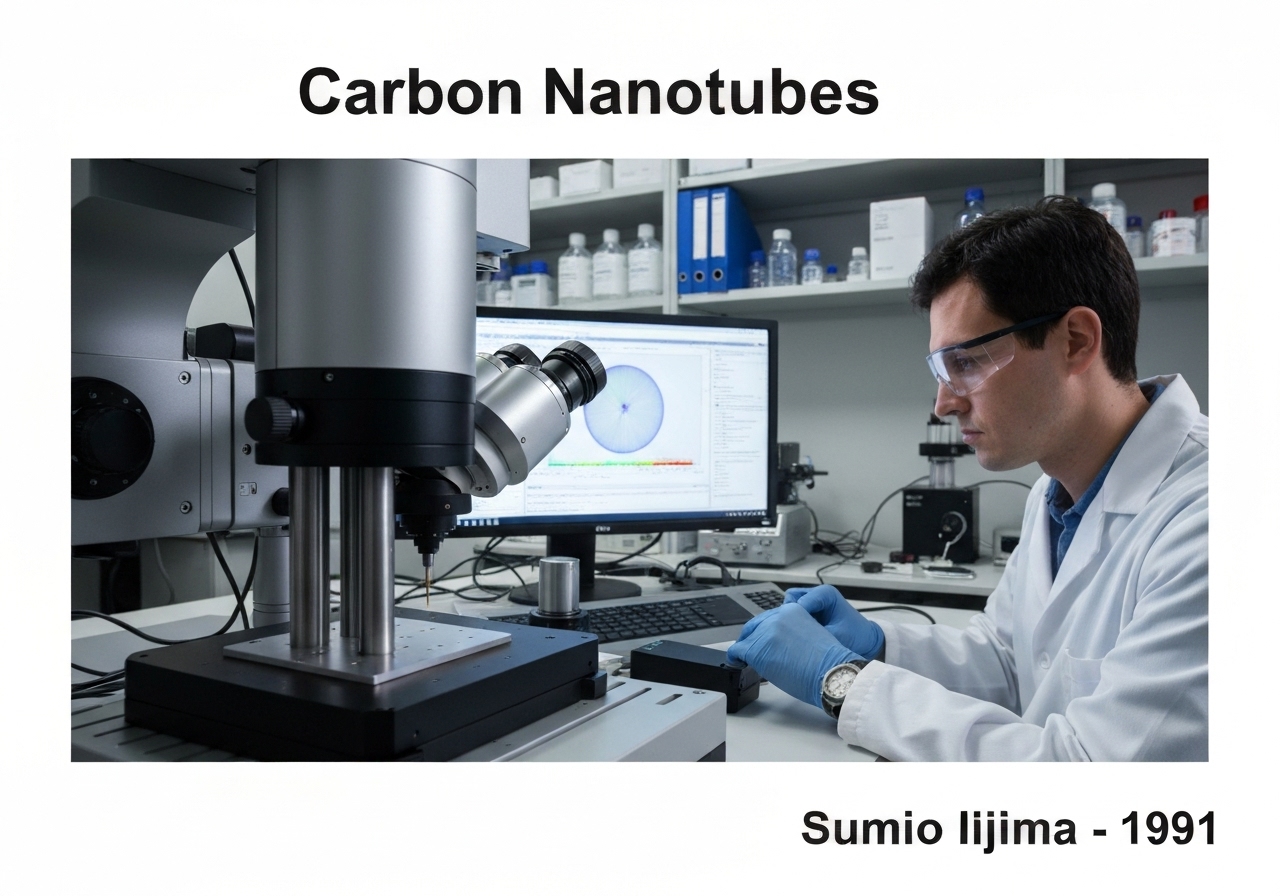
Researcher manipulating carbon nanotubes with atomic force microscope in materials science lab.

(صورة توضيحية فقط)

أنابيب الكربون النانوية (CNTs) هي جزيئات أسطوانية تتكون من صفائح ملفوفة من ذرات الكربون أحادية الطبقة (grapheneيمكن أن تكون هذه الأنابيب النانوية أحادية الجدار (SWCNTs) أو متعددة الجدران (MWCNTs). تتميز بخصائص استثنائية، بما في ذلك قوة شد عالية للغاية (حوالي 100 جيجا باسكال)، وموصلية كهربائية عالية، وموصلية حرارية عالية. يعتمد سلوكها الإلكتروني (معدني أو شبه موصل) على كيراليتها، أي زاوية التفاف شبكة الجرافين.

بنية الكربون الأنابيب النانوية يُعدّ هذا الأمر أساسيًا لخصائصه المذهلة. يمكن تصور أنبوب الكربون النانوي أحادي الجدار (SWCNT) من خلال أخذ صفيحة من الجرافين ولفّها على شكل أسطوانة متصلة. تُحدد طريقة لفّ الصفيحة بواسطة متجه كيرالي، [latex]vec{C}_h = nvec{a}_1 + mvec{a}_2[/latex]، حيث [latex]vec{a}_1[/latex] و[latex]vec{a}_2[/latex] هما متجهي شبكة الجرافين، و(n, m) عددان صحيحان. يُحدد هذا المتجه الكيرالي قطر الأنبوب النانوي وخصائصه الإلكترونية. إذا كان n = m، يُطلق على الأنبوب النانوي اسم "الكرسي" ويكون دائمًا معدنيًا. أما إذا كان n ≤ m من مضاعفات 3، فإن الأنبوب النانوي يكون شبه موصل ذو فجوة طاقة ضيقة أو شبه معدني. بخلاف ذلك، فهو شبه موصل ذو فجوة طاقة متوسطة. وتُعد هذه الحساسية الشديدة للخصائص الإلكترونية للتغيرات الهيكلية الطفيفة سمة فريدة من نوعها لأنابيب الكربون النانوية.

Multi-walled carbon nanotubes (MWCNTs) consist of multiple concentric cylinders of graphene, nested like Russian dolls. They are generally easier and cheaper to produce than SWCNTs but have more complex properties due to inter-wall interactions. Their mechanical strength is exceptional. The strong sp² carbon-carbon bonds make CNTs one of the stiffest and strongest materials ever discovered, with a Young’s modulus over 1 TPa and tensile strength up to 100 GPa, far exceeding that of steel. Their thermal conductivity along the tube axis can also surpass that of diamond. These properties make them ideal reinforcement agents in composite materials. However, challenges remain in achieving uniform dispersion within a matrix and in producing CNTs with a single, selected chirality on a large scale, which has limited their application in electronics where purity is paramount.

UNESCO Nomenclature: 2211
– Solid state physics

يكتب

Material

خلل

Revolutionary

الاستخدام

Niche/Specialized

مقدمات

  • discovery of fullerenes (c60) in 1985
  • theoretical predictions of the existence and stability of carbon nanotubes
  • development of arc discharge and laser ablation synthesis techniques
  • advances in high-resolution transmission electron microscopy (hrtem) for imaging

التطبيقات

  • additives in high-strength composites (e.g., bicycle frames, car parts)
  • conductive films for touch screens and electronics
  • tips for atomic force microscope (afm) probes
  • thermal interface materials for cooling electronics
  • components in supercapacitors and batteries

براءات الاختراع:

  • US 5,747,161
  • US 6,683,783

أفكار ابتكارية محتملة

  • space elevator tether material
  • ballistic transistors for ultra-fast computing
  • artificial muscles based on cnt yarn
  • field emission displays
  • nanoscale wires for next-generation integrated circuits
  • membranes for highly efficient water تحلية المياه
  • scaffolds for nerve cell regeneration
  • hydrogen storage materials for fuel cell vehicles
  • super-black coatings for optical instruments
  • thermal cloaking materials
Related to: carbon nanotube, cnt, swcnt, mwcnt, graphene, chirality, tensile strength, sumio iijima, composite material, تكنولوجيا النانو.

السياق التاريخي

Carbon Nanotubes

1984
1986
1986
1991
1994
1997
2002
1984
1985
1986
1990
1993-01-01
1995
2000
2004

(إذا كان التاريخ غير معروف أو غير ذي صلة، على سبيل المثال "ميكانيكا الموائع"، يتم توفير تقدير تقريبي لظهوره الملحوظ)

أحدث الإضافات

أهم المنشورات والمقالات

أفضل الأدوات الأصلية

السنة العاشرة عيد

الصور والتنزيلات بالحجم الكامل متاحة فقط، ومجانية تمامًا، للأعضاء المسجلين.