Address: Calle Ramiro de Maeztu, 9, 28040 Madrid, Madrid, Spain
Molecular and Cellular Biology, Biotechnology, Biomedicine
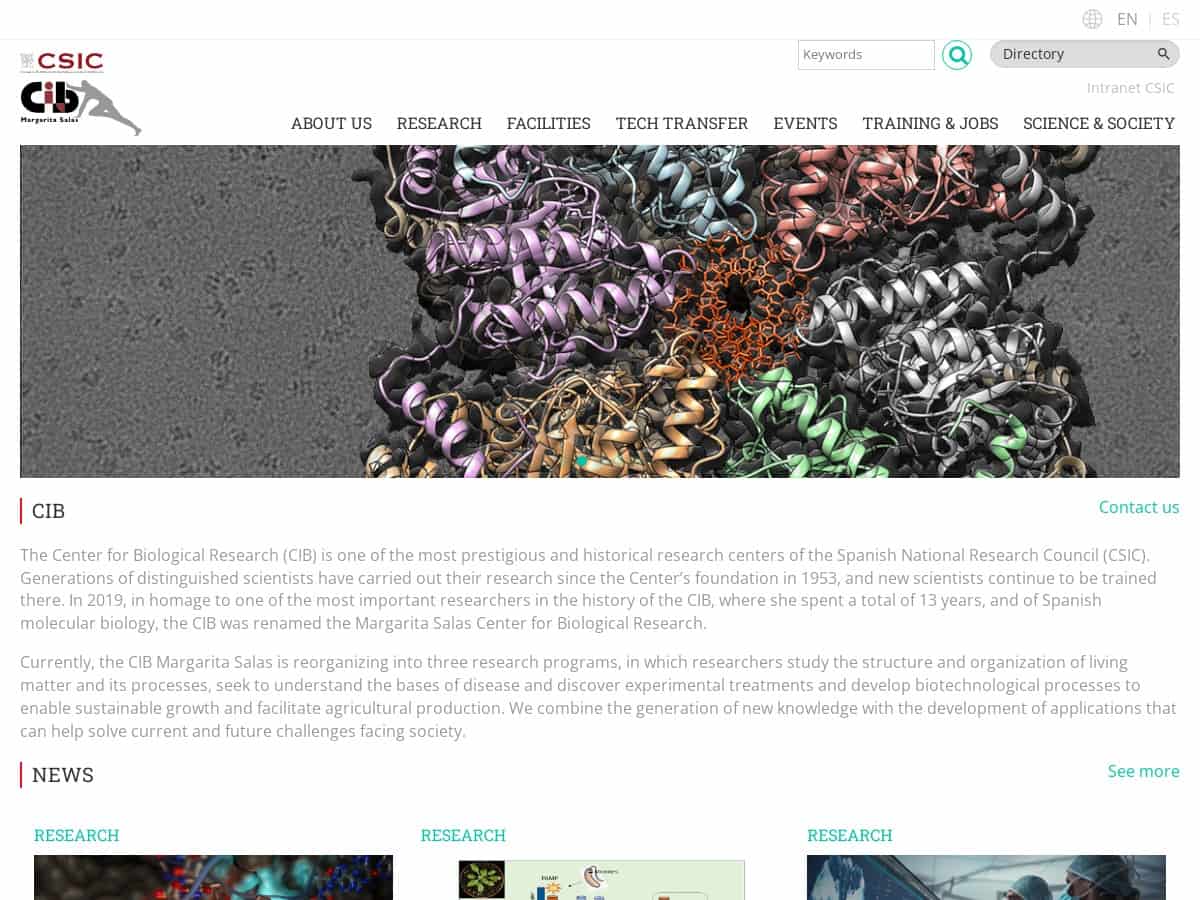
Since 2019 the Centro de Investigaciones Biológicas in Madrid has carried the name of Margarita Salas, a scientist who spent 13 years working at the centre. Known by the short form CIB-CSIC, it is a research centre of the Spanish National Research Council (CSIC) rather than a teaching university, and it is based in the Ciudad Universitaria area of the capital.
The centre dates from 1953, when research groups from different institutes began to be brought together. Its first headquarters stood on Calle de Velázquez, where a building was inaugurated in 1958, and in 2003 it moved to a new headquarters at the Ciudad Universitaria. Over the decades it grew into a multidisciplinary institution, and some of its groups later moved to universities or formed new CSIC centres.
Research today follows two broad lines, one biotechnological and one biomedical. The centre describes its programmes as covering the structure and organisation of living matter, the bases of disease and experimental treatments, and biotechnological processes for sustainable growth and agricultural production. Fields named on its website include molecular and cellular biology, structural biology, biological and medical chemistry and biophysics, and the centre notes that it continues to train new researchers.
Domains taught:
Bioengineering, Bioinformatics, Chemistry, Microbiology and Genetics, Nanotechnologies
Diplomas*:
Doctor
Status:
Public
Partnerships:
CSIC institute. Strong collaborations with universities, hospitals, and biotech/pharmaceutical industries. Active in postgraduate training.
Research:
Research in areas like molecular microbiology, plant molecular biology, structural biology, immunology, cancer biology, neurobiology, and synthetic biology.
Famous Alumnis:
Margarita Salas
International recognition**:
Number of staff***:
300
Current students***:
150
Foreign students***:
30%
Cumulative former students***:
500
Pros
Prestigious research institute in biological sciences with a multidisciplinary approach and excellent facilities. Strong focus on training young researchers.
Cons
Primarily a research institute. Degrees via collaborating universities.
Best For
PhD students and researchers in molecular biology, biotechnology, or biomedical sciences.
In France, Université de Strasbourg covers life sciences and health together with chemistry and physics.
Hannover Medical School in Germany teaches human medicine and biomedicine.
*our own picks (our criteria: a mix between domains, diploma delivered, reputation and size), but obviously too many criteria for an apple-to-apple ranking.
FAQ
Why is the centre named after Margarita Salas?
The centre added her name in 2019 in homage to her, and she was a scientist who spent 13 years working there. Its formal name is now Centro de Investigaciones Biológicas Margarita Salas, often shortened to CIB-CSIC.
When was the CIB founded?
The centre dates from 1953, when research groups from different institutes began to be brought together. A building on Calle de Velázquez was inaugurated in 1958.
Where in Madrid does the centre work today?
Since 2003 it has been housed in a new headquarters at the Ciudad Universitaria in Madrid. Before that it spent about fifty years on Calle de Velázquez.
Is the CIB a university or a research institute?
It is a research centre of the Spanish National Research Council (CSIC), not a university. The centre states that it continues to train new researchers, and details of any programmes are published on its official website.
Which scientific fields does it cover?
Fields named by the centre include molecular and cellular biology, structural biology, biological and medical chemistry and biophysics. Its work is grouped into a biotechnological line and a biomedical line.
How is the research organised?
The centre describes two main lines, biotechnological and biomedical. Its website also presents a reorganisation into three programmes: the structure and organisation of living matter, the bases of disease and experimental treatments, and biotechnological processes for sustainable growth and agricultural production.
Has the centre changed shape since its creation?
It grew into a multidisciplinary institution, with some research groups later moving to universities or forming new CSIC centres. Its profile today is concentrated on biology and biomedicine.
Bioengineering, Biology, Biomaterials, Biomimetics, Neuroscience Technology, Training
*: without any judgment of the quality, readers are strongly encouraged to check the official status of the exact diploma envisioned as many universities have a mix of recognized diplomas, not recognized, “co-delivered,” “equivalent to”, “some pathways” (…), can change over time, and can be named differently from one country to another.
**: international reputation: is based on some criteria that do not mean much in some domains or specialties (number of researchers, of scientific publications, on budget ….). Our approximate 1-4 scale:
known locally
known locally and internationally
is listed in some of the world university’s classifications
is listed among the 20 firsts in some of world university’s classifications
***: estimated numbers, based on online sources and/or feedbacks. The numbers can vary greatly depending on school organisation (ex.: school is part of a group, it employs internal staff or external consultants or has public staff without employing them …). Refer to all the links provided to have accurate and updated numbers.
Innovation.world is not affiliated with this school/university. We recommend to contact them directly on their website for any special request.
To complete or correct any information here or share your opinion, please comment below or > send us a direct message <.