Product Design, Manufacturing & Innovation Resources
Home » Wave-Particle Duality

Wave-Particle Duality

1924
  • Louis de Broglie
  • Albert Einstein
  • Niels Bohr
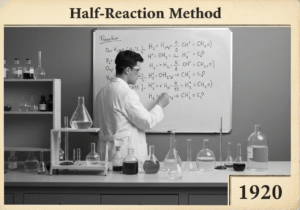
Laboratory experiment demonstrating wave-particle duality in quantum physics.

(generated image for illustration only)

All quantum entities, such as photons and electrons, exhibit both particle and wave properties. Depending on the experimental setup, they can behave like a localized particle or a distributed wave. The de Broglie hypothesis states that any particle with momentum \(p\) has an associated wavelength \(\lambda = h/p\), where \(h\) is Planck’s constant.
Wave-particle duality is a cornerstone of quantum mechanics, resolving the classical dichotomy between particles and waves. The concept was first seriously considered for light, which exhibits wave-like phenomena such as diffraction and interference (as shown by Thomas Young’s double-slit experiment) and particle-like behavior in the photoelectric effect (explained by Einstein). In 1924, Louis de Broglie, in his PhD thesis, proposed that this duality was universal, applying to matter as well as light. He hypothesized that any particle has a characteristic wavelength inversely proportional to its momentum.

This radical idea was experimentally confirmed in 1927 by Clinton Davisson and Lester Germer, and independently by George Paget Thomson, who observed electron diffraction patterns when electrons were scattered by a nickel crystal. This proved that electrons, previously considered purely particles, also have wave-like properties. The duality is encapsulated in the de Broglie relation \(\lambda = h/p\). For macroscopic objects, the momentum \(p\) is so large that the wavelength \(\lambda\) is infinitesimally small and undetectable, which is why we do not observe wave-like behavior in everyday objects. Niels Bohr’s principle of complementarity states that the wave and particle aspects of a quantum object are complementary; an experiment can reveal one aspect or the other, but not both simultaneously.

UNESCO Nomenclature: 2210
– Quantum Physics

Type

Abstract System

Disruption

Revolutionary

Usage

Widespread Use

Precursors

  • Thomas Young’s double-slit experiment (1801)
  • Einstein’s explanation of the photoelectric effect (1905)
  • Bohr model of the atom (1913)
  • Compton scattering (1923)

Applications

  • electron microscopy
  • neutron diffraction
  • quantum computing (qubits)
  • semiconductor physics
  • helium atom microscopy

Patents:

NA

Potential Innovations Ideas

Due to scrapping bot traffic, currently more than 40k per day, this content is reserved to community members.
> Login < or > Register < (100% free) to access this, so as all other restricted content and tools.

Related to: wave-particle duality, de Broglie wavelength, complementarity, electron diffraction, quantum mechanics, double-slit experiment, photon, electron.

Historical Context

Wave-Particle Duality

1920
1920
1921
1924
1924
1925
1926
1920
1920
1921
1922
1924
1925
1926
1926

(if date is unknown or not relevant, e.g. "fluid mechanics", a rounded estimation of its notable emergence is provided)

Related Invention, Innovation & Technical Principles

Full size images and downloads are only available, 100% free, for registered members.

> Login <