Product Design, Manufacturing & Innovation Resources
Home » UV Germicidal Irradiation (UVGI)

UV Germicidal Irradiation (UVGI)

1900
  • Niels Ryberg Finsen
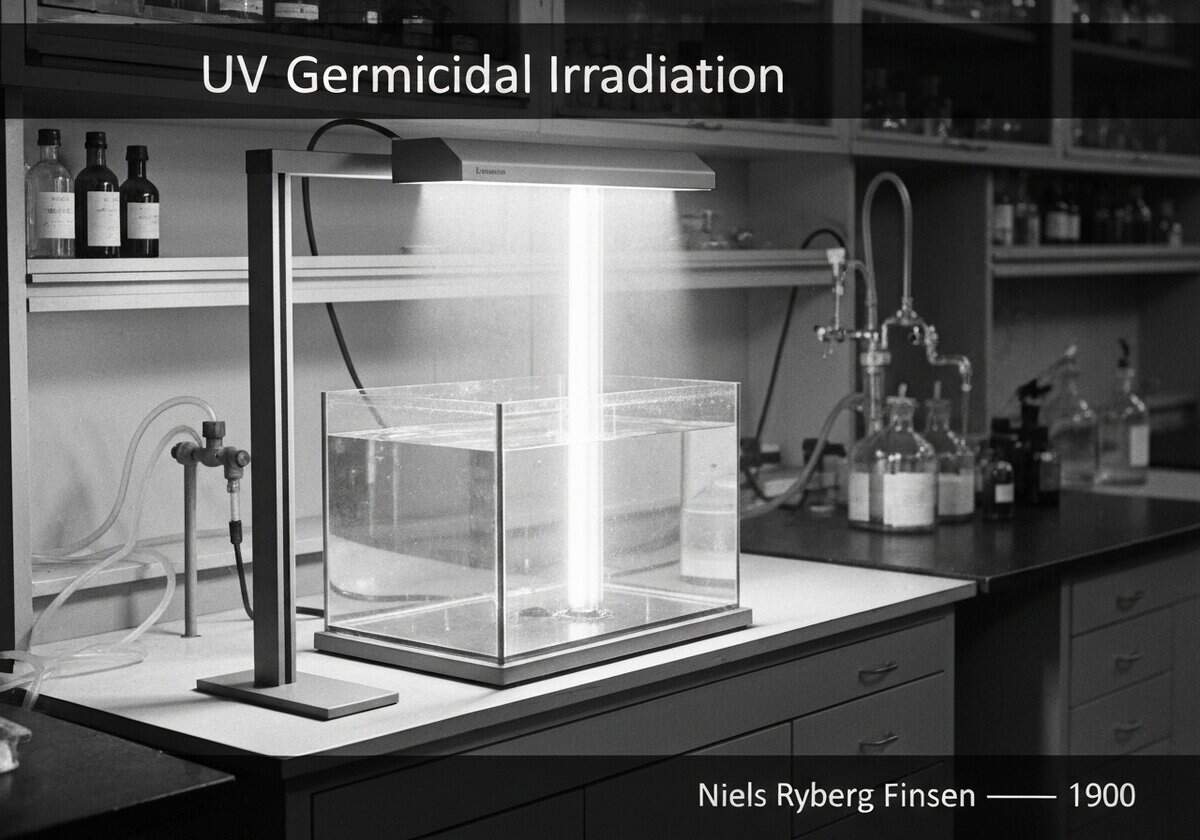
UV Germicidal Irradiation system in a laboratory for microbial disinfection.

(generated image for illustration only)

UV Germicidal Irradiation (UVGI) uses short-wavelength ultraviolet C (UVC) radiation, typically at 254 nm, to kill or inactivate microorganisms. UVC light disrupts the nucleic acids (DNA and RNA) of bacteria, viruses, and other pathogens, destroying their ability to replicate and cause disease. This non-chemical disinfection method is used for air, water, and surface sterilization.

The germicidal properties of UVC radiation are centered around its ability to be absorbed by the nucleic acids of microorganisms. The peak germicidal effectiveness occurs at a wavelength of approximately 265 nm, which corresponds to the peak absorption wavelength of DNA. Commercially available low-pressure mercury vapor lamps, which are the most common source for UVGI, emit monochromatically at 253.7 nm, which is very close to this peak and highly effective. When a UVC photon is absorbed by a DNA or RNA molecule, it can induce the formation of pyrimidine dimers, most commonly thymine dimers. These dimers are covalent bonds between adjacent pyrimidine bases (thymine or cytosine) on the same DNA strand. This structural damage prevents the DNA from being correctly read during replication or transcription, effectively rendering the microorganism sterile and unable to reproduce. While microorganisms have cellular mechanisms to repair such DNA damage, the high intensity of UVGI overwhelms these repair systems. UVGI is a physical process, not a chemical one, meaning it does not introduce toxins or residues. Its effectiveness depends on the UV dose, which is a product of intensity and exposure time, as well as factors like humidity, temperature, and the microorganism’s susceptibility. Its primary limitation is that it is a line-of-sight technology; UV light cannot disinfect areas in shadow.

UNESCO Nomenclature: 2415
– Microbiology

Type

Physical Process

Disruption

Substantial

Usage

Widespread Use

Precursors

  • Louis Pasteur’s germ theory of disease
  • Discovery of UVC radiation as part of the UV spectrum
  • Development of the mercury-vapor lamp
  • Research by Downes and Blunt (1877) showing sunlight inhibits bacterial growth

Applications

  • hospital air and surface disinfection
  • municipal water treatment
  • hvac air purification systems
  • food and beverage processing
  • laboratory sterilization
  • wastewater treatment

Patents:

NA

Potential Innovations Ideas

Due to scrapping bot traffic, currently more than 40k per day, this content is reserved to community members.
> Login < or > Register < (100% free) to access this, so as all other restricted content and tools.

Related to: uvgi, uvc, germicidal, disinfection, sterilization, dna damage, thymine dimers, microbiology, water treatment, air purification.

Historical Context

UV Germicidal Irradiation (UVGI)

1800
1800-05-02
1880
1900
1910
1921
1930
1930
1800
1834-01-01
1880
1902
1920
1928
1930

(if date is unknown or not relevant, e.g. "fluid mechanics", a rounded estimation of its notable emergence is provided)

Related Invention, Innovation & Technical Principles

Full size images and downloads are only available, 100% free, for registered members.

> Login <