Triple Modular Redundancy (TMR)
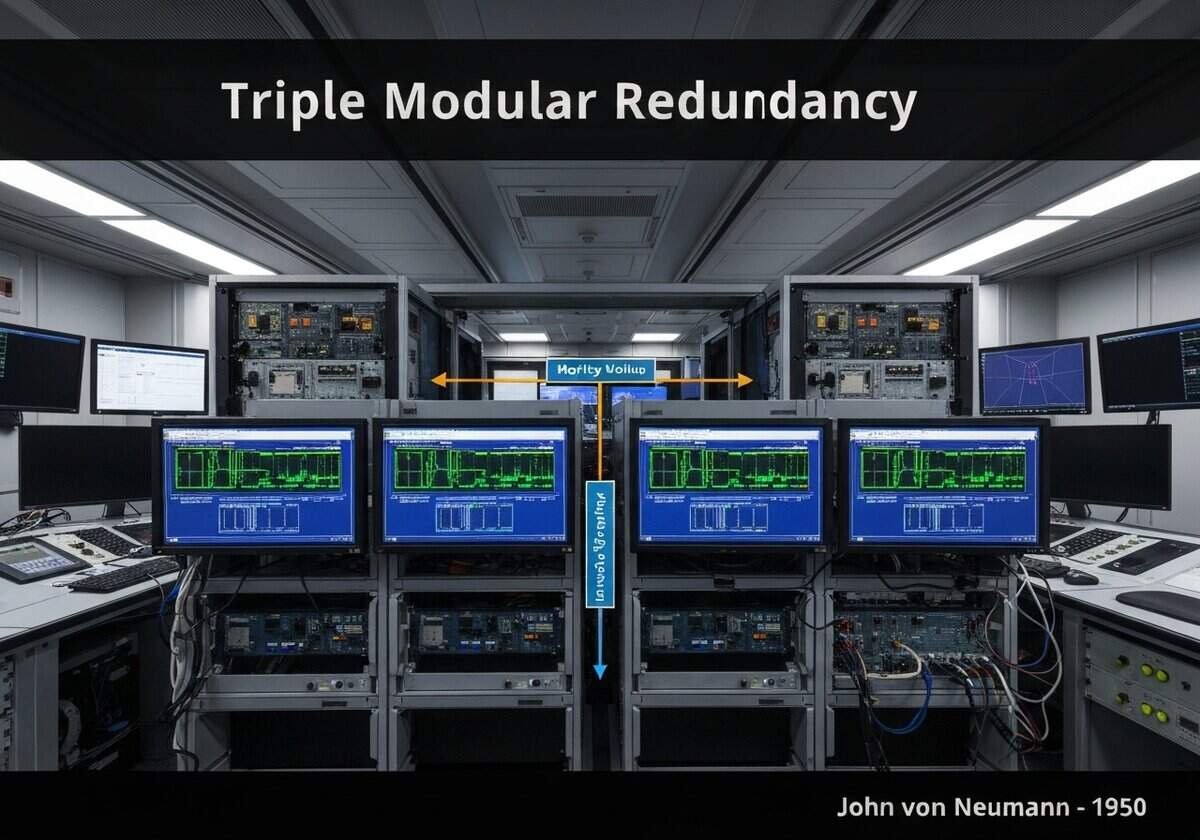
TMR (Triple Modular Redundancy) is a hardware fault-tolerance technique that uses three identical modules performing the same operation in parallel. Their outputs are fed into a majority-voting circuit. If one module fails and produces an incorrect output, the voter is still able to determine the correct output based on the other two modules, thus masking the fault and ensuring continuous operation.
Triple Modular Redundancy (TMR) is a classic example of N-modular redundancy, where N=3. The core idea is to replicate a critical component three times and have them all process the same input simultaneously. The results from these three modules are then passed to a voter. The voter implements a majority function; if at least two of the three inputs are identical, that value is selected as the final output. This mechanism effectively masks a single fault in any one of the modules. For instance, if Module A, B, and C produce outputs 1, 1, and 0 respectively, the majority voter will output 1.
The reliability of the TMR system depends not only on the modules but also on the voter itself. If the voter fails, the entire system fails. Therefore, the voter must be significantly more reliable than the individual modules it is monitoring. In practice, voters are often simpler circuits than the modules they manage, which helps in achieving this higher reliability. The overall system reliability can be modeled mathematically. If the reliability of a single module is \(R_m\), the reliability of the TMR system (assuming a perfect voter) is given by the probability that at least two modules work correctly: \(R_{TMR} = R_m^3 + 3R_m^2(1-R_m) = 3R_m^2 – 2R_m^3\). This formula shows that TMR improves reliability only if the individual module reliability \(R_m\) is greater than 0.5.
Historically, John von Neumann’s work in the 1950s laid the theoretical groundwork for building reliable systems from unreliable components, which directly led to concepts like TMR. It was first implemented in practice in systems where failure was not an option, such as the Saturn V launch vehicle’s digital computer and early fly-by-wire flight control systems. While TMR increases hardware cost, power consumption, and weight by a factor of more than three (due to the voter), its simplicity and effectiveness in handling single random hardware faults make it a cornerstone of high-availability and safety-critical system design.
UNESCO Nomenclature: 1203
– Computer science
Precursors
- Claude Shannon’s information theory and work on relay circuits
- John von Neumann’s lectures on reliable computation with unreliable components
- Early concepts of redundancy in biological systems
- Basic principles of voting and majority logic
Applications
- aerospace systems (e.g., flight control computers)
- satellites
- nuclear power plant safety systems
- fault-tolerant computer architectures
Potential Innovations Ideas
Due to scrapping bot traffic, currently more than 40k per day, this content is reserved to community members.
> Login < or > Register < (100% free) to access this, so as all other restricted content and tools.
Related to: triple modular redundancy, TMR, fault masking, hardware redundancy, N-modular redundancy, majority voting, safety-critical systems, aerospace, von Neumann, reliability engineering.