Product Design, Manufacturing & Innovation Resources
Home » The Transistor as a Digital Switch

The Transistor as a Digital Switch

1959-11
  • Mohamed M. Atalla
  • Dawon Kahng
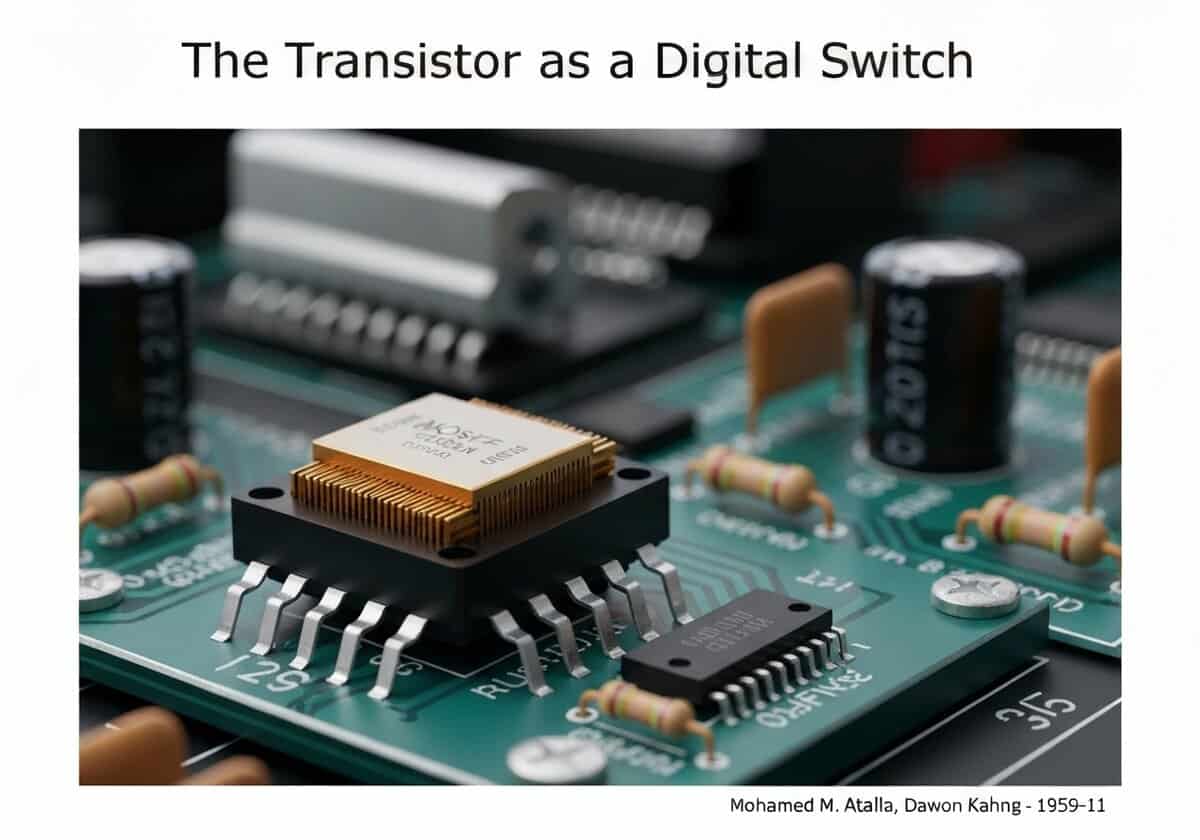
MOSFET transistor on circuit board in electronics laboratory.

(generated image for illustration only)

The fundamental building block of modern digital electronics is the transistor, specifically the MOSFET (Metal-Oxide-Semiconductor Field-Effect Transistor). It operates as an electronically controlled switch. By applying a voltage to its gate terminal, the flow of current between its source and drain terminals can be turned on (representing a ‘1’) or off (representing a ‘0’), enabling the implementation of logic gates.

While the first transistor was the bipolar junction transistor (BJT), the MOSFET became the dominant technology for digital circuits due to its scalability, lower power consumption in the static state, and higher density. A MOSFET has three terminals: the gate, source, and drain. The gate is insulated from the channel between the source and drain by a thin layer of oxide. Applying a voltage to the gate creates an electric field that controls the conductivity of the channel.

In digital applications, a MOSFET is operated in its cutoff (off) and triode/saturation (on) regions. When the gate voltage is below a certain threshold, the channel is non-conductive, the switch is ‘off’, and it represents a logic ‘0’. When the gate voltage is above the threshold, the channel becomes conductive, the switch is ‘on’, and it represents a logic ‘1’. By combining MOSFETs, typically in a complementary pair of P-type and N-type (forming CMOS logic), all basic logic gates can be constructed. The ability to miniaturize MOSFETs, as described by Moore’s Law, has driven the exponential growth in computing power for over half a century.

UNESCO Nomenclature: 2205
– Electronics

Type

Physical Device

Disruption

Revolutionary

Usage

Widespread Use

Precursors

  • Discovery of the electron
  • Development of semiconductor physics
  • Vacuum tube technology (triode)
  • Invention of the point-contact transistor

Applications

  • microprocessors
  • memory chips (dram, flash)
  • integrated circuits
  • smartphones
  • computers
  • all modern electronic devices

Patents:

  • US3102230A

Potential Innovations Ideas

Due to scrapping bot traffic, currently more than 40k per day, this content is reserved to community members.
> Login < or > Register < (100% free) to access this, so as all other restricted content and tools.

Related to: transistor, mosfet, cmos, digital switch, semiconductor, integrated circuit, logic gate, moore’s law.

Historical Context

The Transistor as a Digital Switch

1950
1957
1957
1959-11
1960
1960
1960
1950
1950
1957
1958
1960
1960
1960
1960

(if date is unknown or not relevant, e.g. "fluid mechanics", a rounded estimation of its notable emergence is provided)

Related Invention, Innovation & Technical Principles

Full size images and downloads are only available, 100% free, for registered members.

> Login <