Product Design, Manufacturing & Innovation Resources
Home » Gauss’s Theorema Egregium

Gauss’s Theorema Egregium

1827
  • Carl Friedrich Gauss
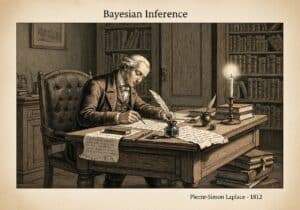
Carl Friedrich Gauss calculating Gaussian curvature in a historical office setting.

(generated image for illustration only)

Theorema Egregium (Latin for “Remarkable Theorem”) states that the Gaussian curvature of a surface is an intrinsic property. This means it depends only on how distances are measured on the surface itself, not on how the surface is embedded in three-dimensional space. A flat sheet of paper can be rolled into a cylinder but not a sphere without stretching.

Gauss’s Theorema Egregium is a cornerstone of differential geometry. Before Gauss, curvature was typically understood extrinsically, relating to how a surface bends within the ambient 3D space. Gauss discovered a way to compute the curvature using only information available to an imaginary two-dimensional being living on the surface. This intrinsic measure is now called Gaussian curvature.

He showed that the Gaussian curvature \(K\) could be expressed entirely in terms of the coefficients of the first fundamental form (\(E, F, G\)) and their derivatives. The first fundamental form, \(ds^2 = E du^2 + 2F du dv + G dv^2\), defines the metric of the surface—it tells how to measure lengths of curves. Since the metric is intrinsic, the curvature must be as well. This was a profound shift in perspective.

The theorem’s practical implication is that any two surfaces that can be transformed into one another without stretching or tearing (an isometry) must have the same Gaussian curvature at corresponding points. For example, a plane has zero curvature. Since a cylinder can be made by rolling up a plane without distortion, it also has zero Gaussian curvature. A sphere, however, has constant positive curvature, which is why it’s impossible to flatten an orange peel without breaking it. This concept was later generalized by Riemann to higher dimensions, paving the way for Einstein’s theory of general relativity.

UNESCO Nomenclature: 1204
– Geometry

Type

Abstract System

Disruption

Revolutionary

Usage

Widespread Use

Precursors

  • Euclidean geometry
  • Theory of curves and surfaces
  • Development of calculus by Newton and Leibniz
  • First fundamental form

Applications

  • cartography (explains why no flat map of the earth can be perfectly accurate)
  • general relativity (curvature of spacetime is intrinsic)
  • structural engineering (designing shells and curved structures)
  • computer graphics (for texture mapping and surface parameterization)

Patents:

NA

Potential Innovations Ideas

Due to scrapping bot traffic, currently more than 40k per day, this content is reserved to community members.
> Login < or > Register < (100% free) to access this, so as all other restricted content and tools.

Related to: gaussian curvature, intrinsic geometry, theorema egregium, first fundamental form, isometry, surfaces, metric, Gauss.

Historical Context

Gauss’s Theorema Egregium

1799
1812
1822
1827
1829
1850
1854
1780
1805
1822
1822
1828
1848
1850
1854

(if date is unknown or not relevant, e.g. "fluid mechanics", a rounded estimation of its notable emergence is provided)

Related Invention, Innovation & Technical Principles

Full size images and downloads are only available, 100% free, for registered members.

> Login <