Product Design, Manufacturing & Innovation Resources
Home » The Gauss-Bonnet Theorem

The Gauss-Bonnet Theorem

1848
  • Carl Friedrich Gauss
  • Pierre Ossian Bonnet
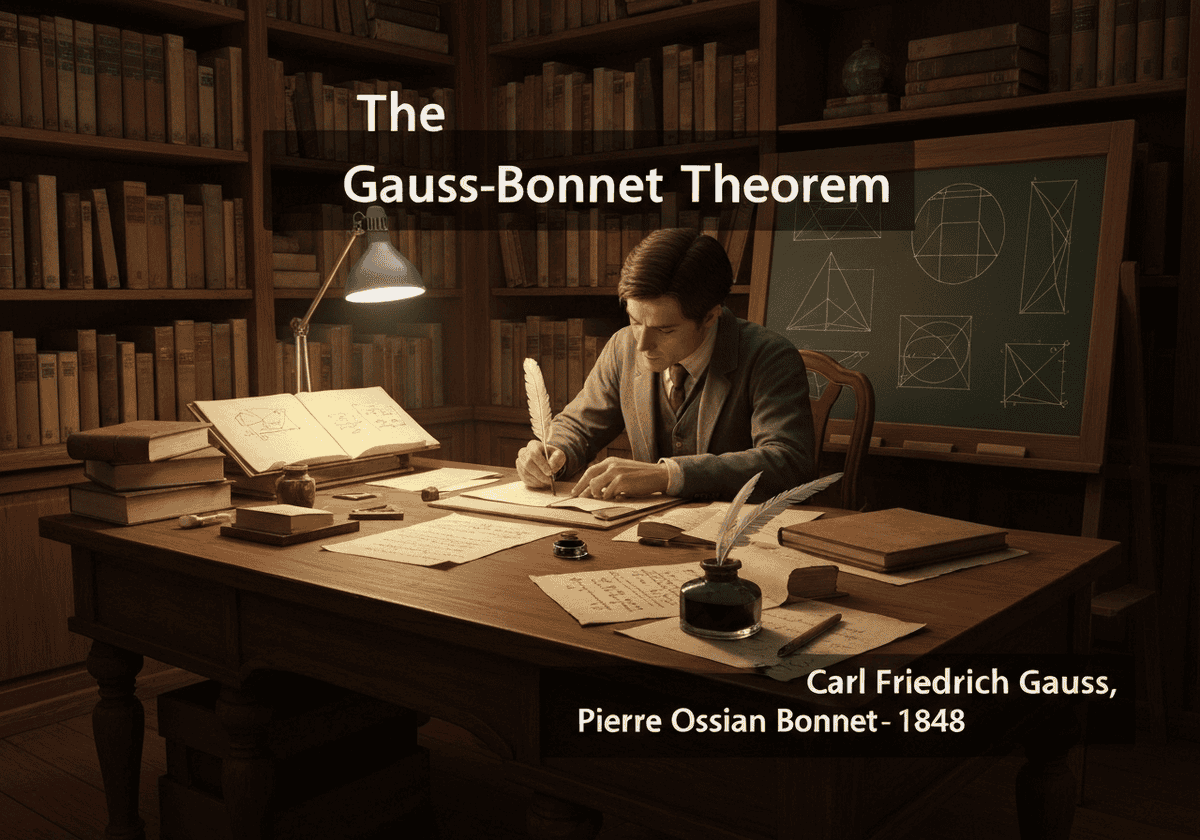
Study room of a mathematician with parchment papers and geometric diagrams related to the Gauss-Bonnet theorem.

(generated image for illustration only)

The Gauss-Bonnet theorem connects the geometry of a compact two-dimensional surface to its topology. It states that the integral of the Gaussian curvature \(K\) over the entire surface \(M\) is equal to \(2\pi\) times the Euler characteristic \(\chi(M)\) of the surface. The formula is \(\int_M K \, dA = 2\pi \chi(M)\).


The Gauss-Bonnet theorem is a remarkable statement that provides a deep link between the local geometric properties of a surface and its global topological structure. The left side of the equation, \(\int_M K \, dA\), involves integrating the Gaussian curvature—a quantity that can vary from point to point—over the entire surface. This is a purely geometric quantity. The right side, \(2\pi \chi(M)\), involves the Euler characteristic, \(\chi(M) = V – E + F\) (Vertices – Edges + Faces for any triangulation of the surface), which is a topological invariant. This means \(\chi(M)\) does not change under continuous deformations of the surface; for example, a sphere always has \(\chi=2\) and a torus always has \(\chi=0\), regardless of how they are stretched or bent.

The theorem implies that no matter how you deform a surface, the total curvature must remain constant. If you create a dimple in a sphere (introducing negative curvature), you must simultaneously create areas of higher positive curvature elsewhere to keep the total integral equal to \(4\pi\) (since \(\chi(sphere)=2\)). For a torus, the total curvature must always be zero; any region of positive curvature must be exactly balanced by a region of negative curvature. This theorem was a precursor to more general index theorems, like the Atiyah-Singer index theorem, which relate analytical and topological invariants in higher dimensions.

UNESCO Nomenclature: 1204
– Geometry

Type

Abstract System

Disruption

Foundational

Usage

Widespread Use

Precursors

  • Girard’s theorem on the area of spherical triangles
  • Gauss’s work on intrinsic curvature (Theorema Egregium)
  • Euler’s polyhedral formula (V – E + F = 2)
  • Development of integral calculus

Applications

  • topology (linking a geometric property, curvature, to a topological invariant, the euler characteristic)
  • physics (in the context of quantum field theory and string theory)
  • computer graphics (for mesh processing and analysis)
  • robotics (for path planning on complex surfaces)

Patents:

NA

Potential Innovations Ideas

Due to scrapping bot traffic, currently more than 40k per day, this content is reserved to community members.
> Login < or > Register < (100% free) to access this, so as all other restricted content and tools.

Related to: gauss-bonnet, gaussian curvature, euler characteristic, topology, geometry, integral, surface, invariant.

Historical Context

The Gauss-Bonnet Theorem

1822
1822
1828
1848
1850
1854
1884
1812
1822
1827
1829
1850
1854
1854
1895

(if date is unknown or not relevant, e.g. "fluid mechanics", a rounded estimation of its notable emergence is provided)

Related Invention, Innovation & Technical Principles

Full size images and downloads are only available, 100% free, for registered members.

> Login <