Product Design, Manufacturing & Innovation Resources
Home » Distinction Between Takt Time and Cycle Time

Distinction Between Takt Time and Cycle Time

1960
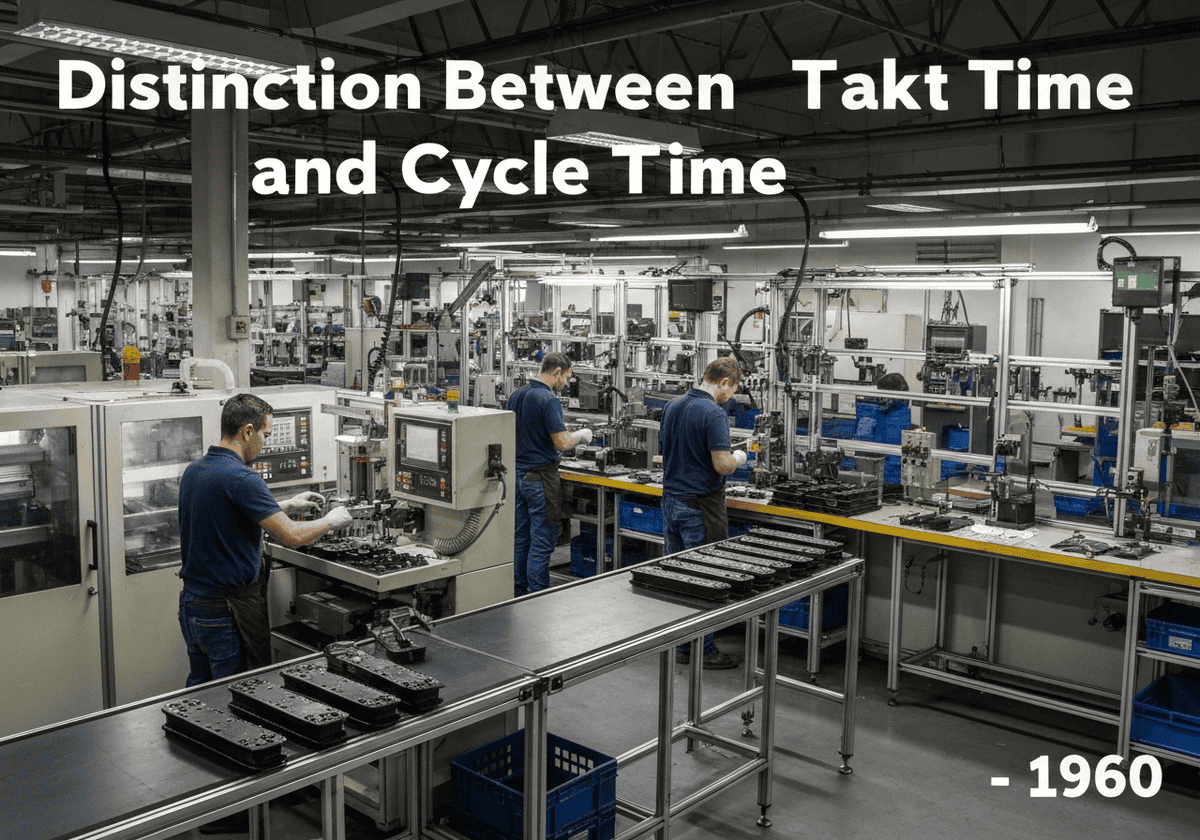
Manufacturing floor illustrating Takt time and Cycle time in industrial technology.

(generated image for illustration only)

Takt time is a theoretical calculation representing the pace of customer demand (\(Available Time \div Demand\)). In contrast, cycle time is an empirical measurement of the actual time taken to complete one unit of work at a specific process step. A core principle of lean manufacturing is to ensure that cycle time is consistently less than or equal to Takt time.


The relationship between Takt time, cycle time, and lead time is critical. Takt time is what you need, cycle time is what you get, and lead time is the total time a customer must wait for a product. The primary diagnostic use of this distinction is in line balancing and bottleneck identification. By measuring the cycle time of every station on a line and comparing it to the Takt time, managers can instantly see where problems lie. Any station where Cycle Time > Takt Time is a bottleneck that constrains the entire system’s output. Efforts for improvement, or ‘kaizen’, should be focused on these bottleneck stations to reduce their cycle time.

Conversely, if a station’s Cycle Time < Takt Time, it has spare capacity. While this may seem good, it can lead to overproduction if not managed. The operator may finish their work early and produce extra units ‘just in case’, creating inventory that is not yet needed by the next station or the customer. The lean ideal is to balance the line so that the cycle time of each station is very close to, but just under, the Takt time. This creates a smooth, synchronized flow and maximizes labor efficiency without generating wasteful inventory.

UNESCO Nomenclature: 3308
– Industrial technology

Type

Abstract System

Disruption

Incremental

Usage

Widespread Use

Precursors

  • the theory of constraints developed by Eliyahu M. Goldratt
  • development of performance metrics in industrial settings
  • the concept of a bottleneck in production theory
  • statistical process control methods for measuring process times

Applications

  • bottleneck analysis and management
  • production capacity planning
  • performance measurement for manufacturing cells
  • guiding continuous improvement (kaizen) activities
  • work balancing across multiple stations

Patents:

NA

Potential Innovations Ideas

Due to scrapping bot traffic, currently more than 40k per day, this content is reserved to community members.
> Login < or > Register < (100% free) to access this, so as all other restricted content and tools.

Related to: takt time, cycle time, lead time, bottleneck, lean manufacturing, toyota production system, process improvement, capacity planning.

Historical Context

Distinction Between Takt Time and Cycle Time

1956
1960
1960
1960
1960
1960
1960
1955
1958
1960
1960
1960
1960
1960
1960

(if date is unknown or not relevant, e.g. "fluid mechanics", a rounded estimation of its notable emergence is provided)

Related Invention, Innovation & Technical Principles

Full size images and downloads are only available, 100% free, for registered members.

> Login <