Product Design, Manufacturing & Innovation Resources
Home » Superconducting Magnetic Energy Storage (SMES)

Superconducting Magnetic Energy Storage (SMES)

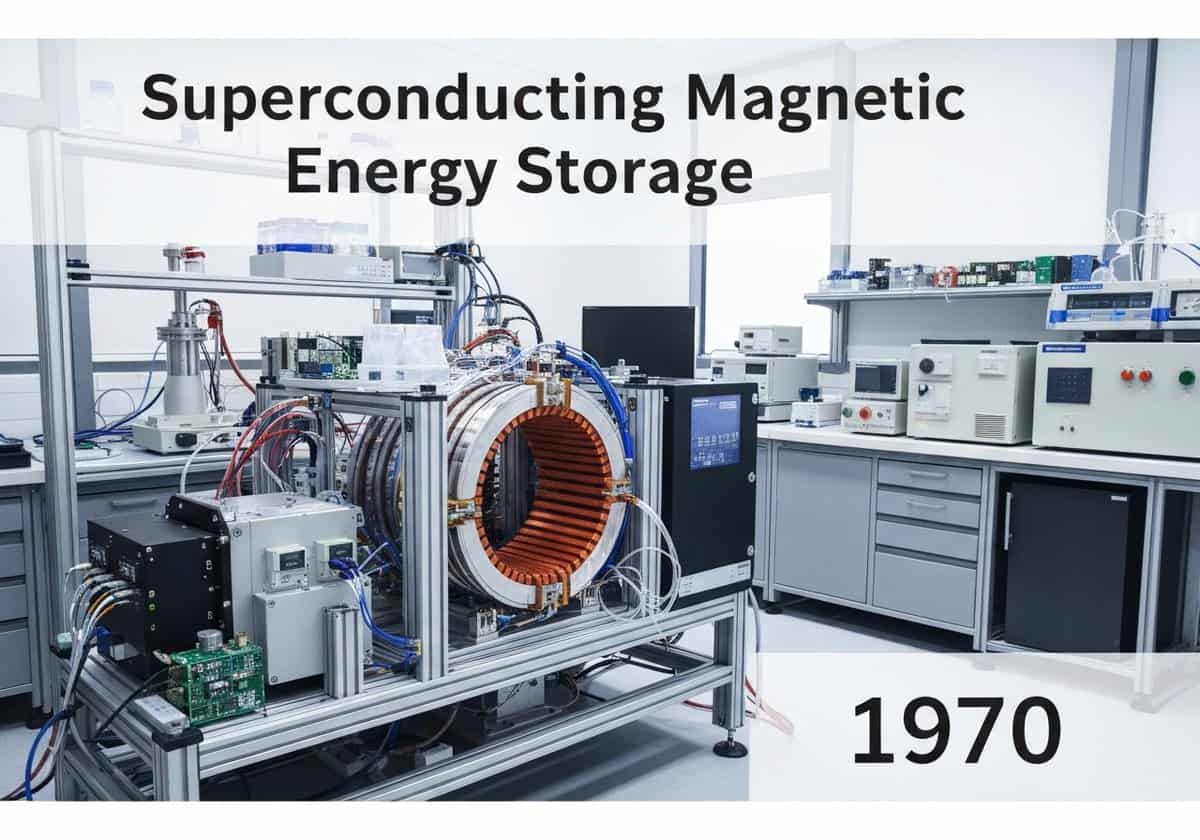
1970
Superconducting Magnetic Energy Storage system in a laboratory for solid state physics applications.

(generated image for illustration only)

Superconducting Magnetic Energy Storage (SMES) systems store energy in the magnetic field created by the flow of direct current in a superconducting coil. The energy can be stored indefinitely as long as the coil is kept at superconducting temperatures, as there is virtually no energy loss due to electrical resistance. The stored energy is given by \(E = \frac{1}{2} L I^2\).


An SMES unit consists of three main parts: a superconducting coil, a power conditioning system (PCS), and a cryogenic refrigerator. The coil is made from a superconducting material (like Niobium-titanium) which, when cooled below its critical temperature, has near-zero electrical resistance. A direct current is charged into the coil, creating a strong magnetic field where energy is stored according to the formula \(E = frac{1}{2} L I^2\), where L is the coil’s inductance and I is the current. Because the resistance is negligible, the current can circulate perpetually with minimal loss, making the storage highly efficient. The PCS, typically using solid-state inverters/rectifiers, manages the flow of power, converting AC power from the grid to DC for charging the coil, and converting the stored DC energy back to AC for discharge. The entire coil must be maintained at extremely low temperatures (around 4.2 K for low-temperature superconductors) by a cryocooler, which represents the main continuous energy cost. SMES systems are characterized by extremely high round-trip efficiency (>95%), instantaneous response time (milliseconds), and an unlimited cycle life. However, their energy density is relatively low and the capital costs, primarily for the superconducting wire and cryogenic system, are very high, limiting their use to high-value, short-duration power applications.

UNESCO Nomenclature: 2211
– Solid state physics

Type

Physical Device

Disruption

Incremental

Usage

Niche/Specialized

Precursors

  • discovery of electromagnetism by Hans Christian Ørsted (1820)
  • Michael Faraday’s law of induction
  • discovery of superconductivity by Heike Kamerlingh onnes (1911)
  • development of type-ii superconductors capable of carrying high currents in strong magnetic fields

Applications

  • power quality improvement and voltage stabilization in electrical grids
  • uninterruptible power supplies (ups) for critical facilities
  • frequency regulation
  • powering high-energy physics experiments

Patents:

NA

Potential Innovations Ideas

Due to scrapping bot traffic, currently more than 40k per day, this content is reserved to community members.
> Login < or > Register < (100% free) to access this, so as all other restricted content and tools.

Related to: SMES, superconductivity, magnetic field, energy storage, superconducting coil, cryogenics, power quality, high efficiency, inductance, direct current.

Historical Context

Superconducting Magnetic Energy Storage (SMES)

1964
1968
1970
1970
1975
1980
1980
1963
1965
1970
1970
1974-11-15
1980
1980
1980

(if date is unknown or not relevant, e.g. "fluid mechanics", a rounded estimation of its notable emergence is provided)

Related Invention, Innovation & Technical Principles

Full size images and downloads are only available, 100% free, for registered members.

> Login <