Product Design, Manufacturing & Innovation Resources
Home » Supercapacitors

Supercapacitors

1957
  • H. I. Becker
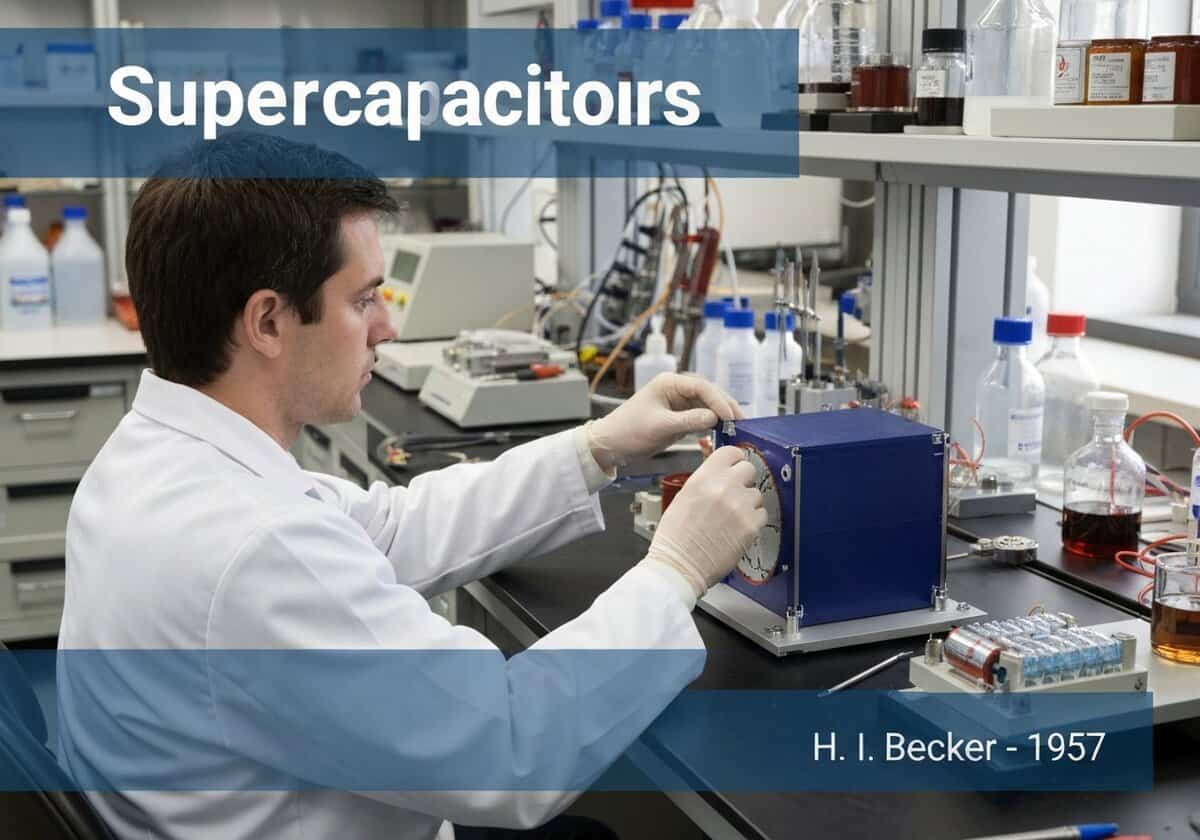
Researcher analyzing supercapacitor in electrochemistry laboratory.

(generated image for illustration only)

An electric double-layer capacitor (EDLC), or supercapacitor, stores energy electrostatically by polarizing an electrolytic solution. Unlike a conventional battery, no chemical reactions are involved. It stores energy in the electric double-layer (Helmholtz double layer) formed at the interface between a high-surface-area electrode and an electrolyte. This allows for extremely fast charging and discharging and a very long cycle life.

The core principle of an EDLC is the separation of charge at the interface between a solid conductive electrode and a liquid electrolyte. The electrodes are typically made of activated carbon or other porous materials with an extraordinarily high surface area (up to 2000 square meters per gram). When a voltage is applied, ions in the electrolyte migrate towards the electrodes of opposite polarity, forming two layers of charge—one electronic layer in the electrode surface and one ionic layer in the electrolyte. These two layers are separated by a molecularly thin insulating layer called the Helmholtz layer, which acts as the dielectric. The capacitance is given by \(C = frac{epsilon A}{d}\), where \(epsilon\) is the electrolyte permittivity, A is the electrode surface area, and d is the charge separation distance. The massive surface area and the minuscule charge separation distance (on the order of nanometers) result in extremely high capacitance values, thousands of times greater than conventional capacitors. This allows them to store significant amounts of energy, although their energy density is still lower than batteries. Their key advantage is power density—the ability to deliver and absorb charge very quickly.

UNESCO Nomenclature: 2203
– Physical chemistry

Type

Physical Device

Disruption

Substantial

Usage

Widespread Use

Precursors

  • invention of the Leyden jar (1745)
  • Helmholtz’s theory of the electric double layer (1850s)
  • development of porous carbon materials
  • basic principles of electrostatics and capacitance

Applications

  • regenerative braking in buses, trains, and cranes
  • short-term power backup for memory in electronic devices (sram, dram)
  • power stabilization in renewable energy systems
  • cold-start assistance for engines
  • camera flashes

Patents:

  • US2800616A

Potential Innovations Ideas

Due to scrapping bot traffic, currently more than 40k per day, this content is reserved to community members.
> Login < or > Register < (100% free) to access this, so as all other restricted content and tools.

Related to: supercapacitor, EDLC, ultracapacitor, electric double-layer, Helmholtz layer, activated carbon, power density, regenerative braking, electrostatic storage, fast charging.

Historical Context

Supercapacitors

1950
1950
1950
1957
1957
1959-11
1960
1950
1950
1950
1950
1957
1958
1960
1960

(if date is unknown or not relevant, e.g. "fluid mechanics", a rounded estimation of its notable emergence is provided)

Related Invention, Innovation & Technical Principles

Full size images and downloads are only available, 100% free, for registered members.

> Login <