Product Design, Manufacturing & Innovation Resources
Home » Stress and Strain

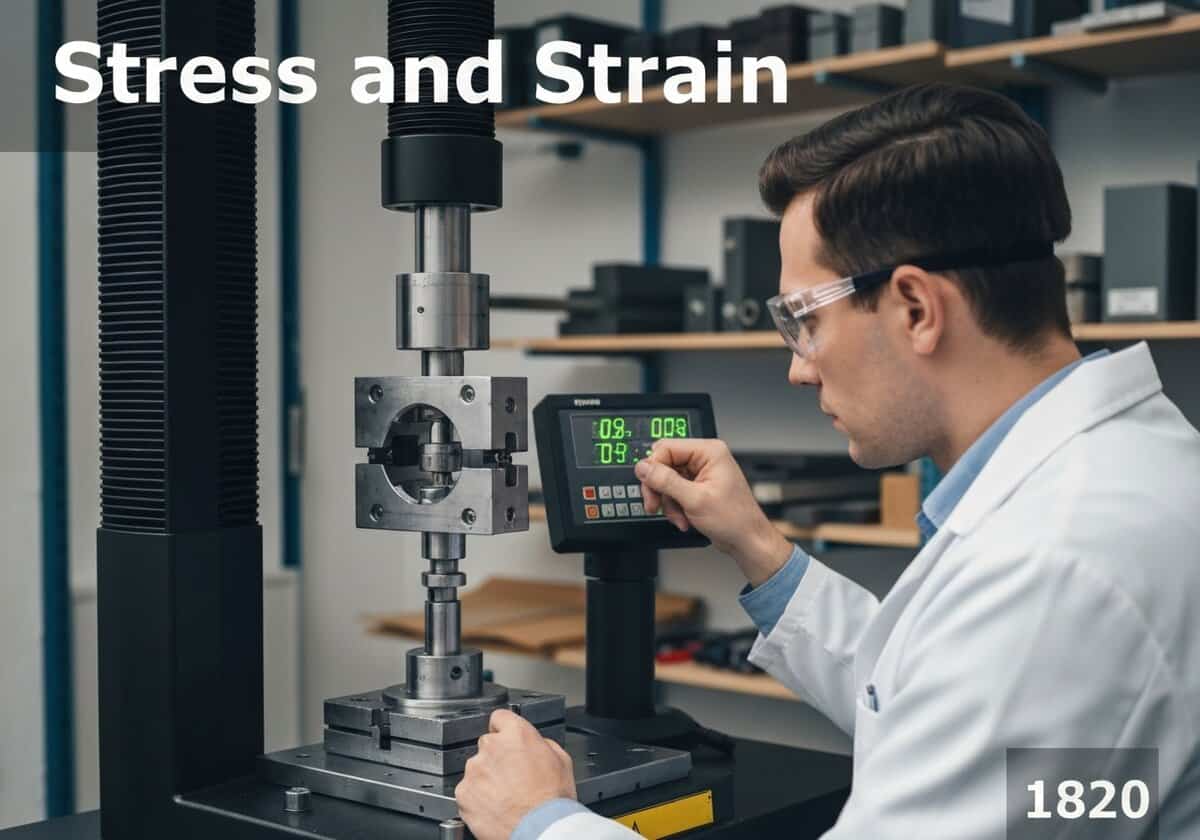
Stress and Strain

1820
Tensile testing machine measuring stress and strain in solid state physics.

(generated image for illustration only)

Engineering stress (\(\sigma\)) is the applied load divided by the original cross-sectional area (\(A_0\)), while engineering strain (\(\epsilon\)) is the change in length (\(\Delta L\)) divided by the original length (\(L_0\)). These definitions, \(\sigma = \frac{F}{A_0}\) and \(\epsilon = \frac{\Delta L}{L_0}\), are fundamental for plotting stress-strain curves but assume the specimen’s dimensions remain constant during the test.


Engineering stress and strain are foundational concepts in materials science and mechanics, providing a simplified yet powerful way to characterize a material’s response to external forces. The assumption that the cross-sectional area remains constant (\(A_0\)) is valid for small deformations, particularly within the elastic region. However, as a material undergoes significant plastic deformation, its cross-sectional area changes—a phenomenon known as necking in tensile tests. This change means engineering stress no longer represents the true stress experienced by the material at its narrowest point. Similarly, engineering strain is based on the original length, which can be less accurate for large deformations compared to an instantaneous strain measure.

Despite these limitations, the engineering stress-strain curve is widely used in industry and academia. Its key features, such as the yield strength and ultimate tensile strength (UTS), are standard parameters for material specification and design. The curve is relatively easy to generate from a standard tensile test, where a specimen is pulled apart at a constant rate while force and elongation are measured. The initial linear portion of this curve is particularly important as it defines the material’s elastic behavior, governed by Hooke’s Law.

UNESCO Nomenclature: 2211
– Solid state physics

Type

Abstract System

Disruption

Foundational

Usage

Widespread Use

Precursors

  • Galileo Galilei’s studies on the strength of materials (17th century)
  • Robert Hooke’s law of elasticity (1678)
  • Thomas Young’s definition of the modulus of elasticity (1807)
  • development of the concept of stress by Cauchy (early 19th century)

Applications

  • structural analysis of buildings and bridges
  • design of mechanical components like gears and shafts
  • quality control in manufacturing
  • material selection for various engineering applications

Patents:

NA

Potential Innovations Ideas

Due to scrapping bot traffic, currently more than 40k per day, this content is reserved to community members.
> Login < or > Register < (100% free) to access this, so as all other restricted content and tools.

Related to: engineering stress, engineering strain, tensile test, material properties, mechanics of materials, deformation, load, cross-sectional area, elongation, solid mechanics.

Historical Context

Stress and Strain

1810
1816
1816-11-16
1820
1820
1822
1824
1808
1811
1816-11-16
1820
1820
1821
1822
1827

(if date is unknown or not relevant, e.g. "fluid mechanics", a rounded estimation of its notable emergence is provided)

Related Invention, Innovation & Technical Principles

Full size images and downloads are only available, 100% free, for registered members.

> Login <