Product Design, Manufacturing & Innovation Resources
Home » Stereolithography (SLA)

Stereolithography (SLA)

1984
  • Chuck Hull
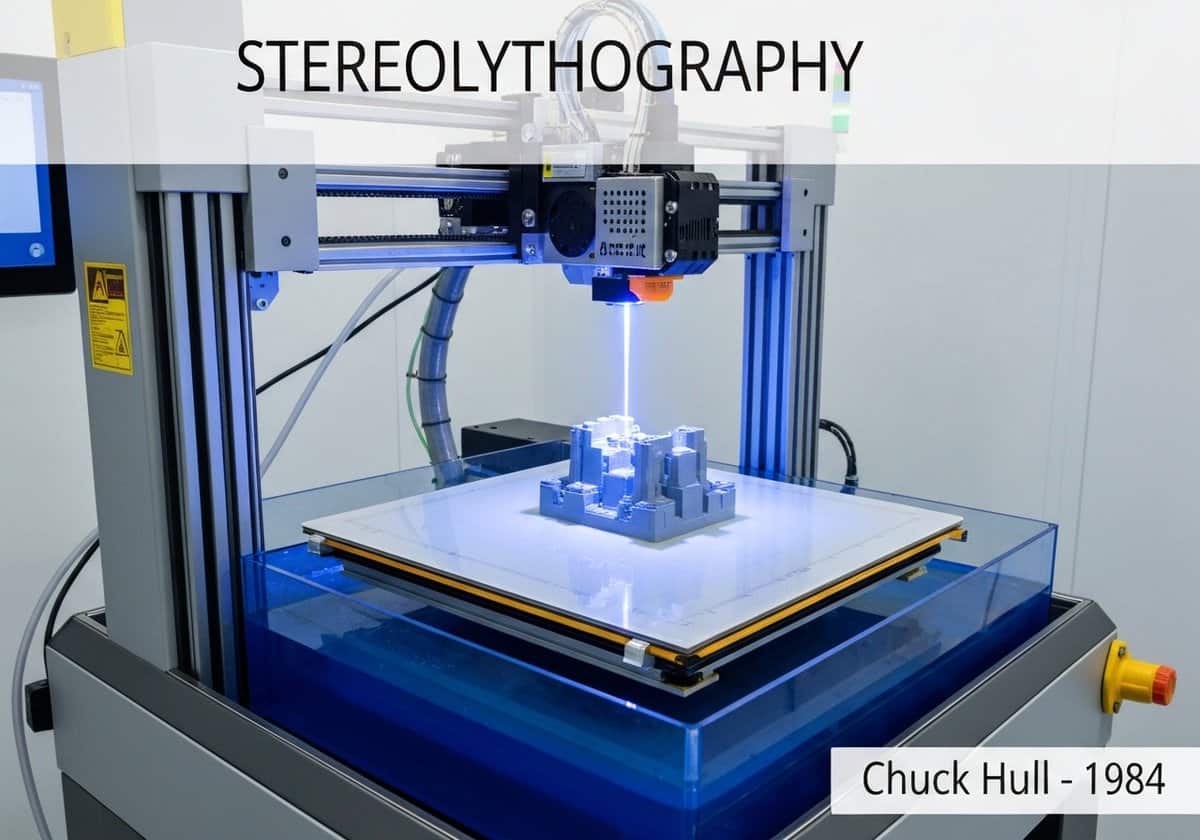
Stereolithography 3D printer curing photopolymer resin in industrial technology.

(generated image for illustration only)

Stereolithography is a vat photopolymerization additive manufacturing process. It employs an ultraviolet (UV) laser to selectively cure and solidify a liquid photopolymer resin. A build platform is submerged in the resin, and the laser traces a cross-section of the object on the surface. The platform then moves down by one layer thickness, allowing a new layer of resin to be cured on top.


The SLA process begins with a 3D CAD model, which is sliced into thin horizontal layers. For each layer, the laser beam, directed by scanning mirrors, traces the corresponding pattern on the surface of the liquid photopolymer. The UV energy triggers a chemical reaction, polymerization, which solidifies the resin where the laser hits. After a layer is completed, the platform descends, and a recoater blade sweeps across the surface to ensure the next layer of liquid resin is smooth and of a consistent thickness. This cycle repeats until the entire object is built. Because parts are built in a liquid vat, they often require support structures to anchor them to the build platform and to support overhangs and islands. After printing, the part is removed from the machine, washed in a solvent (like isopropyl alcohol) to remove excess uncured resin, and then post-cured in a UV chamber to fully solidify the polymer and achieve its final mechanical properties. SLA is known for producing parts with very high accuracy, intricate details, and a smooth surface finish, making it ideal for applications where aesthetics and precision are critical. However, the materials are often more brittle and less UV-stable than thermoplastics used in other processes.

UNESCO Nomenclature: 3313
– Industrial technology

Type

Manufacturing Process

Disruption

Revolutionary

Usage

Widespread Use

Precursors

  • invention of the laser in 1960
  • development of photopolymers and understanding of photochemistry
  • computer-aided design (cad) software
  • computer numerical control (cnc) technology
  • the concept of creating objects layer-by-layer, explored in topography and photosculpture

Applications

  • rapid prototyping for visual and functional models
  • dental applications like surgical guides, aligners, and crowns
  • jewelry manufacturing for creating casting patterns
  • custom hearing aid shells
  • microfluidics device fabrication
  • medical modeling for surgical planning

Patents:

  • US 4575330 A

Potential Innovations Ideas

Due to scrapping bot traffic, currently more than 40k per day, this content is reserved to community members.
> Login < or > Register < (100% free) to access this, so as all other restricted content and tools.

Related to: stereolithography, sla, vat photopolymerization, additive manufacturing, 3d printing, chuck hull, photopolymer, uv laser, rapid prototyping, resin printing.

Historical Context

Stereolithography (SLA)

1980
1980
1980
1984
1986
1986
1987-03
1980
1980
1980
1981
1986
1986
1987
1989

(if date is unknown or not relevant, e.g. "fluid mechanics", a rounded estimation of its notable emergence is provided)

Related Invention, Innovation & Technical Principles

Full size images and downloads are only available, 100% free, for registered members.

> Login <