Principal and Maximum Shear Stresses (Mohr’s Circle)
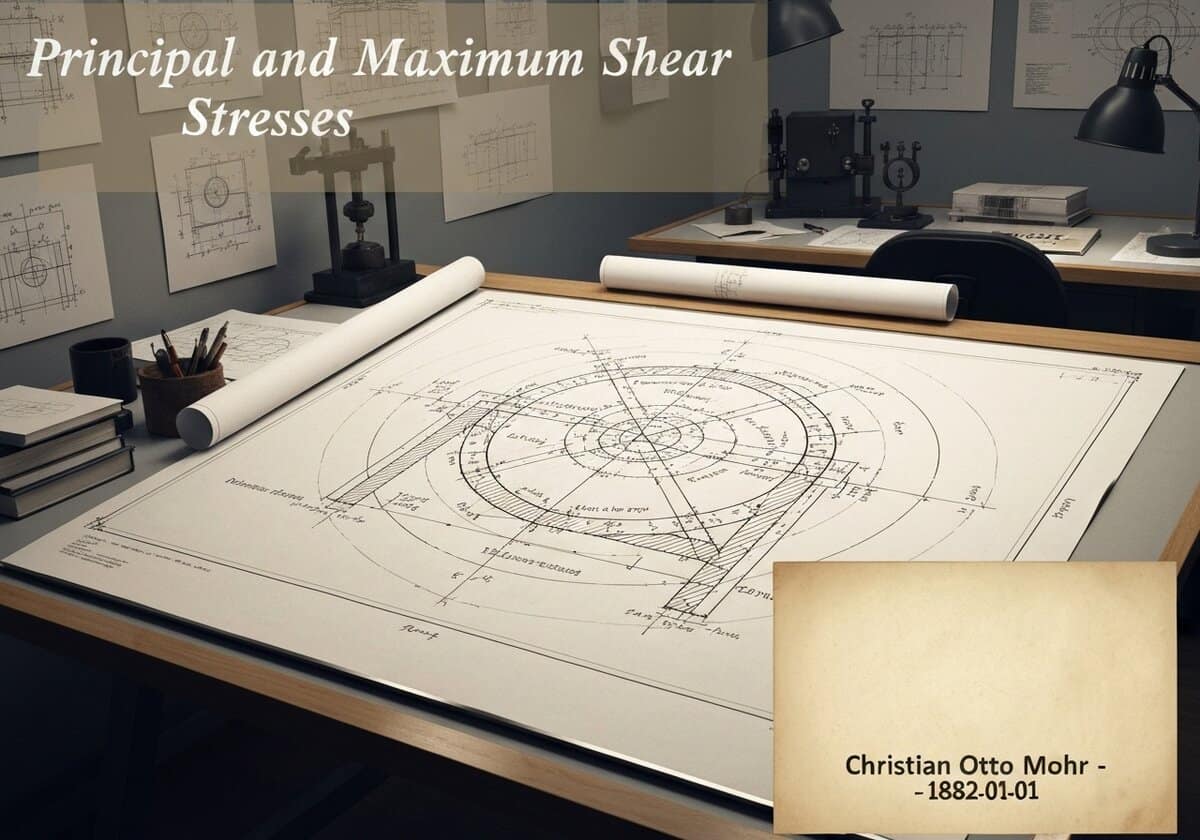
The principal stresses, \(\sigma_1\) and \(\sigma_2\), are the maximum and minimum normal stresses at a point, occurring on planes with zero shear stress. On Mohr’s circle, these correspond to the two points where the circle intersects the horizontal (\(\sigma_n\)) axis. The maximum in-plane shear stress, \(\tau_{max}\), is equal to the radius of the circle, \(R\).
Identifying principal stresses and maximum shear stress is a primary application of Mohr’s circle. The principal stresses are the eigenvalues of the stress tensor and represent the extreme values of normal stress. They are found at the intersections of the circle with the \(\sigma_n\) axis, calculated as \(\sigma_{1,2} = \sigma_{avg} \pm R\), where \(\sigma_{avg}\) is the center of the circle and \(R\) is its radius. The planes on which these stresses act are called principal planes, and they are mutually orthogonal. On Mohr’s circle, the angle \(2\theta_p\) from the reference state to the principal state can be found using trigonometry: \(\tan(2\theta_p) = \frac{2\tau_{xy}}{\sigma_x – \sigma_y}\).
The maximum in-plane shear stress, \(\tau_{max}\), corresponds to the highest and lowest points on the circle, with a magnitude equal to the circle’s radius, \(R\). The planes of maximum shear are oriented at 45 degrees to the principal planes. This is visually represented on the circle by a 90-degree rotation from the principal stress points. Understanding these maximum values is critical in engineering design, as material failure, particularly in ductile materials, is often initiated by shear stress. Failure theories, such as the Tresca (Maximum Shear Stress) criterion, directly use this value to predict the onset of yielding.
UNESCO Nomenclature: 3328
– Materials science and engineering
Precursors
- Rankine’s theory of earth pressure
- Cauchy’s stress tensor
- Navier’s equations of motion for elastic solids
- The concept of eigenvalues and eigenvectors in linear algebra
Applications
- failure analysis of materials (e.g., tresca and von mises yield criteria)
- design of pressure vessels and pipes
- structural analysis of bridges and buildings
- geotechnical engineering for slope stability analysis
Potential Innovations Ideas
Due to scrapping bot traffic, currently more than 40k per day, this content is reserved to community members.
> Login < or > Register < (100% free) to access this, so as all other restricted content and tools.
Related to: principal stress, maximum shear stress, Mohr’s circle, stress analysis, failure criteria, Tresca criterion, solid mechanics, material science, structural design, normal stress.