Product Design, Manufacturing & Innovation Resources
Home » Quantum Statistics

Quantum Statistics

1926
  • Satyendra Nath Bose
  • Albert Einstein
  • Enrico Fermi
  • Paul Dirac
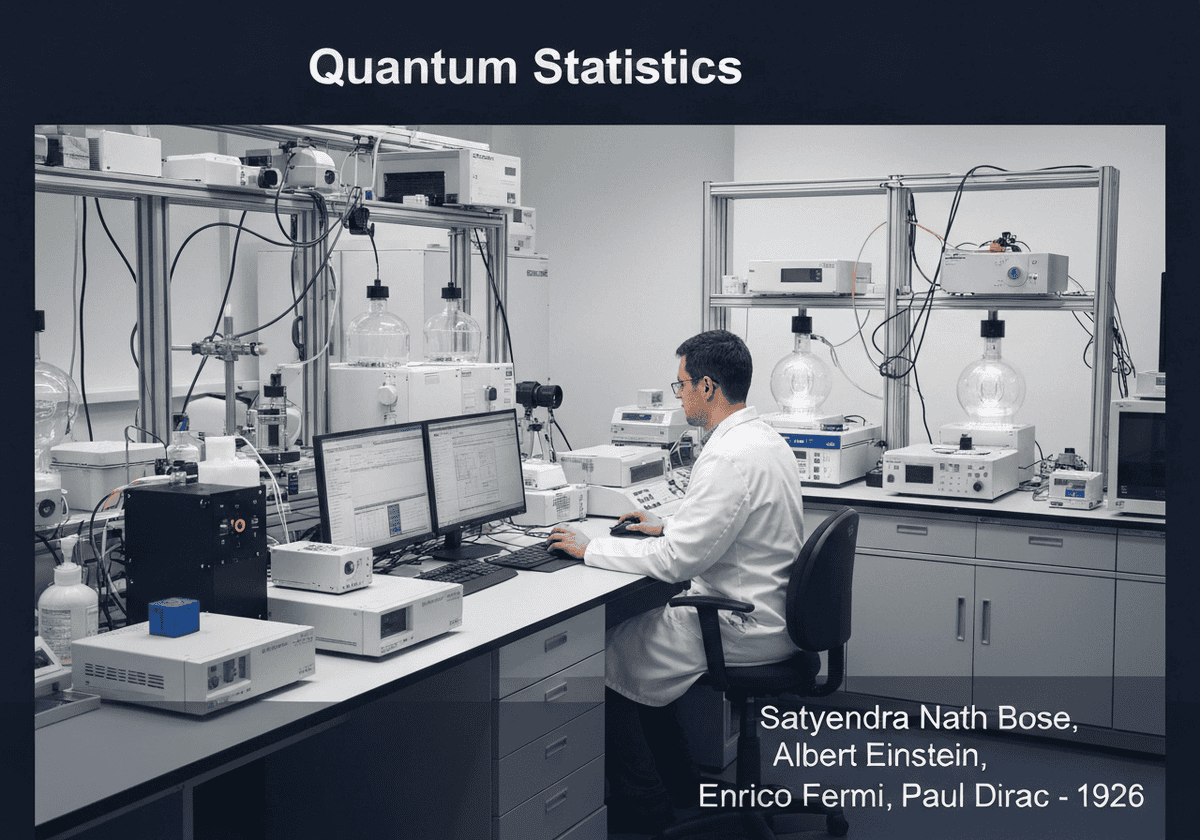
Research laboratory focused on quantum statistics applications in semiconductor physics and lasers.

(generated image for illustration only)

Quantum statistics modifies classical statistical mechanics to account for the indistinguishability of identical particles. It splits into two types: Fermi-Dirac statistics for fermions (half-integer spin particles like electrons), which obey the Pauli exclusion principle, and Bose-Einstein statistics for bosons (integer spin particles like photons), which can occupy the same quantum state. This distinction is crucial at low temperatures and high densities.
Classical Maxwell-Boltzmann statistics assumes that particles in a system are distinguishable, meaning one could, in principle, label and track each one. However, quantum mechanics revealed that identical particles are fundamentally indistinguishable. This leads to profound changes in how microstates are counted. For bosons, multiple particles can occupy a single energy state, leading to an enhanced probability of collective behavior. The average occupation number of a state with energy \(\epsilon_i\) is given by the Bose-Einstein distribution: \(\langle n_i \rangle_{BE} = \frac{1}{e^{(\epsilon_i – \mu)/k_B T} – 1}\). This can lead to a macroscopic number of particles collapsing into the ground state at low temperatures, forming a Bose-Einstein condensate.

For fermions, the Pauli exclusion principle forbids any two identical particles from occupying the same quantum state. This ‘repulsive’ statistical effect gives rise to the structure of atoms and the stability of matter. The average occupation number is given by the Fermi-Dirac distribution: \(\langle n_i \rangle_{FD} = \frac{1}{e^{(\epsilon_i – \mu)/k_B T} + 1}\). This function is always less than or equal to 1. At absolute zero, fermions fill up all available energy levels up to a maximum energy called the Fermi energy. This creates a ‘Fermi sea’ and is responsible for the pressure that supports white dwarf stars against gravitational collapse. At high temperatures, both quantum distributions converge to the classical Maxwell-Boltzmann distribution.

UNESCO Nomenclature: 2211
– Thermodynamics

Type

Abstract System

Disruption

Revolutionary

Usage

Widespread Use

Precursors

  • Planck’s law of black-body radiation, which implicitly treated photons as bosons
  • The Pauli exclusion principle, which is the foundation of Fermi-Dirac statistics
  • De Broglie’s hypothesis of wave-particle duality
  • Classical Maxwell-Boltzmann statistical mechanics

Applications

  • semiconductor physics and the operation of transistors
  • superconductivity and superfluidity
  • the theory of white dwarf and neutron stars
  • the operation of lasers (based on properties of bosons)
  • bose-einstein condensates

Patents:

NA

Potential Innovations Ideas

Due to scrapping bot traffic, currently more than 40k per day, this content is reserved to community members.
> Login < or > Register < (100% free) to access this, so as all other restricted content and tools.

Related to: quantum statistics, Fermi-Dirac, Bose-Einstein, fermions, bosons, Pauli exclusion principle, Bose-Einstein condensate, quantum mechanics.

Historical Context

Quantum Statistics

1924
1924
1925
1926
1927
1927
1930
1922
1924
1925
1926
1926
1927
1930
1930

(if date is unknown or not relevant, e.g. "fluid mechanics", a rounded estimation of its notable emergence is provided)

Related Invention, Innovation & Technical Principles

Full size images and downloads are only available, 100% free, for registered members.

> Login <