Product Design, Manufacturing & Innovation Resources
Home » Pythagorean Theorem

Pythagorean Theorem

-550
  • Pythagoras of Samos
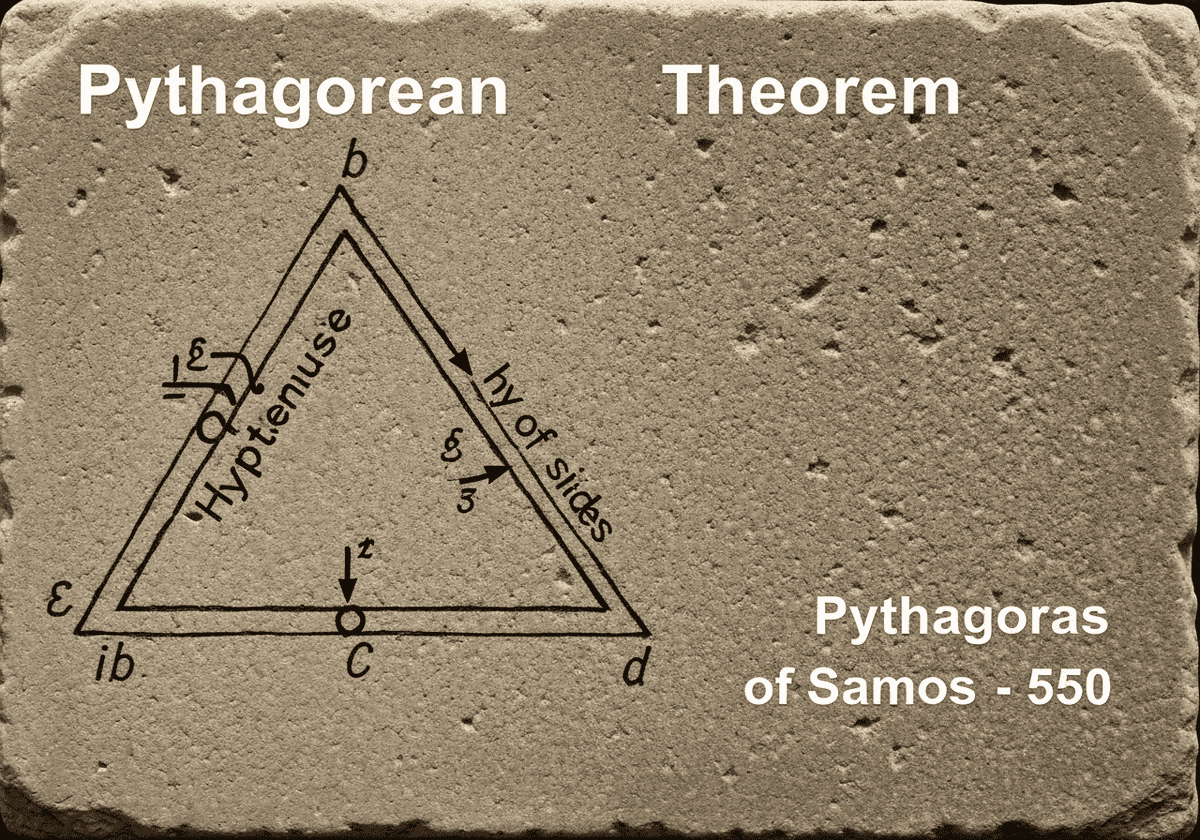
Right-angled triangle illustrating the Pythagorean theorem in geometry.

(generated image for illustration only)

The Pythagorean theorem is a fundamental relation in Euclidean geometry among the three sides of a right-angled triangle. It states that the area of the square whose side is the hypotenuse (the side opposite the right angle) is equal to the sum of the areas of the squares on the other two sides. The formula is expressed as \(a^2 + b^2 = c^2\).

While the theorem is named after the Greek mathematician Pythagoras, evidence suggests that the relationship was known to earlier civilizations, including the Babylonians and Egyptians, who used it for practical purposes like surveying and construction. However, the Pythagoreans are credited with the first formal proof of the theorem, elevating it from a practical observation to a mathematical certainty within a deductive system. There are hundreds of known proofs for the theorem, some geometric and some algebraic, demonstrating its deep and multifaceted nature.

The theorem is a special case of the more general law of cosines, \(c^2 = a^2 + b^2 – 2ab\cos(\gamma)\), which relates the lengths of the sides of any triangle. When the angle \(\gamma\) is a right angle (90 degrees or \(\pi/2\) radians), its cosine is 0, and the formula simplifies to the Pythagorean theorem. The theorem also defines the Euclidean distance between two points in a Cartesian coordinate system. If two points have coordinates \((x_1, y_1)\) and \((x_2, y_2)\), the distance \(d\) between them is given by \(d = \sqrt{(x_2-x_1)^2 + (y_2-y_1)^2}\), which is a direct application of the theorem.

UNESCO Nomenclature: 1204
– Geometry

Type

Abstract System

Disruption

Foundational

Usage

Widespread Use

Precursors

  • Babylonian clay tablets (e.g., Plimpton 322) showing knowledge of Pythagorean triples
  • Egyptian rope-stretching techniques for creating right angles in construction
  • Early Greek geometric concepts of lines, angles, and areas

Applications

  • construction and carpentry (e.g., ensuring square corners)
  • navigation and triangulation for determining location
  • physics calculations involving vectors
  • computer graphics for distance calculations
  • forensic science for crime scene reconstruction

Patents:

NA

Potential Innovations Ideas

Due to scrapping bot traffic, currently more than 40k per day, this content is reserved to community members.
> Login < or > Register < (100% free) to access this, so as all other restricted content and tools.

Related to: Pythagorean theorem, right-angled triangle, hypotenuse, Euclidean distance, geometry, trigonometry, a^2+b^2=c^2, proof.

Historical Context

Pythagorean Theorem

-300
-300
-400
-550
1635
1650
1736
-300
-300
-350
-500
150
1640
1650
1747

(if date is unknown or not relevant, e.g. "fluid mechanics", a rounded estimation of its notable emergence is provided)

Related Invention, Innovation & Technical Principles

Full size images and downloads are only available, 100% free, for registered members.

> Login <