Product Design, Manufacturing & Innovation Resources
Home » Proton-Exchange Membrane Fuel Cell (PEMFC)

Proton-Exchange Membrane Fuel Cell (PEMFC)

1960
  • Willard Thomas Grubb
  • Leonard Niedrach
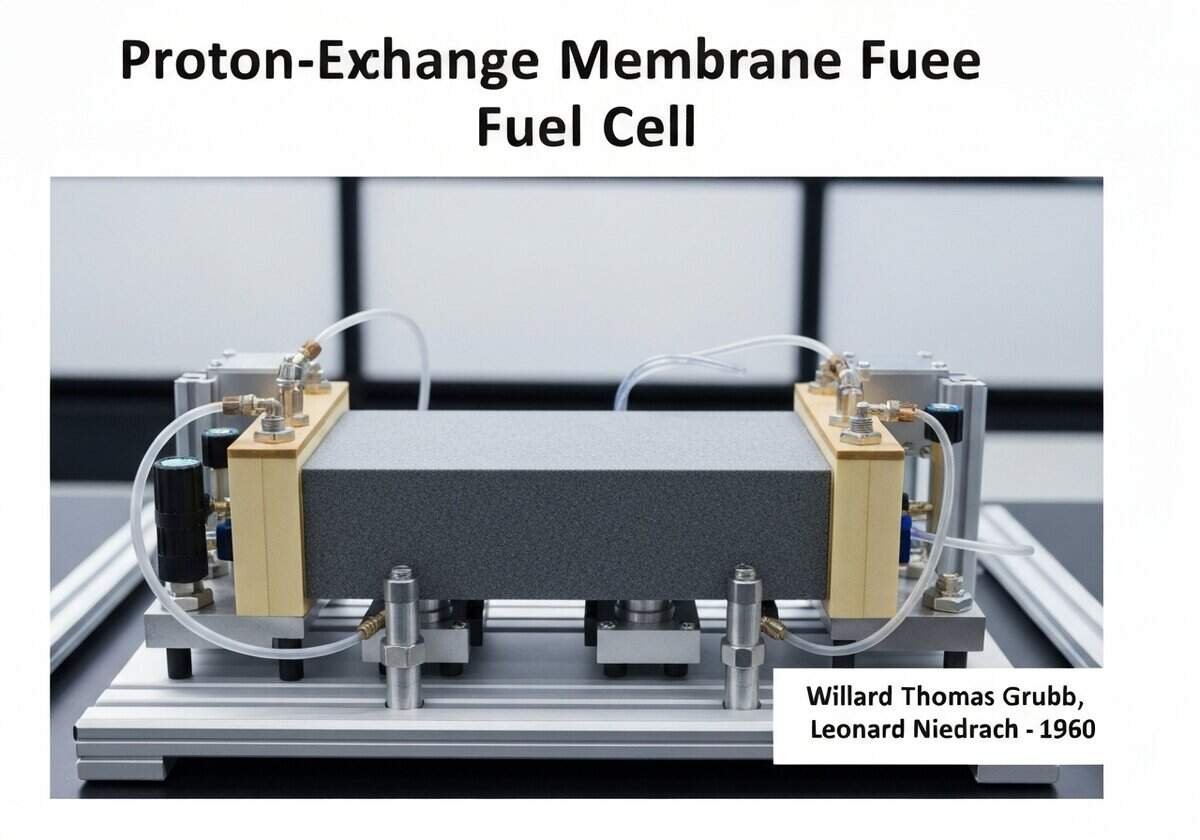
Proton-Exchange Membrane Fuel Cell in a laboratory setting, showcasing energy conversion technology.

(generated image for illustration only)

A Proton-Exchange Membrane Fuel Cell (PEMFC) uses a solid polymer membrane, such as Nafion, as its electrolyte. This membrane selectively conducts protons (\(H^+\)) from the anode to the cathode. PEMFCs operate at low temperatures (typically 50-100°C), enabling rapid start-up and a compact design. They require high-purity hydrogen as fuel to avoid poisoning the platinum-based catalysts.
The heart of the PEMFC is the membrane electrode assembly (MEA), which consists of the proton-exchange membrane sandwiched between two catalyst-coated electrodes. At the anode, hydrogen gas is split into protons and electrons: \(H_2 \rightarrow 2H^+ + 2e^-\). The solid polymer membrane, which is an electrical insulator, allows only the protons to pass through to the cathode. The electrons are forced to travel through an external circuit, generating the electrical current. At the cathode, oxygen from the air, the protons from the membrane, and the electrons from the external circuit combine to form water: \(O_2 + 4H^+ + 4e^- \rightarrow 2H_2O\).

A critical aspect of PEMFC operation is water management. The membrane must remain hydrated to maintain its proton conductivity, but excess water at the cathode (product water) can block the flow of oxygen to the catalyst sites, a phenomenon known as ‘flooding’. The low operating temperature makes PEMFCs susceptible to catalyst poisoning, particularly from carbon monoxide (CO) present in reformed hydrogen, which binds strongly to the platinum catalyst sites. This necessitates the use of very pure hydrogen fuel, increasing operational costs.

UNESCO Nomenclature: 3305
– Energy technology

Type

Physical Device

Disruption

Substantial

Usage

Widespread Use

Precursors

  • invention of the fuel cell by William Grove (1838)
  • development of the first ion-exchange polymer membrane, Nafion, by Walther Grot at DuPont (late 1960s)
  • research into platinum’s catalytic properties

Applications

  • propulsion systems for fuel cell electric vehicles (FCEVs) like the Toyota Mirai and Hyundai Nexo
  • backup power units for critical infrastructure
  • portable power generators for recreational and military use
  • material handling vehicles like forklifts
  • power sources for NASA’s Project Gemini spacecraft

Patents:

  • US2913511A (Willard T. Grubb, 1959)

Potential Innovations Ideas

Due to scrapping bot traffic, currently more than 40k per day, this content is reserved to community members.
> Login < or > Register < (100% free) to access this, so as all other restricted content and tools.

Related to: pemfc, proton-exchange membrane, nafion, catalyst, platinum, hydrogen fuel, membrane electrode assembly, low-temperature, automotive, general electric.

Historical Context

Proton-Exchange Membrane Fuel Cell (PEMFC)

1960
1960
1960
1960
1962
1964
1970
1960
1960
1960
1960
1960
1963
1965-12-21
1970

(if date is unknown or not relevant, e.g. "fluid mechanics", a rounded estimation of its notable emergence is provided)

Related Invention, Innovation & Technical Principles

Full size images and downloads are only available, 100% free, for registered members.

> Login <