Product Design, Manufacturing & Innovation Resources
Home » Photosynthesis

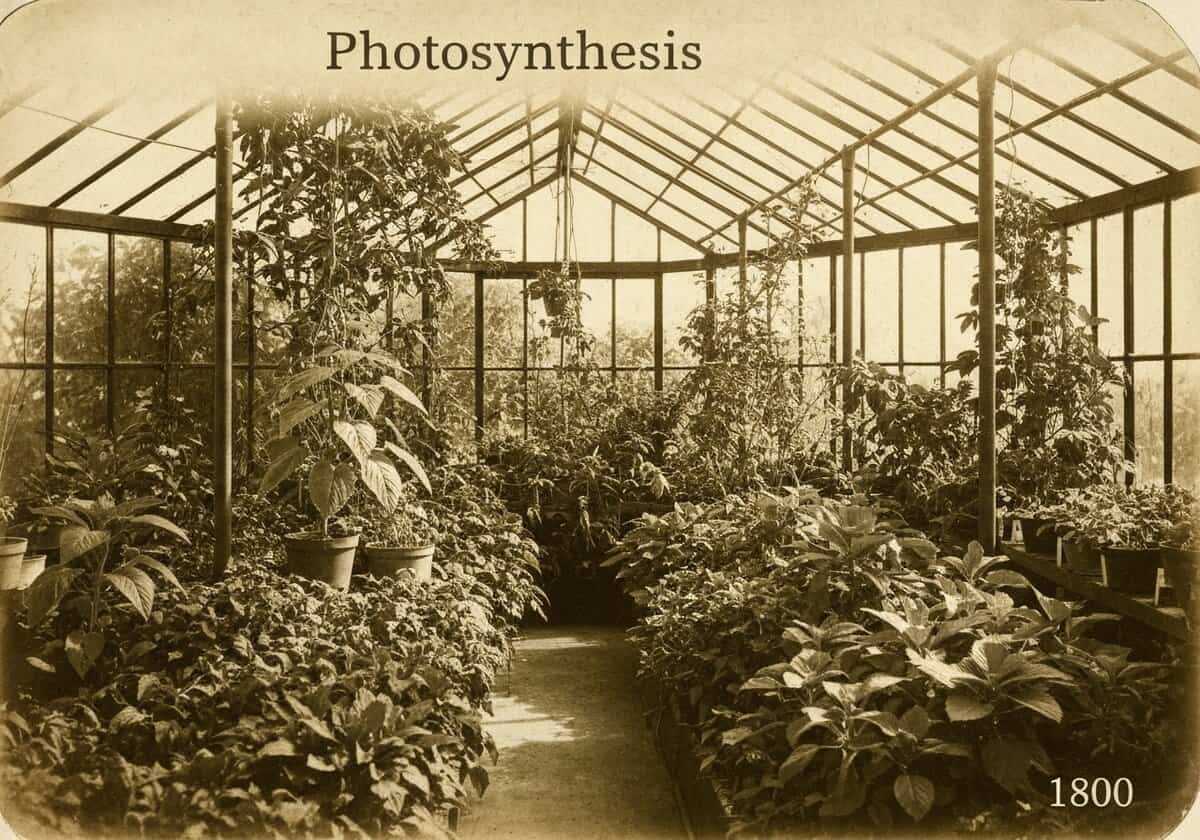
Photosynthesis

1800
Greenhouse showcasing plants undergoing photosynthesis in a vintage setting.

(generated image for illustration only)

Photosynthesis is a process used by plants, algae, and some bacteria to convert light energy into chemical energy. Sunlight provides the energy to convert carbon dioxide and water into glucose (a sugar for energy storage) and oxygen as a byproduct. The overall simplified chemical equation is \(6CO_2 + 6H_2O + \text{Light Energy} \rightarrow C_6H_{12}O_6 + 6O_2\).
The process of photosynthesis occurs in two main stages within the chloroplasts of plant cells. The first stage, the light-dependent reactions, takes place in the thylakoid membranes. Here, pigments like chlorophyll absorb photons from sunlight. This energy is used to split water molecules in a process called photolysis, which releases oxygen, protons, and electrons. The energy captured from light is converted into two short-term energy-storing molecules: ATP (adenosine triphosphate) and NADPH (nicotinamide adenine dinucleotide phosphate). The second stage, known as the Calvin cycle or light-independent reactions, occurs in the stroma of the chloroplast. This cycle does not directly require light but uses the ATP and NADPH produced in the first stage. In the Calvin cycle, carbon dioxide from the atmosphere is ‘fixed’ into organic molecules and converted into glucose, a high-energy sugar that the plant can use for growth, metabolism, or storage as starch. This entire process is the foundation of nearly all life on Earth, providing the energy for most ecosystems and producing the oxygen in our atmosphere.

UNESCO Nomenclature: 2417
– Plant Physiology

Type

Biological Process

Disruption

Revolutionary

Usage

Widespread Use

Precursors

  • Stephen Hales’s proposal that plants are nourished by the atmosphere
  • Joseph Priestley’s discovery that plants can ‘restore’ air ‘injured’ by a burning candle
  • Antoine Lavoisier’s work on oxygen and combustion
  • the development of the microscope for observing plant cell structures like chloroplasts

Applications

  • agriculture and horticulture
  • biofuel production (e.g., from algae)
  • carbon sequestration and climate change mitigation
  • life support systems in space exploration
  • pharmaceutical development from plant-derived compounds
  • understanding of global carbon and oxygen cycles

Patents:

NA

Potential Innovations Ideas

Due to scrapping bot traffic, currently more than 40k per day, this content is reserved to community members.
> Login < or > Register < (100% free) to access this, so as all other restricted content and tools.

Related to: photosynthesis, chlorophyll, light energy, chemical energy, carbon dioxide, oxygen, glucose, plants, algae, Calvin cycle.

Historical Context

Photosynthesis

1800
1800-05-02
1880
1900
1910
1921
1930
1930
1800
1834-01-01
1880
1902
1920
1928
1930

(if date is unknown or not relevant, e.g. "fluid mechanics", a rounded estimation of its notable emergence is provided)

Related Invention, Innovation & Technical Principles

Full size images and downloads are only available, 100% free, for registered members.

> Login <