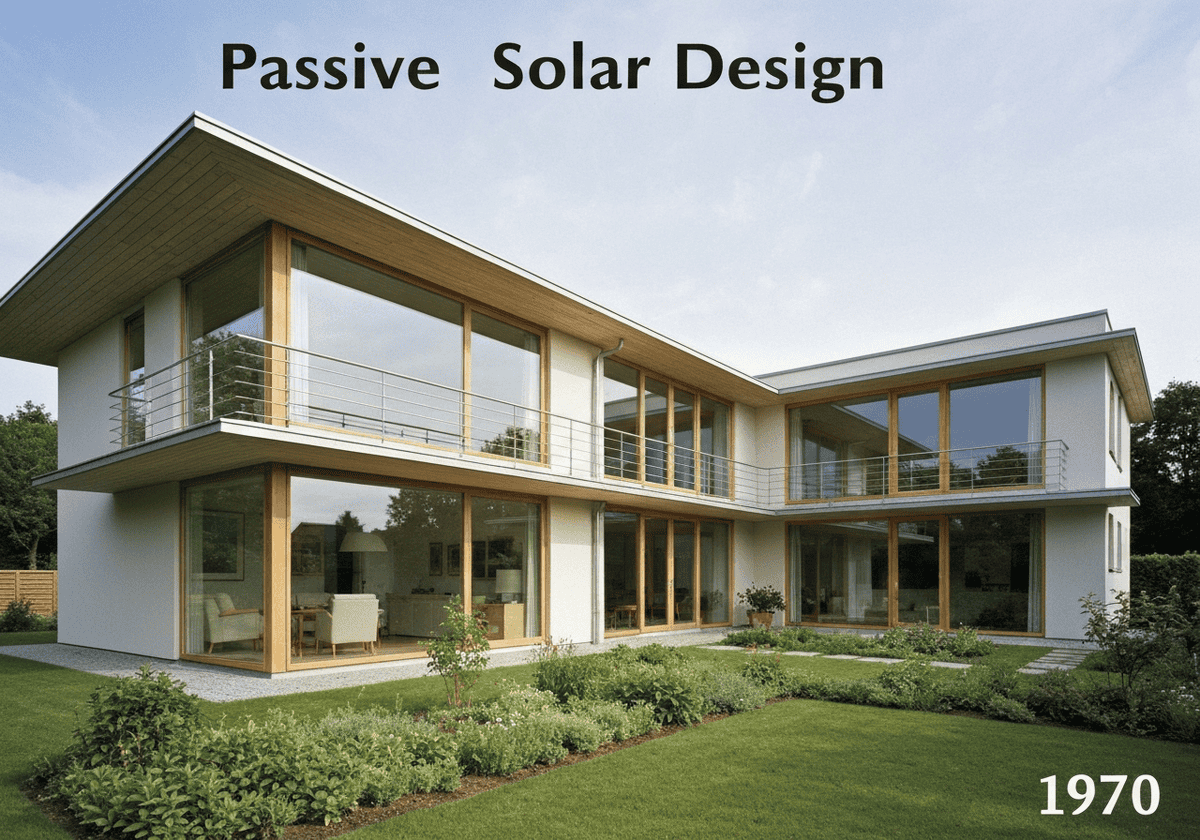
Passive Solar Design
Passive solar design is a building design strategy that uses a building’s components—walls, floors, windows, and orientation—to collect, store, reflect, and distribute solar energy in the form of heat in the winter and reject solar heat in the summer. Unlike active solar heating systems, it does not involve the use of mechanical and electrical devices.
Passive solar design relies on five key principles. The first is the aperture (or collector), which consists of large glass areas (windows, skylights) oriented to face the sun’s path, typically south in the Northern Hemisphere. These allow sunlight to enter the building. The second principle is the absorber, which involves hard, darkened surfaces on the sun-exposed side of a thermal mass. These surfaces absorb the incoming solar radiation and convert it into heat.
The third principle is thermal mass, which is a material with the capacity to store significant amounts of heat. Materials like concrete, brick, stone, and water are commonly used. The thermal mass is positioned to be irradiated by the sunlight entering through the aperture. It absorbs excess heat during the day and slowly releases it into the space at night, moderating internal temperature fluctuations.
The fourth principle is distribution, the method by which solar heat circulates from the collection and storage points to different areas of the building. This can occur through natural convection, conduction, and radiation. For example, warm air rises and can be circulated through high vents, while cooler air is drawn in through low vents.
The final principle is control. This involves mechanisms to manage the effects of the sun, especially to prevent overheating in the summer. Roof overhangs, awnings, blinds, and deciduous trees are common control elements. They are designed to block the high-angle summer sun while allowing the low-angle winter sun to penetrate the building.
UNESCO Nomenclature: 3303
– Architecture
Precursors
- Ancient Greek and Roman practices of orienting buildings to capture winter sun
- Socrates’ description of the “megaron house” designed for solar gain
- The invention of clear glass, allowing for large windows
- Research into heat transfer and thermodynamics in the 19th century
Applications
- trombe walls in residential homes
- south-facing windows with calculated overhangs in the northern hemisphere
- high thermal mass materials like concrete or stone floors
- sunspaces or solariums attached to buildings
- daylighting strategies to reduce electrical lighting needs
Potential Innovations Ideas
Due to scrapping bot traffic, currently more than 40k per day, this content is reserved to community members.
> Login < or > Register < (100% free) to access this, so as all other restricted content and tools.
Related to: passive solar, building design, architecture, thermal mass, solar energy, sustainable building, energy efficiency, daylighting.