Product Design, Manufacturing & Innovation Resources
Home » NIOSH Lifting Equation

NIOSH Lifting Equation

1991
  • National Institute for Occupational Safety and Health (NIOSH)
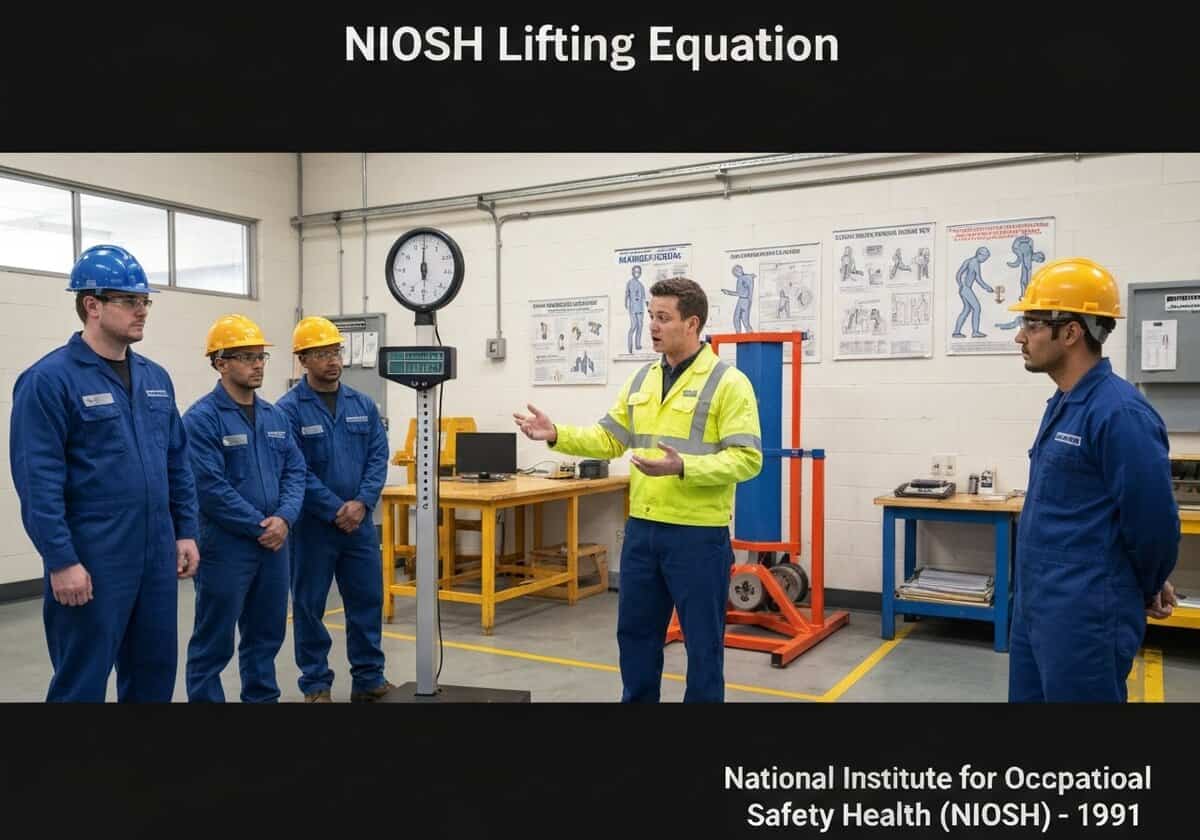
Occupational health professional demonstrating NIOSH Lifting Equation in industrial setting.

(generated image for illustration only)

The NIOSH lifting equation is a tool used by occupational health and safety professionals to assess the risk of musculoskeletal injury associated with manual lifting tasks. It calculates a Recommended Weight Limit (RWL) for a specific task, representing the maximum weight a healthy worker could lift without increased risk of low back injury, considering factors like task geometry and frequency.


The revised NIOSH lifting equation from 1991 provides a more comprehensive risk assessment than its 1981 predecessor. The core of the method is the calculation of the Recommended Weight Limit (RWL) using the formula: \(RWL = LC \times HM \times VM \times DM \times AM \times FM \times CM\). In this formula, LC is the Load Constant (51 lbs or 23 kg), which is the maximum recommended weight under ideal conditions. The other terms are multipliers, each with a value between 0 and 1, which reduce the allowable weight based on deviations from these ideal conditions. These multipliers are: HM (Horizontal Multiplier), VM (Vertical Multiplier), DM (Distance Multiplier), AM (Asymmetric Multiplier), FM (Frequency Multiplier), and CM (Coupling Multiplier). For example, the further an object is held from the body (increasing the horizontal distance), the smaller the HM value becomes, thus lowering the RWL. The equation also allows for the calculation of a Lifting Index (LI), where \(LI = \frac{Load Weight}{RWL}\). An LI greater than 1.0 indicates that the task is high-risk for some fraction of the workforce, and redesign should be prioritized. An LI of 3.0 or more is considered highly hazardous. The equation is a cornerstone of physical ergonomics, providing a quantitative, evidence-based method for evaluating and mitigating one of the most common causes of workplace injury.

UNESCO Nomenclature: 3307
– Industrial engineering

Type

Abstract System

Disruption

Incremental

Usage

Widespread Use

Precursors

  • biomechanical models of the lumbar spine
  • epidemiological studies linking manual lifting to low back pain
  • psychophysical studies on maximum acceptable weights
  • the original 1981 niosh lifting guide
  • static strength prediction models

Applications

  • job hazard analysis in manufacturing and logistics
  • redesign of workstations to reduce lifting risks
  • development of workplace safety standards and regulations
  • training programs for manual material handling
  • rehabilitation and return-to-work planning for injured employees

Patents:

NA

Potential Innovations Ideas

Due to scrapping bot traffic, currently more than 40k per day, this content is reserved to community members.
> Login < or > Register < (100% free) to access this, so as all other restricted content and tools.

Related to: NIOSH, lifting equation, RWL, recommended weight limit, musculoskeletal injury, occupational safety, biomechanics, manual handling, risk assessment, ergonomics.

Historical Context

NIOSH Lifting Equation

1990
1990
1990
1991
1992
1993
1994
1990
1990
1990
1990
1992
1992
1993-07-22
1996

(if date is unknown or not relevant, e.g. "fluid mechanics", a rounded estimation of its notable emergence is provided)

Related Invention, Innovation & Technical Principles

Full size images and downloads are only available, 100% free, for registered members.

> Login <