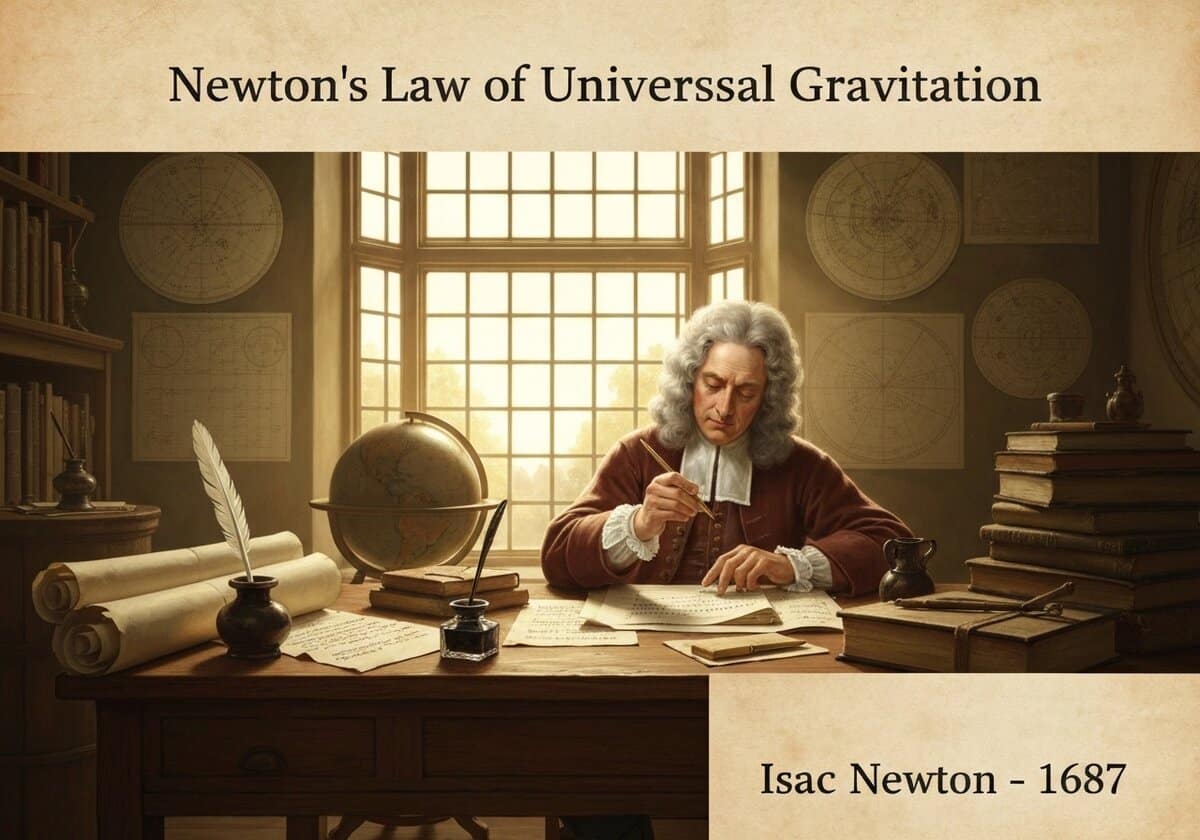
Newton’s Law of Universal Gravitation
This law states that every particle attracts every other particle in the universe with a force directly proportional to the product of their masses and inversely proportional to the square of the distance between their centers. The formula is \(F = G \frac{m_1 m_2}{r^2}\), where \(G\) is the gravitational constant. It unified terrestrial and celestial mechanics.
Newton’s law of universal gravitation was a landmark achievement, also published in his *Principia Mathematica*. It proposed a single, universal principle to explain both the falling of an apple on Earth and the orbits of the planets around the Sun, unifying terrestrial and celestial mechanics for the first time.
The law is expressed by the equation \(F = G \frac{m_1 m_2}{r^2}\). This equation embodies several profound concepts. The force is proportional to the product of the two masses (\(m_1\) and \(m_2\)), indicating that gravity is a property of mass itself. The force follows an inverse-square law, meaning it weakens with the square of the distance \(r\) between the objects. This mathematical form was crucial for correctly deriving Kepler’s laws of planetary motion. The force is always attractive and acts along the line connecting the centers of the two bodies. The constant of proportionality, \(G\), is the universal gravitational constant, a fundamental constant of nature whose value must be determined experimentally. Henry Cavendish first measured it with precision in 1798.
Newton’s theory was incredibly successful, allowing for precise predictions of planetary positions, explaining the ocean tides as a result of the Moon’s and Sun’s gravitational pull, and even leading to the discovery of Neptune through its gravitational perturbations on Uranus’s orbit.
Despite its success, the theory had conceptual difficulties, such as the idea of ‘action at a distance’—how gravity could act instantaneously across empty space. It also failed to perfectly account for the precession of Mercury’s orbit. These issues were ultimately resolved by Albert Einstein’s theory of General Relativity, which describes gravity not as a force, but as the curvature of spacetime caused by mass and energy. Nevertheless, Newton’s law remains an excellent and highly accurate approximation for nearly all practical applications.
UNESCO Nomenclature: 2211
– Physics
Precursors
- Kepler’s laws of planetary motion
- Galileo’s work on falling bodies
- Robert Hooke’s suggestions on an inverse-square law
- Copernican heliocentrism
Applications
- calculating satellite and planetary orbits
- predicting tides
- space exploration mission planning (e.g., gravity assist maneuvers)
- geophysical prospecting for mineral deposits
- predicting the existence of planets (e.g., Neptune)
Potential Innovations Ideas
Due to scrapping bot traffic, currently more than 40k per day, this content is reserved to community members.
> Login < or > Register < (100% free) to access this, so as all other restricted content and tools.
Related to: gravitation, newton, inverse-square law, gravity, celestial mechanics, orbits, universal gravitation constant, general relativity.