Product Design, Manufacturing & Innovation Resources
Home » Motional Electromotive Force

Motional Electromotive Force

1890
  • Hendrik Lorentz
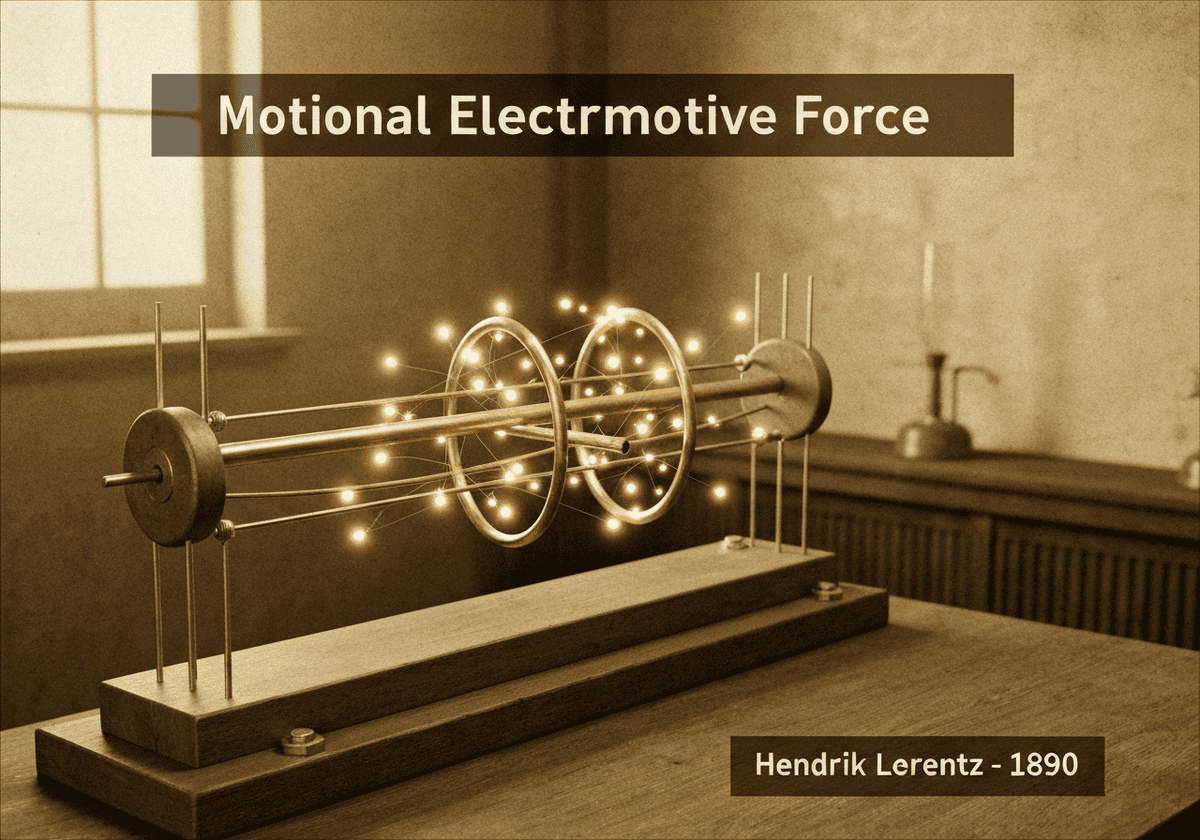
Homopolar generator demonstrating motional electromotive force in electricity and magnetism.

(generated image for illustration only)

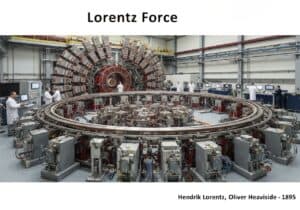
Motional EMF is generated when a conductor moves through a magnetic field. The magnetic component of the Lorentz force, \(\mathbf{F} = q(\mathbf{v} \times \mathbf{B})\), acts on the charge carriers within the conductor, causing them to move and create a charge separation. This separation establishes an electric field and a potential difference. The resulting EMF is given by the line integral \(\mathcal{E} = \oint (\mathbf{v} \times \mathbf{B}) \cdot d\mathbf{l}\).
Motional EMF is a direct consequence of the Lorentz force acting on mobile charges inside a conductor that is moving relative to a magnetic field. As the conductor moves with velocity \(\mathbf{v}\) through a magnetic field \(\mathbf{B}\), the free charges (electrons) within it experience a magnetic force \(\mathbf{F}_m = q(\mathbf{v} \times \mathbf{B})\). This force is perpendicular to both the velocity and the magnetic field, causing the charges to accumulate at one end of the conductor, leaving the other end with a net positive charge. This charge separation creates an internal electrostatic field \(\mathbf{E}_e\) that opposes the further migration of charges. Equilibrium is reached when the electrostatic force \(\mathbf{F}_e = q\mathbf{E}_e\) exactly balances the magnetic force, i.e., \(q\mathbf{E}_e = -q(\mathbf{v} \times \mathbf{B})\).

The effective electric field experienced by the charges, \(\mathbf{E}_{eff} = \mathbf{v} \times \mathbf{B}\), is a non-conservative field that drives the current. The EMF is the work done per unit charge by this effective field integrated along the length of the conductor. For a straight wire of length \(L\) moving perpendicular to a uniform field \(B\), the EMF simplifies to \(\mathcal{E} = BLv\). While motional EMF can be seen as a specific case of Faraday’s law of induction (in terms of changing flux), the Lorentz force perspective provides a more microscopic explanation of the mechanism responsible for the charge separation and the resulting voltage.

UNESCO Nomenclature: 2205
– Electricity and Magnetism

Type

Physical Phenomenon

Disruption

Substantial

Usage

Widespread Use

Precursors

  • Michael Faraday’s discovery of electromagnetic induction
  • James Clerk Maxwell’s equations of electromagnetism
  • Discovery of the electron by J.J. Thomson

Applications

  • homopolar generators
  • railguns
  • magnetohydrodynamic (mhd) generators
  • eddy current brakes
  • electrodynamic tethers in space

Patents:

NA

Potential Innovations Ideas

Due to scrapping bot traffic, currently more than 40k per day, this content is reserved to community members.
> Login < or > Register < (100% free) to access this, so as all other restricted content and tools.

Related to: motional EMF, Lorentz force, magnetic field, conductor, velocity, generator, charge separation, induction.

Historical Context

Motional Electromotive Force

1887
1888
1889
1890
1890
1895
1895
1885
1887
1889
1890
1890
1895
1895
1896

(if date is unknown or not relevant, e.g. "fluid mechanics", a rounded estimation of its notable emergence is provided)

Related Invention, Innovation & Technical Principles

Full size images and downloads are only available, 100% free, for registered members.

> Login <