Product Design, Manufacturing & Innovation Resources
Home » Magnetic Dipole Moment

Magnetic Dipole Moment

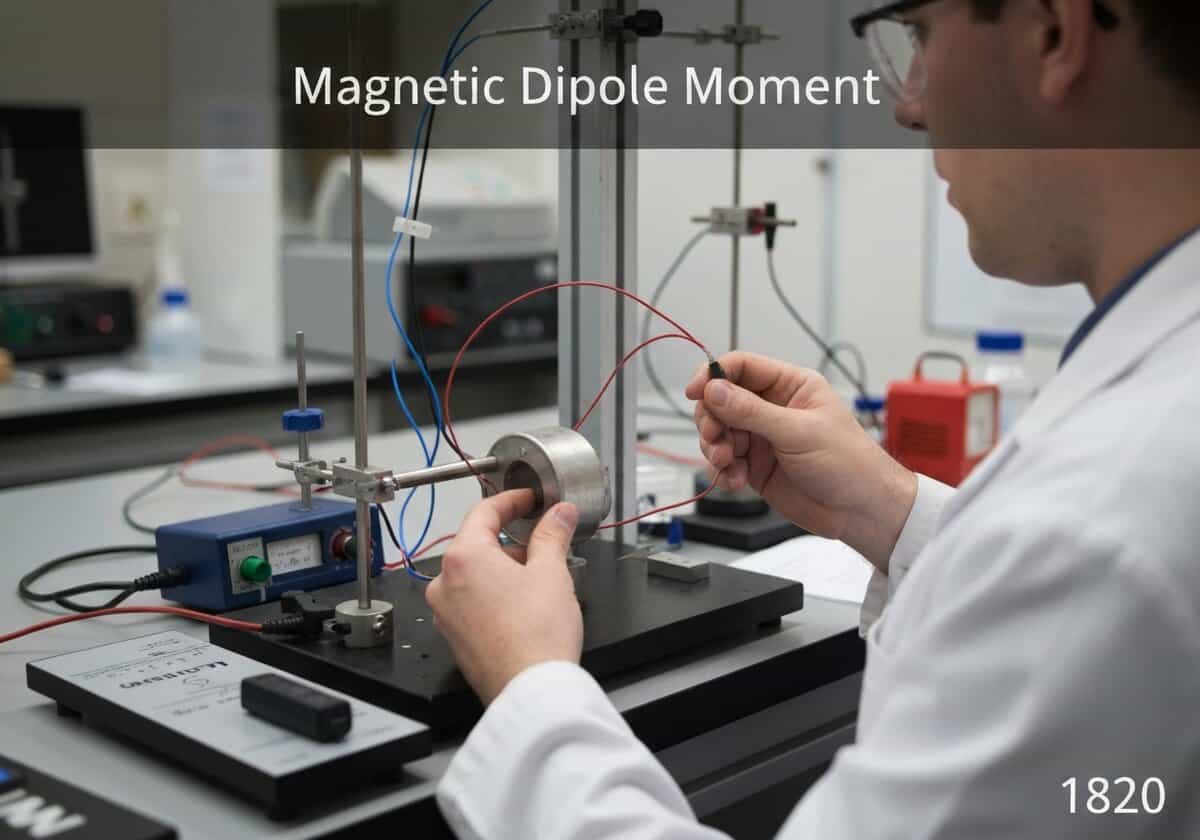
1820
Laboratory setup for studying magnetic dipole moment in electromagnetism.

(generated image for illustration only)

A magnet’s magnetic moment is a vector quantity that characterizes its overall magnetic properties. It can be visualized as a magnetic dipole, a hypothetical pair of north and south poles separated by a distance. The moment points from the south to the north pole. For a current loop, the magnetic moment \(\vec{\mu} = I \vec{A}\), where I is the current and A is the area vector.

The magnetic dipole moment is the fundamental quantity describing a magnetic source. In classical physics, it arises from electric currents. Ampère hypothesized that all magnetism is due to microscopic current loops, known as “Ampèrian currents,” within materials. This model explains why breaking a magnet in half creates two new magnets, each with its own north and south pole, rather than isolating the poles. The magnetic moment vector \(\vec{\mu}\) is crucial for calculating the torque \(\vec{\tau} = \vec{\mu} \times \vec{B}\) experienced by a magnet in an external magnetic field \(\vec{B}\), and the potential energy \(U = -\vec{\mu} \cdot \vec{B}\).

In quantum mechanics, the magnetic moment is an intrinsic property of elementary particles, like electrons, due to their spin. This intrinsic spin magnetic moment is a purely quantum effect and is not due to any physical spinning or current loop. The total magnetic moment of an atom is the vector sum of the orbital magnetic moments (from electrons orbiting the nucleus) and the intrinsic spin magnetic moments of its electrons and nucleus. In most materials, these moments are randomly oriented and cancel out. However, in magnetic materials, a significant number of these moments can align, creating a net macroscopic magnetic moment and thus a magnetic field.

UNESCO Nomenclature: 2212
– Electromagnetism

Type

Abstract System

Disruption

Foundational

Usage

Widespread Use

Precursors

  • discovery of the magnetic compass
  • observation of attraction and repulsion between lodestones
  • øersted’s discovery of the connection between electricity and magnetism
  • ampère’s force law

Applications

  • magnetic resonance imaging (mri)
  • particle accelerators
  • data storage (hard drives)
  • electric motors and generators
  • compasses

Patents:

NA

Potential Innovations Ideas

Due to scrapping bot traffic, currently more than 40k per day, this content is reserved to community members.
> Login < or > Register < (100% free) to access this, so as all other restricted content and tools.

Related to: magnetic moment, dipole, ampèrian currents, torque, potential energy, quantum spin, vector, magnetism, electromagnetism, physics.

Historical Context

Magnetic Dipole Moment

1811
1816-11-16
1820
1820
1821
1822
1827
1810
1816
1816-11-16
1820
1820
1822
1824
1827

(if date is unknown or not relevant, e.g. "fluid mechanics", a rounded estimation of its notable emergence is provided)

Related Invention, Innovation & Technical Principles

Full size images and downloads are only available, 100% free, for registered members.

> Login <