Liquid-Liquid Extraction
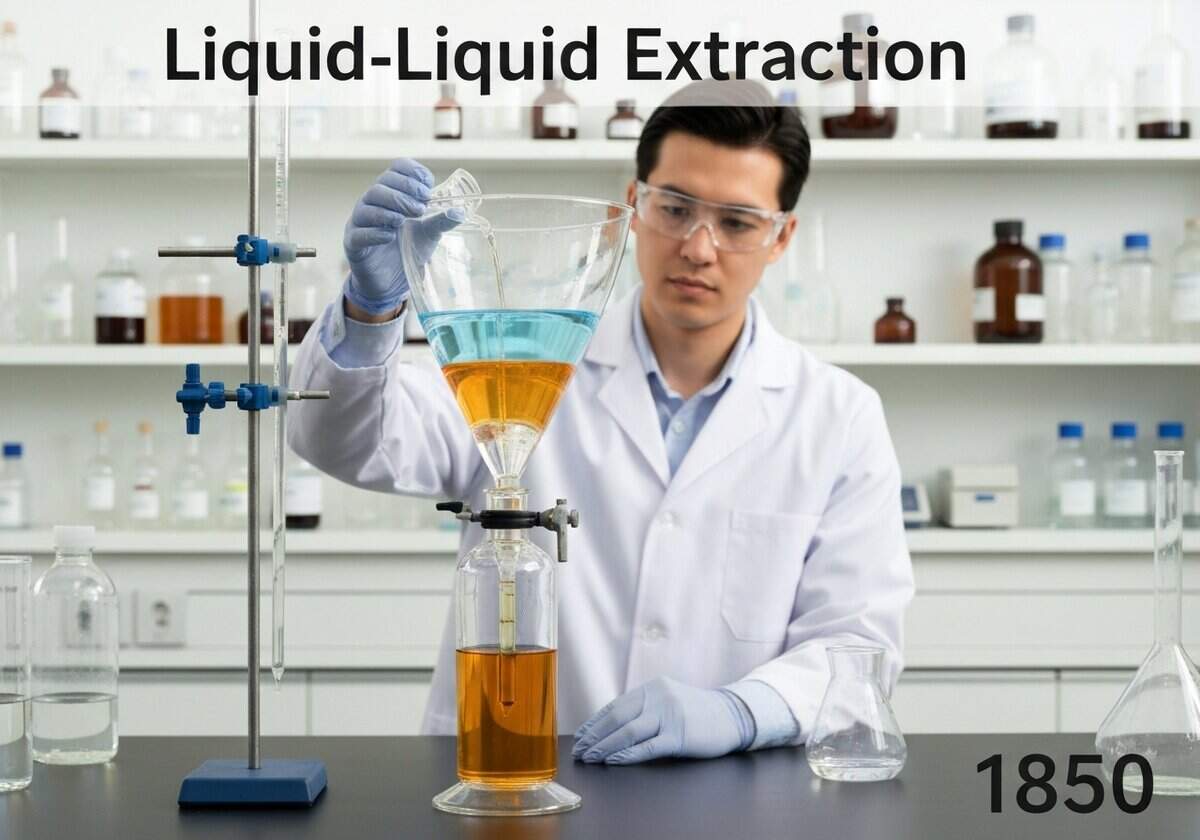
Liquid-liquid extraction (LLE) is a separation method based on the differential solubility of a solute between two immiscible or partially miscible liquid phases. A compound partitions from a feed phase (often aqueous) into a solvent phase (often organic). The transfer is driven by differences in chemical potential, ceasing when equilibrium is reached and the solute is distributed between phases.
The fundamental principle of liquid-liquid extraction, also known as solvent extraction, hinges on the concept of phase equilibrium. When a solute is introduced into a system containing two immiscible liquid phases, it will distribute itself between them until its chemical potential is equal in both phases. This equilibrium state is described by the partition coefficient or distribution coefficient, which quantifies the ratio of the solute’s concentration in the two phases. The choice of solvent is critical; an ideal solvent should have a high affinity for the target solute (high distribution coefficient), low solubility in the feed phase, a significant density difference from the feed phase for easy separation, and be non-toxic, inexpensive, and easily recoverable.
The process involves three main steps: contacting, separation, and solvent recovery. In the contacting stage, the feed solution and the extraction solvent are mixed vigorously to create a large interfacial area, which facilitates rapid mass transfer of the solute from the feed to the solvent phase. Following this, the mixture is allowed to settle in a separation stage, where the two immiscible phases separate due to their density difference, forming a distinct interface. The solvent phase, now enriched with the solute, is called the extract, while the depleted feed phase is termed the raffinate. Finally, the solute is typically recovered from the extract, and the solvent is regenerated for reuse, often through another separation process like distillation or stripping. This principle is highly versatile and can be applied to a wide range of chemical species, from small organic molecules to large metal complexes.
UNESCO Nomenclature: 3305
– Chemical engineering
Precursors
- concept of solubility and ‘like dissolves like’
- discovery of immiscible liquids
- alchemical practices of distillation and separation
- understanding of chemical equilibrium and thermodynamics
Applications
- purification of pharmaceuticals
- extraction of metals from ores (hydrometallurgy)
- nuclear fuel reprocessing
- production of fine organic chemicals
- removal of pollutants from wastewater
- food processing (e.g., decaffeination)
Potential Innovations Ideas
Due to scrapping bot traffic, currently more than 40k per day, this content is reserved to community members.
> Login < or > Register < (100% free) to access this, so as all other restricted content and tools.
Related to: liquid-liquid extraction, solvent extraction, phase equilibrium, mass transfer, solubility, separation process, chemical potential, raffinate, extract, immiscible liquids.