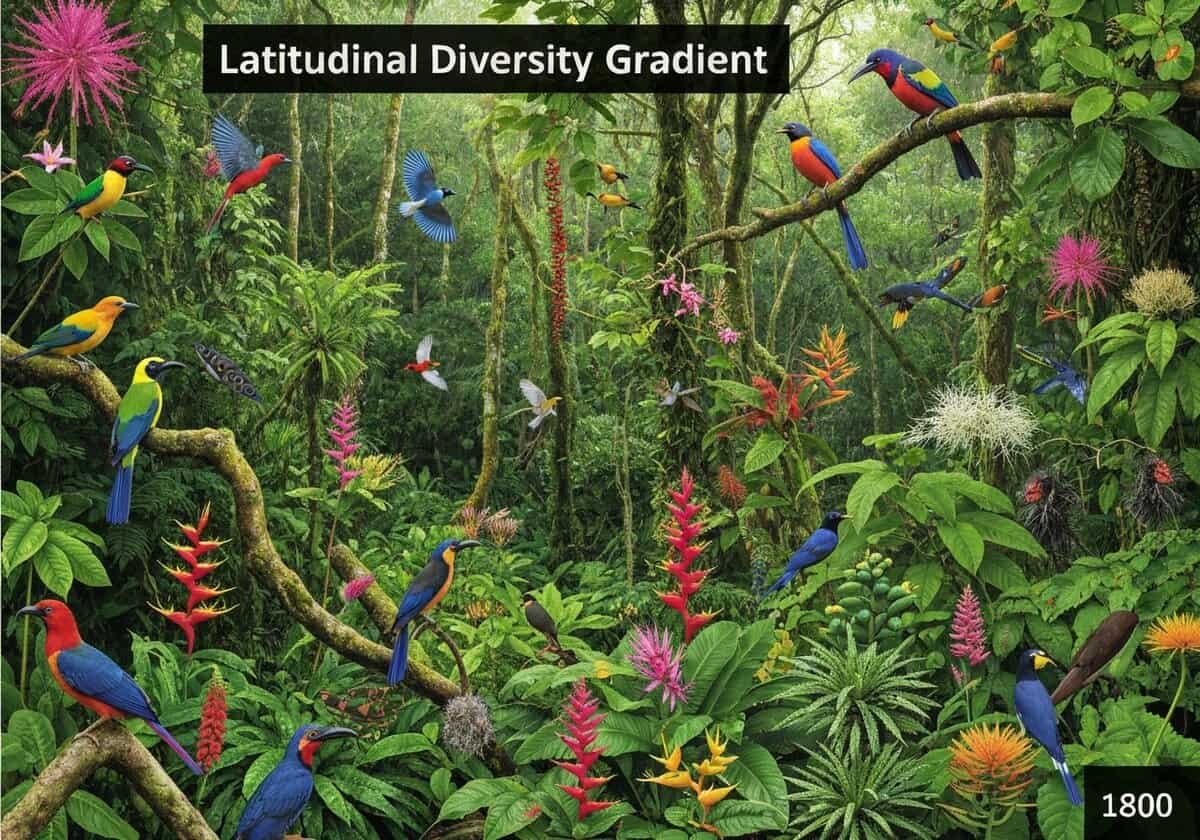
Latitudinal Diversity Gradient (LDG)
The Latitudinal Diversity Gradient is one of the most recognized global patterns in ecology. It describes the general increase in biodiversity, measured as species richness, from the high-latitude polar regions to the low-latitude tropics. This pattern is observed across a wide range of taxonomic groups, including mammals, birds, insects, and plants, in both terrestrial and marine environments.
The observation that the tropics are teeming with life compared to the poles is ancient, but it was systematically documented by 18th and 19th-century naturalists like Alexander von Humboldt and Alfred Russel Wallace during their expeditions. This pattern, the Latitudinal Diversity Gradient (LDG), has since been confirmed for nearly every major group of organisms. For example, Colombia, a tropical country, has around 1,900 bird species, while the entire Arctic region has fewer than 100. The gradient is a fundamental macroecological pattern that demands an explanation, and dozens of hypotheses have been proposed, though no single one is universally accepted.
These hypotheses can be broadly grouped into several categories. Historical hypotheses suggest the tropics are older and have been more climatically stable over geological time, allowing more time for speciation to occur and less extinction to interrupt it (the ‘tropics as cradle and museum’ idea). Ecological hypotheses focus on current environmental conditions. For instance, the tropics receive more solar energy, which increases productivity at the base of the food web, potentially supporting more species. The ‘climatic harshness’ hypothesis suggests that the stable, favorable conditions of the tropics allow for finer niche specialization, enabling more species to coexist. Evolutionary hypotheses propose that speciation rates are intrinsically higher in the tropics, perhaps due to faster metabolic rates driven by higher temperatures, leading to shorter generation times and more rapid genetic divergence.
Understanding the mechanisms behind the LDG is a central goal of ecology and biogeography. It is not merely an academic puzzle; it has profound implications for conservation. The gradient means that a disproportionate amount of Earth’s biodiversity is concentrated in tropical countries, many of which are developing nations facing significant economic and social pressures that can lead to habitat destruction. Furthermore, climate change is predicted to disrupt this pattern, potentially pushing species’ ranges poleward and altering the very structure of global biodiversity.
UNESCO Nomenclature: 2407
– Ecology
Precursors
- Linnaean taxonomy for classifying and counting species
- age of exploration and naturalist expeditions (e.g., by Humboldt, Wallace)
- Darwin’s theory of evolution by natural selection
- development of the concept of biomes and ecosystems
Applications
- predicting the potential impacts of global warming on species distributions
- guiding global conservation strategies to focus on tropical regions
- serving as a baseline for biogeographical and macroecological research
- informing theories about the mechanisms that generate and maintain biodiversity
- understanding the evolutionary history of different clades
Potential Innovations Ideas
Due to scrapping bot traffic, currently more than 40k per day, this content is reserved to community members.
> Login < or > Register < (100% free) to access this, so as all other restricted content and tools.
Related to: latitudinal gradient, biodiversity, species richness, tropics, macroecology, biogeography, ecology, alexander von humboldt, climate, speciation.