Product Design, Manufacturing & Innovation Resources
Home » Lanthanide Contraction

Lanthanide Contraction

1925
  • Victor Goldschmidt
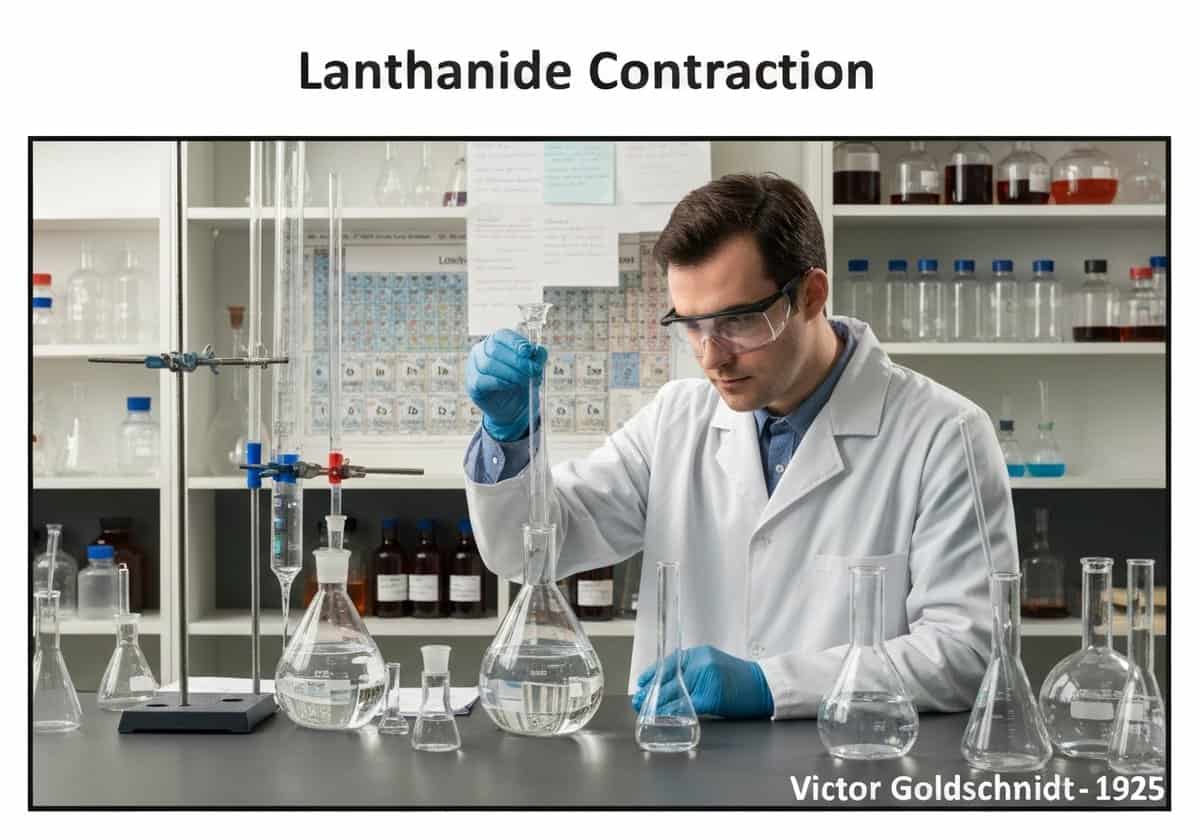
Laboratory experiment on lanthanide elements in inorganic chemistry.

(generated image for illustration only)

The lanthanide contraction is the steady decrease in the atomic and ionic radii of the lanthanide elements (lanthanum to lutetium) with increasing atomic number. This effect is caused by the poor shielding of the nuclear charge by the 4f electrons. It results in the 6th-period elements following the lanthanides being unexpectedly small, similar to their 5th-period counterparts.


The lanthanide contraction is a fundamental concept in inorganic chemistry that explains periodic trends involving the f-block elements. As one moves across the lanthanide series from cerium to lutetium, a proton is added to the nucleus and an electron is added to the 4f subshell with each step. The 4f orbitals are large and diffuse, meaning they are very poor at shielding the outer valence electrons (in the 5d and 6s orbitals) from the increasing positive charge of the nucleus. Consequently, the effective nuclear charge experienced by these outer electrons increases significantly across the series. This stronger attraction pulls the valence electrons closer to the nucleus, causing a gradual decrease in both atomic and ionic radii.

This contraction has profound consequences for the chemistry of the elements that follow the lanthanides in the periodic table (the 6th period transition metals, such as hafnium, tantalum, and tungsten). The total size decrease across the lanthanide series nearly perfectly cancels out the expected size increase from moving down a group from the 5th period to the 6th period. As a result, the atomic radius of hafnium (159 pm) is almost identical to that of zirconium (160 pm), the element directly above it. This similarity in size and electronic configuration makes their chemical properties remarkably alike, leading to their co-occurrence in nature and making their separation one of the most difficult in chemistry. The same effect is observed for pairs like niobium/tantalum and molybdenum/tungsten. Furthermore, the increased effective nuclear charge and smaller size contribute to the high densities and high ionization energies of the post-lanthanide elements.

UNESCO Nomenclature: 2206
– Inorganic chemistry

Type

Chemical Property

Disruption

Foundational

Usage

Widespread Use

Precursors

  • development of the Bohr model of the atom
  • discovery of the lanthanide elements
  • formulation of quantum mechanics and atomic orbital theory
  • Moseley’s law relating atomic number to x-ray spectra

Applications

  • chemical separation of lanthanides from each other
  • explains the extreme chemical similarity of zirconium and hafnium, making their separation difficult
  • contributes to the high density of post-lanthanide elements like gold and platinum
  • influences the coordination chemistry and catalytic activity of lanthanide compounds

Patents:

NA

Potential Innovations Ideas

Due to scrapping bot traffic, currently more than 40k per day, this content is reserved to community members.
> Login < or > Register < (100% free) to access this, so as all other restricted content and tools.

Related to: lanthanide contraction, atomic radius, f-block, shielding effect, lanthanides, periodic trends, geochemistry, zirconium, hafnium, Victor Goldschmidt.

Historical Context

Lanthanide Contraction

1921
1924
1924
1925
1926
1927
1927
1921
1922
1924
1925
1926
1926
1927
1930

(if date is unknown or not relevant, e.g. "fluid mechanics", a rounded estimation of its notable emergence is provided)

Related Invention, Innovation & Technical Principles

Full size images and downloads are only available, 100% free, for registered members.

> Login <