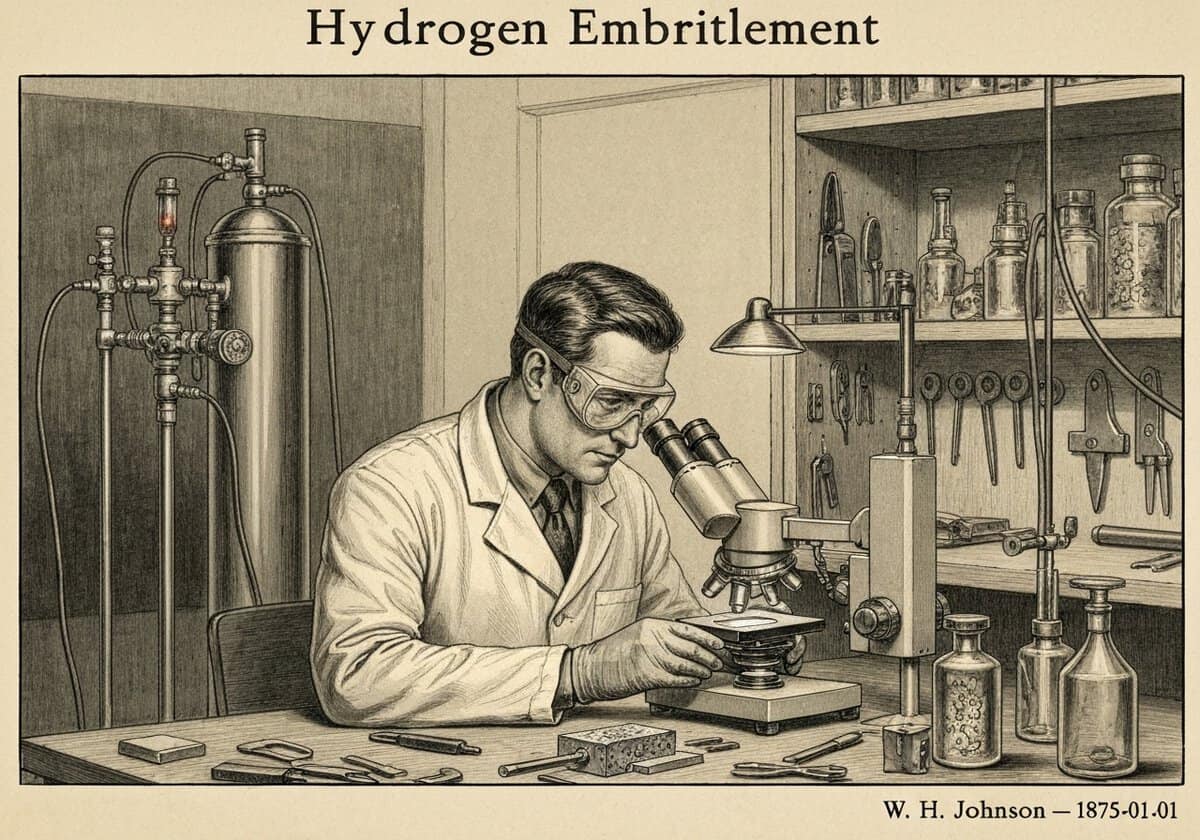
Hydrogen Embrittlement
Hydrogen embrittlement (HE) is a process where metals, most notably high-strength steels, become brittle and fracture following exposure to hydrogen. Atomic hydrogen diffuses into the metal lattice and reduces its ductility and load-bearing capacity. Key proposed mechanisms include Hydrogen-Enhanced Decohesion (HEDE), which weakens atomic bonds, and Hydrogen-Enhanced Localized Plasticity (HELP), which facilitates dislocation motion and localized failure.
The technical context of hydrogen embrittlement involves the ingress of atomic hydrogen into a susceptible material, often under tensile stress. Sources of hydrogen are varied and include manufacturing processes like electroplating, welding, and pickling, as well as operational environments involving corrosion or high-pressure hydrogen gas. Once inside the metal, hydrogen atoms, being very small, can diffuse rapidly through the crystal lattice. They tend to accumulate at stress concentration sites such as crack tips, grain boundaries, and inclusions.
The HEDE model suggests that this accumulation of hydrogen lowers the cohesive energy required to separate metal atoms, promoting brittle fracture along crystallographic planes or grain boundaries. In contrast, the HELP model posits that hydrogen enhances the mobility of dislocations, leading to intense, localized plastic deformation and the formation of micro-voids that coalesce into a crack. It is now widely believed that both mechanisms can operate, sometimes simultaneously, depending on the material, temperature, and hydrogen concentration. This understanding was a significant novelty, shifting the view of fracture from a purely mechanical process to one heavily influenced by chemical interactions at the atomic level, fundamentally changing how high-strength materials are designed and protected.
UNESCO Nomenclature: 3308
– Materials science
Precursors
- discovery of the element hydrogen by henry cavendish
- development of atomic theory by john dalton
- understanding of crystallography and metal lattice structures
- early observations of metal failures in industrial processes like acid pickling
- development of mechanical testing methods to measure ductility and strength
Applications
- development of hydrogen-resistant alloys for pipelines and storage tanks
- guidelines for welding and electroplating high-strength steels to prevent hydrogen uptake
- design criteria for components in the petrochemical and aerospace industries
- failure analysis of bolts, welds, and structural components exposed to corrosive environments
Potential Innovations Ideas
Due to scrapping bot traffic, currently more than 40k per day, this content is reserved to community members.
> Login < or > Register < (100% free) to access this, so as all other restricted content and tools.
Related to: hydrogen embrittlement, steel, ductility, fracture, HELP, HEDE, diffusion, corrosion, failure analysis, metallurgy.