Product Design, Manufacturing & Innovation Resources
Home » Heat Exchanger Fouling

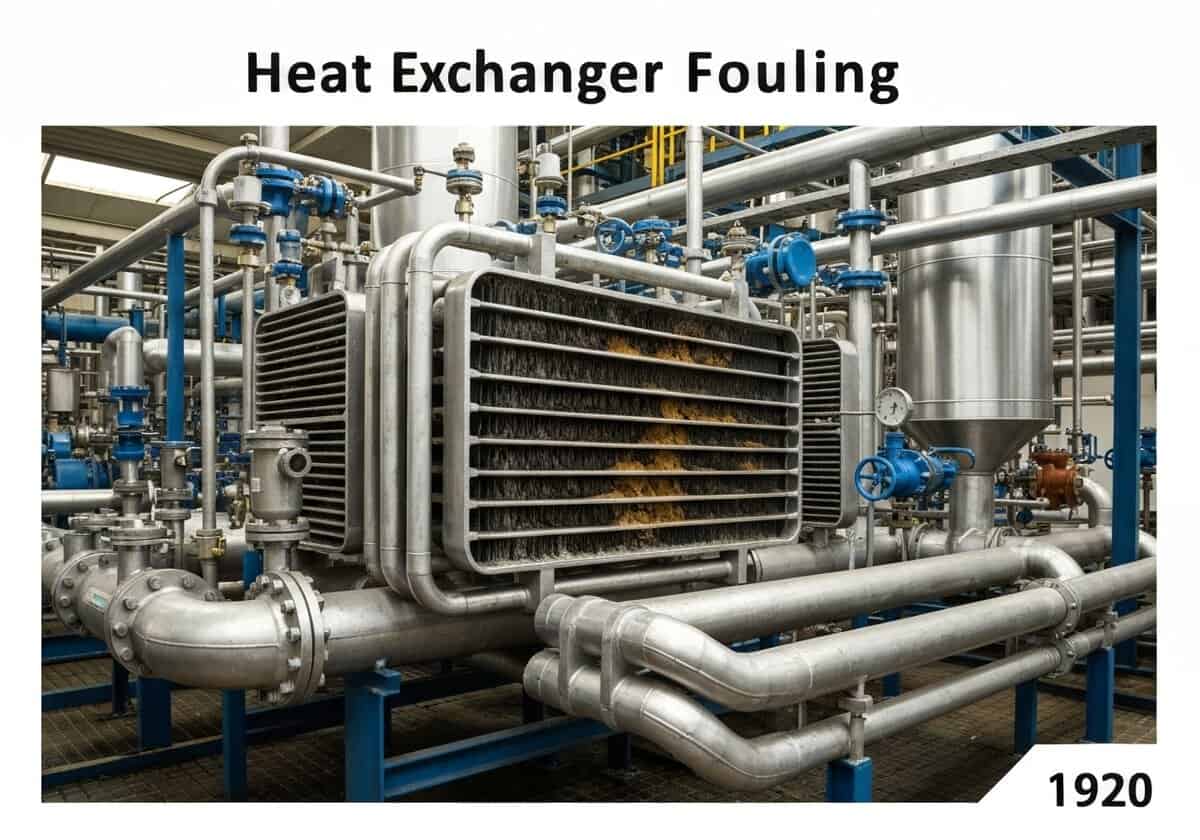
Heat Exchanger Fouling

1920
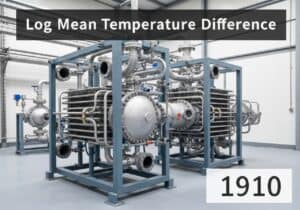
Heat exchanger with fouling deposits affecting thermal performance in thermodynamics.

(generated image for illustration only)

Fouling is the accumulation of unwanted material on heat transfer surfaces, which introduces an additional thermal resistance and degrades the performance of a heat exchanger. This fouling resistance (\(R_f\)) reduces the overall heat transfer coefficient (U). The effect is quantified in the overall heat transfer equation: \(\frac{1}{U} = \frac{1}{h_i} + \frac{1}{h_o} + R_f + R_w\).

Fouling is a critical, time-dependent problem in nearly all heat exchanger applications. It increases thermal resistance, impedes fluid flow (increasing pressure drop and pumping costs), and can initiate corrosion. There are several types of fouling. Precipitation fouling occurs when dissolved solids in a fluid precipitate onto surfaces, common in cooling water systems (scaling). Particulate fouling is the accumulation of suspended particles like dust or rust. Corrosion fouling results from the heat transfer surface itself reacting to form an insulating layer of corrosion products. Chemical reaction fouling involves reactions within the process fluid that form deposits, such as in polymerization processes. Finally, biofouling is the growth of microorganisms, algae, or slime on surfaces, prevalent in raw water systems. To account for this inevitable degradation, engineers include a ‘fouling factor’ or ‘fouling resistance’ (\(R_f\)) during the design phase. This essentially means the heat exchanger is oversized to ensure it still meets the required heat duty after a certain period of operation with the expected level of fouling. The overall heat transfer coefficient for a clean exchanger (\(U_{clean}\)) is related to the dirty or service coefficient (\(U_{dirty}\)) by \(\frac{1}{U_{dirty}} = \frac{1}{U_{clean}} + R_f\). Managing and mitigating fouling through chemical treatment, filtration, and periodic cleaning is a major aspect of industrial maintenance.

UNESCO Nomenclature: 3328
– Thermodynamics

Type

Physical Process

Disruption

Incremental

Usage

Widespread Use

Precursors

  • observation of scale buildup in boilers and kettles
  • understanding of thermal resistance and Fourier’s law
  • development of industrial chemistry and water treatment
  • advances in material science and corrosion studies

Applications

  • predictive maintenance schedules for industrial plants
  • design of chemical cleaning procedures for process equipment
  • development of anti-fouling coatings and materials
  • water treatment programs for cooling towers and boilers
  • oversizing of new heat exchangers to account for future fouling

Patents:

NA

Potential Innovations Ideas

Due to scrapping bot traffic, currently more than 40k per day, this content is reserved to community members.
> Login < or > Register < (100% free) to access this, so as all other restricted content and tools.

Related to: fouling, scaling, heat exchanger, thermal resistance, maintenance, heat transfer, overall heat transfer coefficient, biofouling, pressure drop, cleaning.

Historical Context

Heat Exchanger Fouling

1910
1920
1920
1920
1922
1925-01-01
1930
1910
1920
1920
1920
1922
1924
1927
1930

(if date is unknown or not relevant, e.g. "fluid mechanics", a rounded estimation of its notable emergence is provided)

Related Invention, Innovation & Technical Principles

Full size images and downloads are only available, 100% free, for registered members.

> Login <