Hamiltonian Mechanics
A reformulation of classical mechanics that uses generalized coordinates and their conjugate momenta. It is based on the Hamiltonian function, \(H(q, p, t)\), representing the system’s total energy. The dynamics are described by Hamilton’s equations: \(\dot{q}_i = \frac{\partial H}{\partial p_i}\) and \(\dot{p}_i = -\frac{\partial H}{\partial q_i}\). This framework is central to quantum mechanics and statistical mechanics.
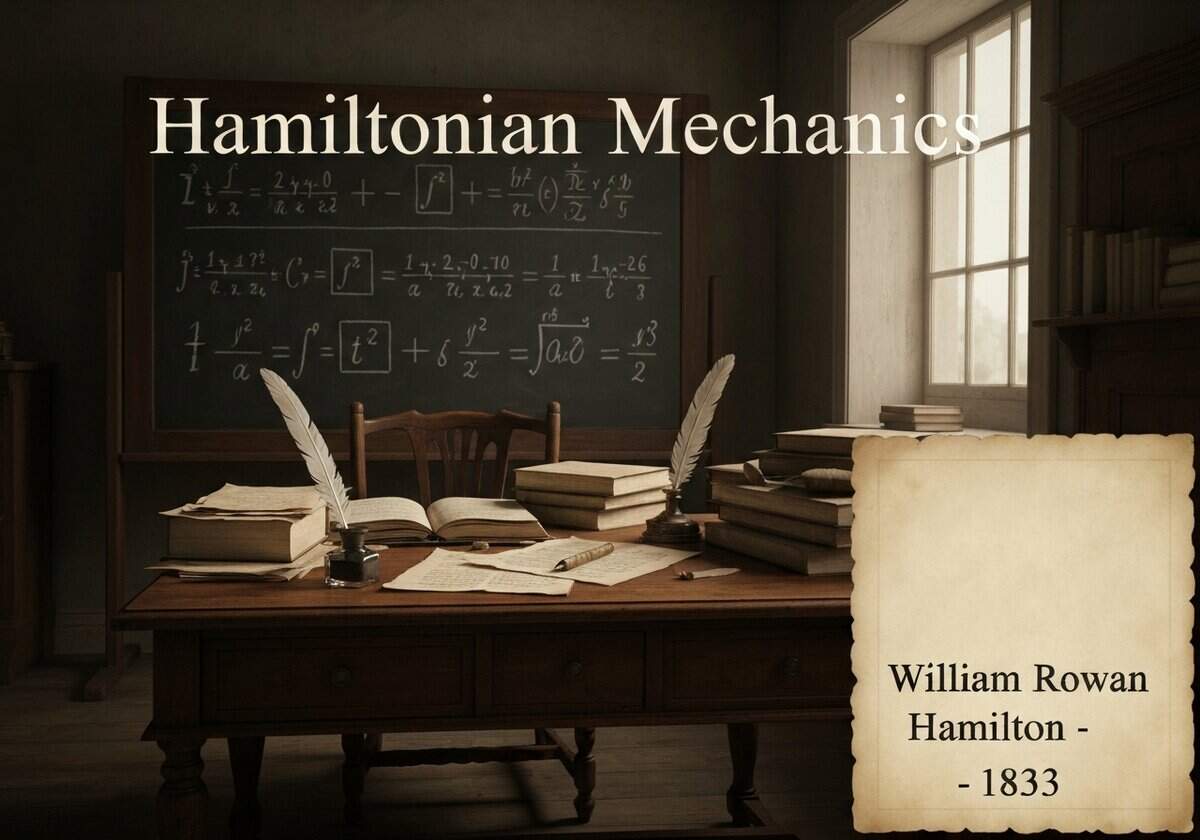
Hamiltonian mechanics, developed by William Rowan Hamilton, is a further abstraction of classical mechanics, building upon the Lagrangian framework. Its natural setting is phase space, an abstract space where the axes are the generalized coordinates (\(q_i\)) and their corresponding generalized momenta (\(p_i = \frac{\partial L}{\partial \dot{q}_i}\)). The complete state of a system at any instant is represented by a single point in this phase space.
The central function is the Hamiltonian, \(H(q, p, t)\), which is derived from the Lagrangian via a Legendre transformation. For many common systems, the Hamiltonian is simply the total energy, \(H = T + V\). The system’s evolution in time is governed by a set of first-order differential equations known as Hamilton’s equations: \(\dot{q}_i = \frac{\partial H}{\partial p_i}\) and \(\dot{p}_i = -\frac{\partial H}{\partial q_i}\). These equations are symmetric and often easier to work with than the second-order Euler-Lagrange equations.
A profound aspect of this formalism is its deep connection to other areas of physics. The structure of Hamiltonian mechanics is preserved under a class of transformations called canonical transformations. The time evolution of any quantity \(f(q, p)\) can be expressed using Poisson brackets, a mathematical operation that has a direct analogue in quantum mechanics: the commutator. This makes Hamiltonian mechanics the most direct classical precursor to quantum theory.
Furthermore, Hamiltonian mechanics is the foundation of statistical mechanics. Liouville’s theorem, a direct consequence of Hamilton’s equations, states that the volume of a region in phase space is conserved as it evolves in time. This principle is crucial for understanding the behavior of large ensembles of particles, such as atoms in a gas.
UNESCO Nomenclature: 2211
– Physics
Precursors
- Lagrangian mechanics
- Legendre transformation
- Calculus of variations
- Newtonian mechanics
Applications
- quantum mechanics (schrödinger equation formulation)
- statistical mechanics (phase space and liouville’s theorem)
- celestial mechanics (perturbation theory)
- control theory and optimal control
- geometric optics
Potential Innovations Ideas
Due to scrapping bot traffic, currently more than 40k per day, this content is reserved to community members.
> Login < or > Register < (100% free) to access this, so as all other restricted content and tools.
Related to: hamiltonian, phase space, canonical coordinates, conjugate momentum, poisson brackets, quantum mechanics, statistical mechanics, symplectic geometry.