Product Design, Manufacturing & Innovation Resources
Home » Half-Reaction Method

Half-Reaction Method

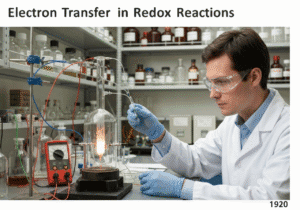
1920
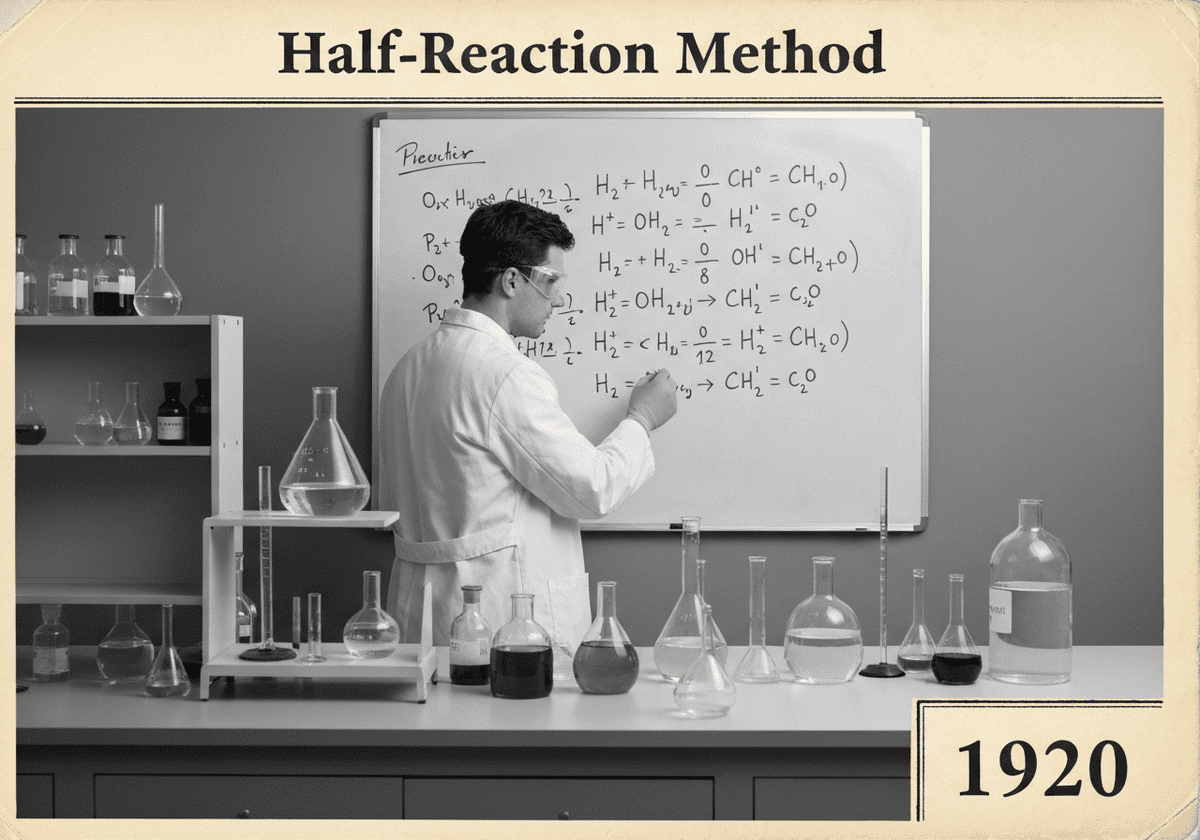
Chemist balancing redox reactions using the half-reaction method in analytical chemistry.

(generated image for illustration only)

Complex redox reactions can be balanced using the half-reaction method. The overall reaction is split into two separate half-reactions: one for oxidation and one for reduction. Each half-reaction is balanced for atoms and charge independently, often by adding H+, OH-, and H2O in aqueous solutions. Finally, the electron counts are equalized and the half-reactions are combined.
The half-reaction method, also known as the ion-electron method, provides a systematic way to balance redox equations that would be difficult to balance by simple inspection. The process involves several steps. First, the reaction is split into an oxidation half-reaction and a reduction half-reaction. For each half-reaction, all elements other than oxygen and hydrogen are balanced. Then, oxygen atoms are balanced by adding water (\(H_2O\)) molecules. Hydrogen atoms are then balanced by adding hydrogen ions (\(H^+\)) in acidic solution, or water molecules in basic solution (with \(OH^-\) added to the other side).

After mass is balanced, charge is balanced by adding electrons (\(e^-\)) to the more positive side. The oxidation half-reaction will have electrons as a product, while the reduction half-reaction will have them as a reactant. The next crucial step is to multiply each half-reaction by an integer so that the number of electrons lost in the oxidation half equals the number of electrons gained in the reduction half. Finally, the two balanced half-reactions are added together, and any species that appear on both sides of the equation are canceled out. This rigorous method ensures that both mass and charge are conserved, which is essential for accurate stoichiometric analysis.

UNESCO Nomenclature: 2201
– Analytical chemistry

Type

Software/Algorithm

Disruption

Substantial

Usage

Widespread Use

Precursors

  • law of conservation of mass
  • law of conservation of charge
  • understanding of redox as electron transfer
  • concept of ions in solution

Applications

  • stoichiometric calculations in analytical chemistry
  • electrochemistry (describing processes at electrodes)
  • corrosion science
  • environmental chemistry (e.g., analyzing water treatment processes)

Patents:

NA

Potential Innovations Ideas

Due to scrapping bot traffic, currently more than 40k per day, this content is reserved to community members.
> Login < or > Register < (100% free) to access this, so as all other restricted content and tools.

Related to: half-reaction, balancing equations, redox stoichiometry, electrochemistry, oxidation half-reaction, reduction half-reaction, ion-electron method, aqueous solution.

Historical Context

Half-Reaction Method

1916
1918
1919-05-29
1920
1920
1921
1924
1916
1917
1918
1920
1920
1921
1922
1924

(if date is unknown or not relevant, e.g. "fluid mechanics", a rounded estimation of its notable emergence is provided)

Related Invention, Innovation & Technical Principles

Full size images and downloads are only available, 100% free, for registered members.

> Login <