Product Design, Manufacturing & Innovation Resources
Home » Geomagnetic Secular Variation

Geomagnetic Secular Variation

1650
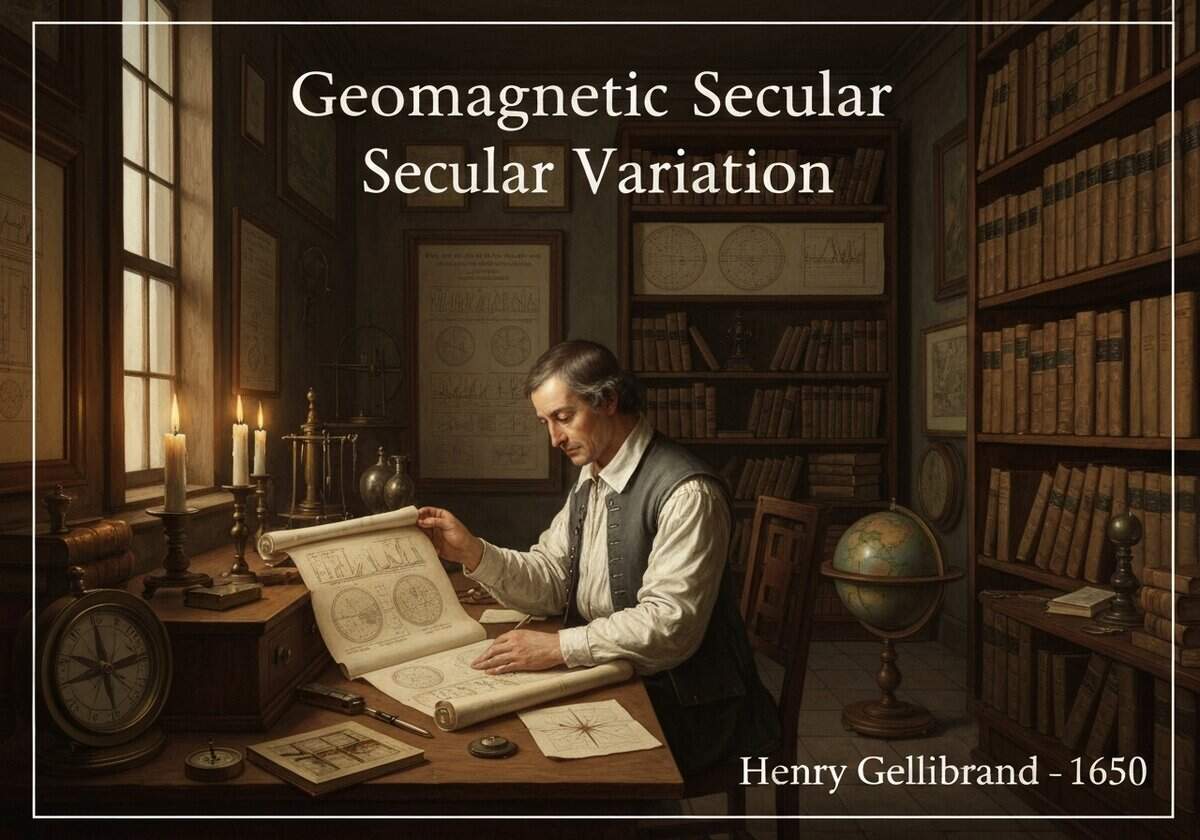
  • Henry Gellibrand
17th century geophysicist studying geomagnetic secular variation data.

(generated image for illustration only)

Geomagnetic secular variation refers to the slow changes in Earth’s magnetic field on timescales of years to millennia. These changes include shifts in field strength and the direction of the dipole axis, as well as the westward drift of non-dipole features. This variation is caused by the changing flow of molten iron in the outer core, the source of the geodynamo.

Secular variation is observed through continuous monitoring of the magnetic field at observatories and by satellites. The most prominent features include the decay of the main dipole component and the westward drift. The dipole moment has been decreasing at a rate of about 5% per century, which, if it continues, could lead to a geomagnetic reversal in a few thousand years. The westward drift is the tendency for non-dipolar features of the field, such as areas of high or low intensity, to move westward at approximately 0.2 degrees per year. This is thought to reflect a difference in rotation speed between the outer core and the overlying mantle.

On shorter timescales, scientists have observed ‘geomagnetic jerks,’ which are abrupt changes in the rate of secular variation, occurring over just a year or two. These are unpredictable and are thought to be caused by rapid changes in the fluid flow within the core. Because of secular variation, magnetic maps and models must be regularly updated. The World Magnetic Model (WMM), for instance, is updated every five years and is essential for navigation in applications ranging from military and commercial aviation to the compass in a smartphone.

UNESCO Nomenclature: 2505
– Geophysics

Type

Physical Phenomenon

Disruption

Substantial

Usage

Widespread Use

Precursors

  • invention of the magnetic compass
  • systematic recording of magnetic declination for navigation
  • William Gilbert’s model of Earth as a giant magnet

Applications

  • updating navigation charts and models like the World Magnetic Model (WMM)
  • archaeomagnetism for dating fired archaeological materials like pottery or kilns
  • providing constraints for geodynamo computer simulations
  • studying the dynamics of the Earth’s deep interior

Patents:

NA

Potential Innovations Ideas

Due to scrapping bot traffic, currently more than 40k per day, this content is reserved to community members.
> Login < or > Register < (100% free) to access this, so as all other restricted content and tools.

Related to: secular variation, geomagnetic, westward drift, World Magnetic Model, archaeomagnetism, geodynamo, outer core, magnetic declination, dipole moment, geomagnetic jerk.

Historical Context

Geomagnetic Secular Variation

1650
1800
1852
1900
1912
1940
1940
1950
1800
1838
1872
1910
1940
1940
1946

(if date is unknown or not relevant, e.g. "fluid mechanics", a rounded estimation of its notable emergence is provided)

Related Invention, Innovation & Technical Principles

Full size images and downloads are only available, 100% free, for registered members.

> Login <