Product Design, Manufacturing & Innovation Resources
Home » Galvanic Corrosion

Galvanic Corrosion

1800
  • Luigi Galvani
  • Alessandro Volta
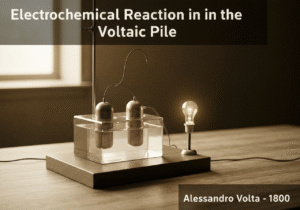
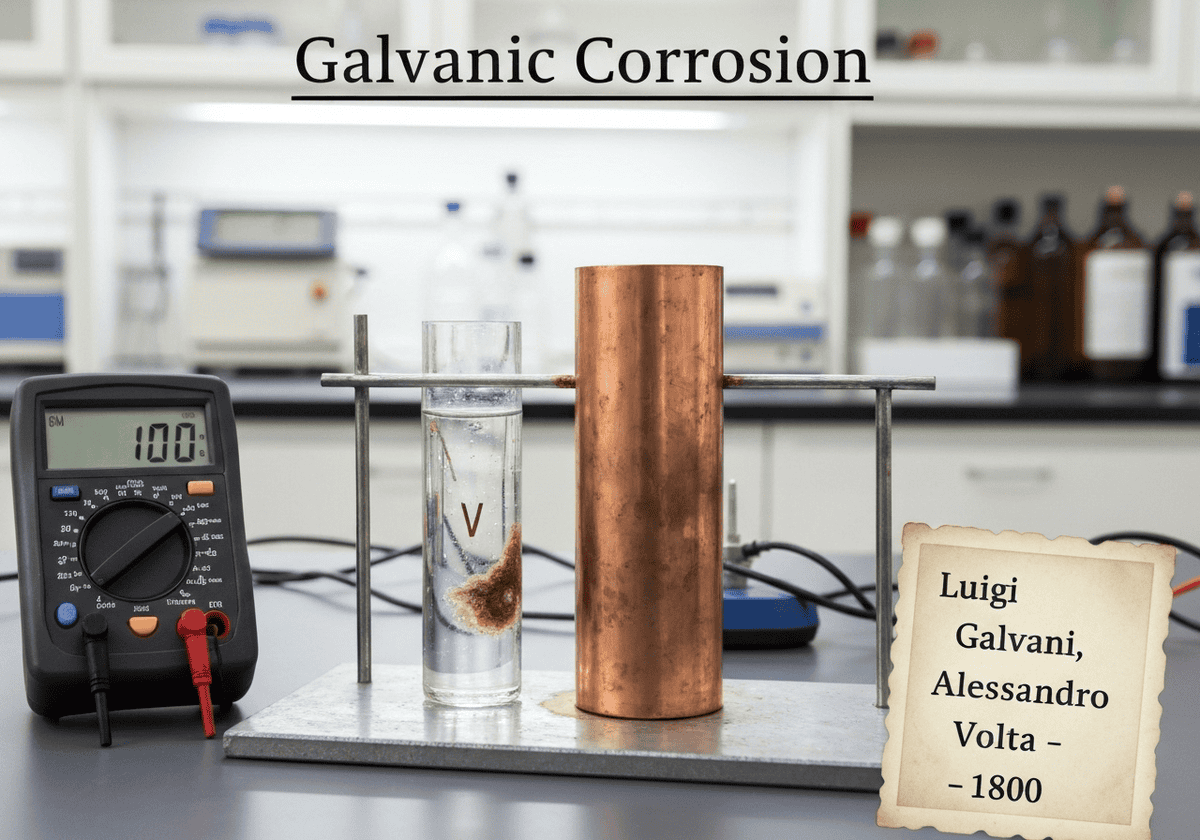
Galvanic corrosion experiment with zinc and copper in electrolyte solution, measuring electrochemical reactions.

(generated image for illustration only)

Galvanic corrosion is an electrochemical process where one metal corrodes preferentially when in electrical contact with another in the presence of an electrolyte. This occurs because the dissimilar metals create a bimetallic couple, with the less noble (more active) metal acting as the anode and corroding, while the more noble metal acts as the cathode.


The driving force for galvanic corrosion is the difference in electrode potential between the two dissimilar metals. When connected, they form a short-circuited electrochemical cell. The metal with the more negative electrode potential (the less noble metal) becomes the anode and undergoes oxidation, releasing electrons and metal ions into the electrolyte. For example, when zinc is in contact with steel in seawater, zinc oxidizes: \(Zn \\rightarrow Zn^{2+} + 2e^-\).

Simultaneously, the more noble metal (with the more positive potential) becomes the cathode, where a reduction reaction occurs. The electrons released by the anode travel through the metallic connection to the cathode. In a neutral or acidic electrolyte like seawater, the reduction reaction is typically the reduction of oxygen: \(O_2 + 2H_2O + 4e^- \\rightarrow 4OH^-\).

The rate of galvanic corrosion is influenced by several factors, including the potential difference between the metals (a larger difference leads to faster corrosion), the ratio of the cathode-to-anode surface area (a large cathode and small anode is the worst-case scenario, leading to rapid localized corrosion of the anode), and the conductivity of the electrolyte. The Galvanic Series, which ranks metals and alloys by their electrochemical potential in a specific electrolyte (commonly seawater), is a critical tool for engineers to predict and prevent this type of corrosion by selecting compatible materials.

UNESCO Nomenclature: 2203
– Electrochemistry

Type

Chemical Process

Disruption

Foundational

Usage

Widespread Use

Precursors

  • Luigi Galvani’s discovery of ‘animal electricity’ (1780s)
  • Alessandro Volta’s invention of the voltaic pile (1800)
  • Michael Faraday’s laws of electrolysis (1834)

Applications

  • sacrificial anodes for protecting ship hulls and pipelines
  • galvanized steel (zinc coating on steel)
  • batteries (the fundamental principle)
  • understanding material compatibility in engineering design

Patents:

NA

Potential Innovations Ideas

Due to scrapping bot traffic, currently more than 40k per day, this content is reserved to community members.
> Login < or > Register < (100% free) to access this, so as all other restricted content and tools.

Related to: galvanic corrosion, bimetallic couple, electrochemistry, anode, cathode, electrolyte, galvanic series, sacrificial anode.

Historical Context

Galvanic Corrosion

1750
1785
1788
1800
1800
1800
1800
1750
1757
1788
1800
1800
1800
1800
1801

(if date is unknown or not relevant, e.g. "fluid mechanics", a rounded estimation of its notable emergence is provided)

Related Invention, Innovation & Technical Principles

Full size images and downloads are only available, 100% free, for registered members.

> Login <