Product Design, Manufacturing & Innovation Resources
Home » Fluorescent Whitening Agents (FWAs)

Fluorescent Whitening Agents (FWAs)

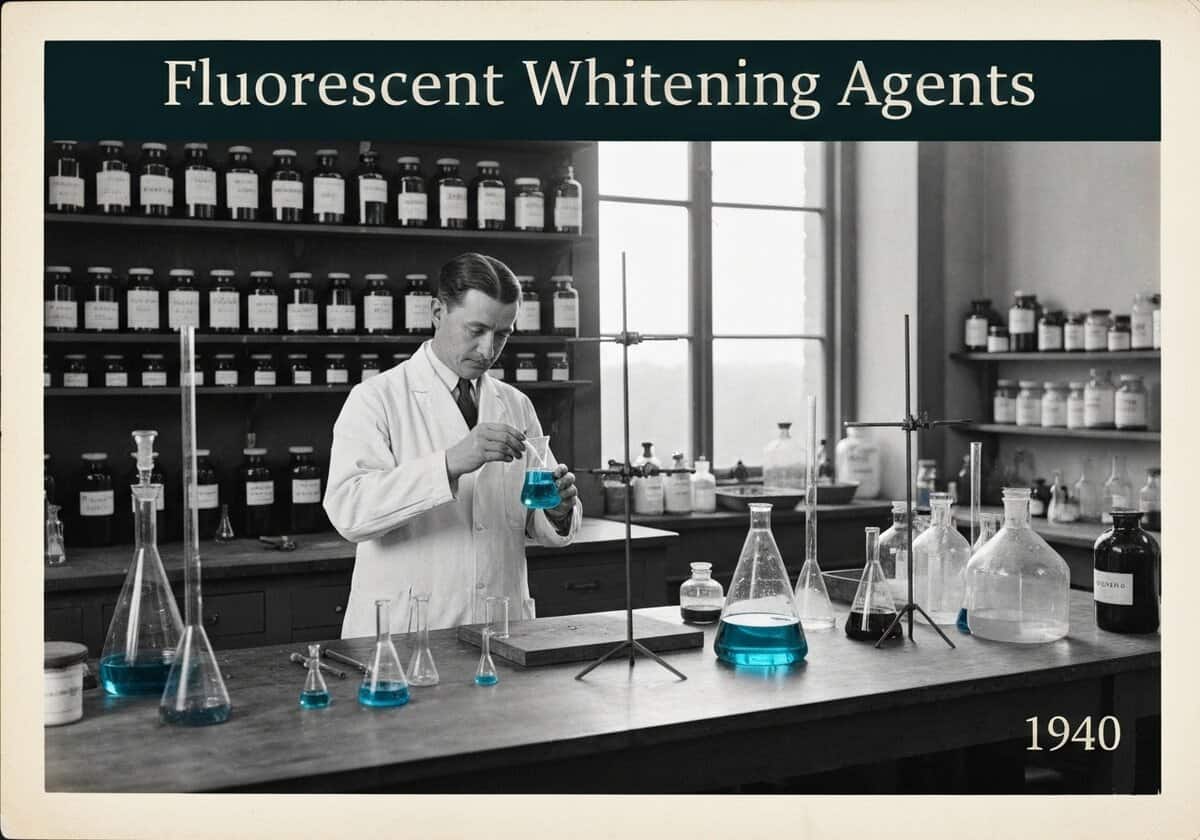
1940
Laboratory scene with chemist measuring fluorescent whitening agents in physical chemistry.

(generated image for illustration only)

Fluorescent Whitening Agents, also known as optical brightening agents (OBAs), are chemical compounds that enhance the perception of whiteness. They absorb light in the ultraviolet (UV) spectrum, which is invisible to the human eye, and re-emit it as light in the blue region of the visible spectrum. This blue light counteracts any residual yellow or cream cast in a material.

Fluorescent Whitening Agents (FWAs) are a key technology for achieving high levels of whiteness in many consumer and industrial products. Their mechanism relies on the phenomenon of fluorescence. FWAs are designed to absorb high-energy photons from the near-ultraviolet range (typically 340–370 nm) and, through a process of electronic excitation and relaxation, re-emit lower-energy photons in the blue part of the visible spectrum (typically 420–470 nm). This emitted blue light adds to the light reflected by the material, making it appear brighter. More importantly, the blue emission masks the inherent yellowish appearance common in many natural and synthetic materials like cotton, wool, and paper pulp. This masking effect shifts the material’s color towards blue, which the human eye perceives as ‘whiter than white.’ The effectiveness of an FWA depends on the presence of a UV component in the viewing light source. For this reason, whiteness measurements of FWA-treated materials must be performed under a calibrated illuminant with a known UV content, such as CIE Standard Illuminant D65, which simulates daylight. Without UV energy, the FWA is inactive, and the material will appear less white. This is why white clothes can look different indoors under incandescent light (low UV) compared to outdoors in daylight (high UV).

UNESCO Nomenclature: 2501
– Physical chemistry

Type

Chemical Process

Disruption

Incremental

Usage

Widespread Use

Precursors

  • Discovery of fluorescence by George Stokes in 1852
  • Development of synthetic dye chemistry in the 19th century
  • Understanding of the CIE color space and human color perception
  • Early use of bluing agents (e.g., ultramarine blue) to counteract yellowing

Applications

  • laundry detergents
  • paper manufacturing
  • textile finishing
  • plastics production
  • cosmetics and personal care products

Patents:

  • US2218374
  • DE723555

Potential Innovations Ideas

Due to scrapping bot traffic, currently more than 40k per day, this content is reserved to community members.
> Login < or > Register < (100% free) to access this, so as all other restricted content and tools.

Related to: fluorescence, FWA, OBA, optical brightener, whiteness, UV light, blue light, textiles, paper, detergents.

Historical Context

Fluorescent Whitening Agents (FWAs)

1872
1910
1940
1940
1946
1950
1960
1852
1900
1912
1940
1940
1950
1950
1960

(if date is unknown or not relevant, e.g. "fluid mechanics", a rounded estimation of its notable emergence is provided)

Related Invention, Innovation & Technical Principles

Full size images and downloads are only available, 100% free, for registered members.

> Login <