Product Design, Manufacturing & Innovation Resources
Home » Flashback Arrestor Safety Device

Flashback Arrestor Safety Device

1940
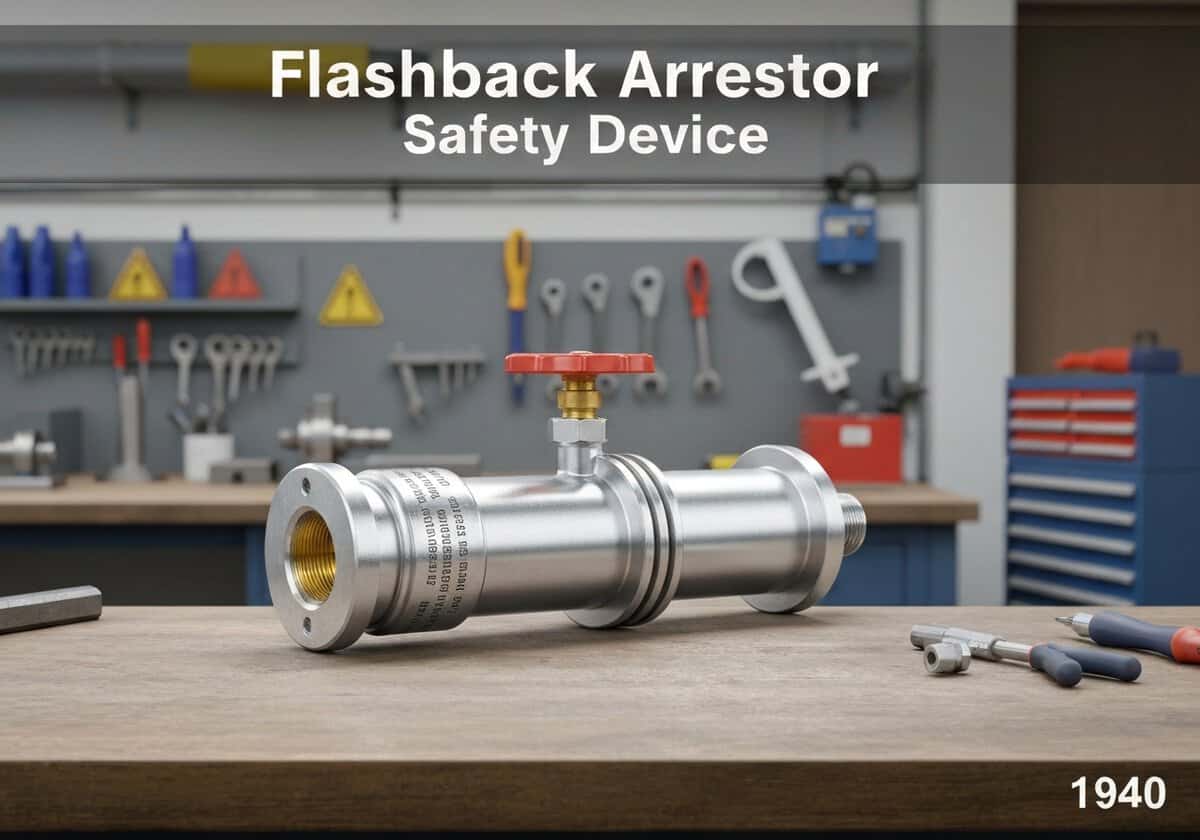
Flashback arrestor safety device used in mechanical engineering for gas safety.

(generated image for illustration only)

A flashback is a dangerous condition where the flame propagates backward from the torch tip into the hoses. A flashback arrestor is a critical safety device that quenches this flame. It typically contains a flame-extinguishing element, such as a sintered metal filter, and a non-return valve to stop the reverse flow of gas, preventing explosive mixtures from forming in the hoses.

A flashback arrestor integrates multiple safety features to prevent catastrophic equipment failure. The core component is the flame barrier, often a cylinder of sintered bronze or stainless steel. This material has a porous, sponge-like structure with a very high surface area. If a flame front enters the arrestor, it is forced through these tiny, tortuous passages. The large surface area of the metal rapidly absorbs heat from the flame, cooling the gases below their autoignition temperature and extinguishing the flame, a principle known as flame quenching.

In addition to the flame barrier, a spring-loaded non-return valve (or check valve) is included. This allows gas to flow in the correct direction but snaps shut if a back-pressure event occurs, preventing the reverse flow of gas. This is vital to stop oxygen from mixing with fuel gas inside the fuel hose, or vice-versa, which would create a highly explosive mixture. More advanced arrestors also incorporate a thermal cut-off valve. This valve is held open by a low-melting-point solder. If a sustained backfire heats the arrestor to a dangerous temperature, the solder melts, and a spring-loaded valve closes, completely shutting off the gas supply.

UNESCO Nomenclature: 3313
– Mechanical engineering and machinery

Type

Physical Device

Disruption

Substantial

Usage

Widespread Use

Precursors

  • Incidents of explosions and accidents in early oxy-fuel systems
  • The Davy safety lamp (1815), which first demonstrated the principle of flame quenching using a wire mesh to prevent explosions in coal mines
  • Development of non-return valve (check valve) technology
  • Advances in powder metallurgy to create sintered metal components

Applications

  • all oxy-fuel welding and cutting setups
  • hydrogen gas lines in laboratories and industry
  • flammable gas handling systems in chemical plants
  • biogas and landfill gas collection systems
  • pipelines transporting flammable gases
  • fuel cell systems

Patents:

NA

Potential Innovations Ideas

Due to scrapping bot traffic, currently more than 40k per day, this content is reserved to community members.
> Login < or > Register < (100% free) to access this, so as all other restricted content and tools.

Related to: flashback arrestor, safety device, welding safety, flame propagation, non-return valve, backfire, oxy-fuel, gas handling, flame quenching, sintered metal.

Historical Context

Flashback Arrestor Safety Device

1930
1930
1940
1940
1940
1940
1940
1930
1930
1934
1940
1940
1940
1940
1940

(if date is unknown or not relevant, e.g. "fluid mechanics", a rounded estimation of its notable emergence is provided)

Related Invention, Innovation & Technical Principles

Full size images and downloads are only available, 100% free, for registered members.

> Login <