Product Design, Manufacturing & Innovation Resources
Home » Finite Element Method

Finite Element Method

1943
  • Richard Courant
  • Alexander Hrennikoff
  • Olgierd Zienkiewicz
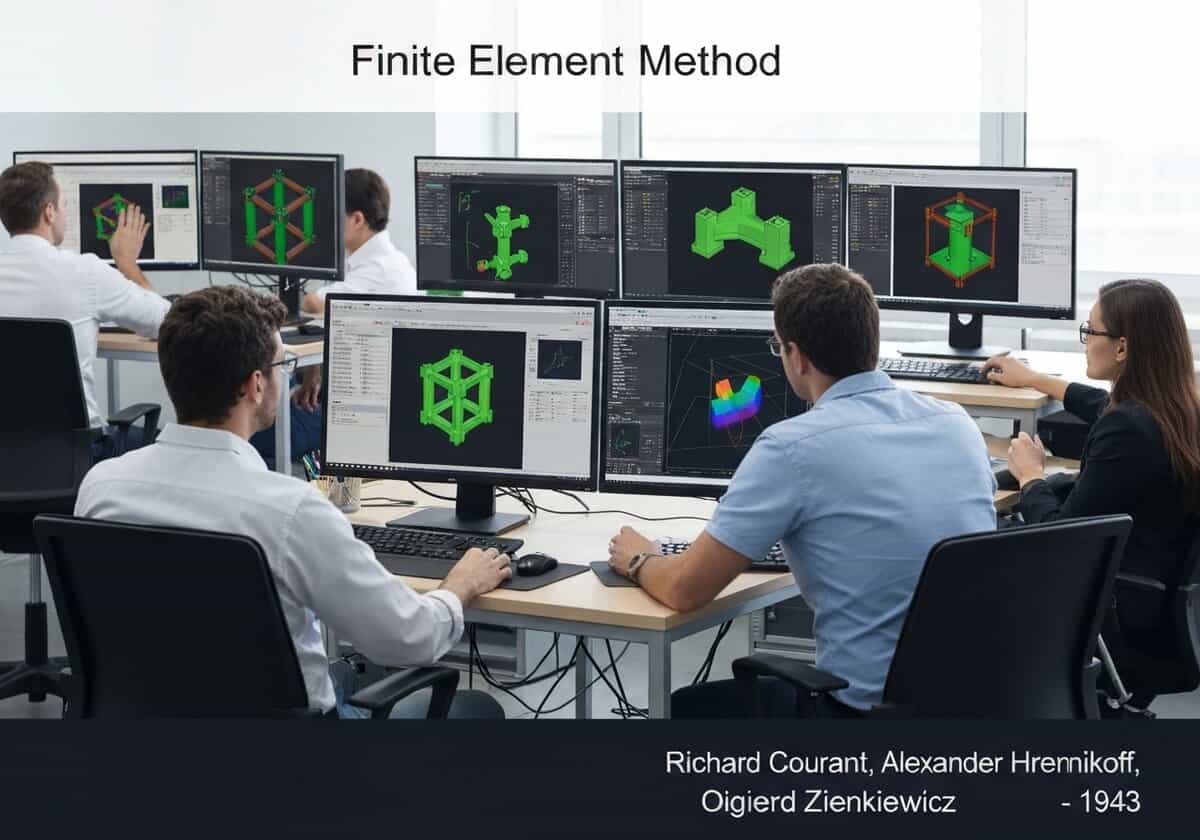
Finite Element Method applied in structural analysis within an engineering office.

(generated image for illustration only)

The Finite Element Method (FEM) is a powerful numerical technique for solving complex engineering and physics problems described by partial differential equations. It works by discretizing a continuous domain into a set of smaller, simpler subdomains called ‘finite elements’. This allows for the approximate numerical solution of problems in structural analysis, heat transfer, fluid flow, and electromagnetism.


The FEM process begins with the ‘discretization’ of the problem domain into a mesh of finite elements (e.g., triangles or quadrilaterals in 2D, tetrahedra or hexahedra in 3D). Within each element, the unknown field variable (e.g., displacement) is approximated by simple polynomial functions, known as shape functions. The values of the field at the element nodes become the new unknowns of the problem.

A system of algebraic equations for the entire domain is derived, typically using a variational principle like the principle of minimum potential energy or a weighted residual method like the Galerkin method. This process generates an ‘element stiffness matrix’ \([k_e]\) for each element, which relates the nodal forces \(\{f_e\}\) to the nodal displacements \(\{u_e\}\) via \([k_e] \{u_e\} = \{f_e\}\). These individual element matrices are then systematically combined (‘assembled’) into a single global stiffness matrix \([K]\) for the entire structure. After applying known boundary conditions (forces and constraints), the resulting large system of linear equations, \([K] \{U\} = \{F\}\), is solved numerically for the unknown global displacement vector \(\{U\}\). Once the nodal displacements are known, other quantities like strains and stresses can be calculated for each element.

UNESCO Nomenclature: 1208
– Numerical analysis

Type

Software/Algorithm

Disruption

Revolutionary

Usage

Widespread Use

Precursors

  • Calculus of variations
  • Matrix algebra
  • The advent of digital computers
  • Theory of elasticity and continuum mechanics
  • Rayleigh-Ritz method for approximating solutions

Applications

  • structural analysis software (e.g., ansys, abaqus, nastran)
  • automotive crash simulations
  • aerospace component design and stress analysis
  • thermal analysis of electronic components
  • biomechanical simulation of implants and tissues

Patents:

NA

Potential Innovations Ideas

Due to scrapping bot traffic, currently more than 40k per day, this content is reserved to community members.
> Login < or > Register < (100% free) to access this, so as all other restricted content and tools.

Related to: finite element method, fem, numerical analysis, simulation, structural analysis, partial differential equations, meshing, computational mechanics.

Historical Context

Finite Element Method

1930
1936
1940
1943
1950
1950
1953
1930
1931
1939
1940
1950
1950
1952
1956

(if date is unknown or not relevant, e.g. "fluid mechanics", a rounded estimation of its notable emergence is provided)

Related Invention, Innovation & Technical Principles

Full size images and downloads are only available, 100% free, for registered members.

> Login <